





 Meet&Co
The classroom layout is not just about fitting desks into a room. It is a powerful teaching tool. Research shows that the physical arrangement of furniture influences student focus, engagement, behavior, and even academic outcomes. A static room sends the message that learning is linear and predictable, when in fact it is dynamic and evolving.
Yet many teachers inherit a fixed layout—rows of desks facing a whiteboard—and never change it. The result is a space that works well for direct instruction but actively hinders collaboration, discussion, and project-based learning.
This Mee&Co’s school furniture guide shows you how to match classroom furniture arrangements to different teaching styles. You will learn layouts for lecture-based teaching, collaborative group work, whole-class discussions, and project-based learning—plus furniture recommendations to make each configuration work.
Why Classroom Layout Matters
Your classroom layout is a silent co-teacher. It signals to students how they are expected to behave and interact. Traditional rows encourage students to focus on the teacher and work independently. Clusters invite conversation and collaboration. Circles promote equal participation.
What research tells us:
-
Students in traditional rows are more on-task during individual work but less engaged during group activities.
-
Students in clusters talk more and collaborate more, but off-task behavior can increase without clear expectations.
-
Classrooms with flexible furniture promote student autonomy and increase engagement.
-
A classroom that adapts to different activities—not a static layout—supports diverse learning needs.
The best approach is not to pick one layout and stick with it. It is to choose furniture that allows you to switch between layouts as your teaching style shifts throughout the day.

Teaching Styles and Their Ideal Classroom Layouts
Below is a quick reference guide to matching teaching styles with classroom layouts.
| Teaching Style | Best Layout | Key Furniture | Student Interaction Level |
|---|---|---|---|
| Lecture / Direct Instruction | Traditional rows | Fixed or mobile desks, chairs facing front | Low (teacher → students) |
| Collaborative / Group Work | Clusters / Pods | Round or trapezoidal tables, mobile chairs | High (student ↔ student) |
| Whole-Class Discussion | Horseshoe (U-shape) or Circle | Desks in U or chairs in circle | Medium (teacher ↔ students, student ↔ student) |
| Project-Based Learning (PBL) | Flexible / Zoned | Modular desks on casters, varied seating types | Very high (student-led) |
Layout 1: Traditional Rows for Direct Instruction
Best for: Lectures, test-taking, direct instruction, and the beginning of a lesson when you need students to settle in and focus.
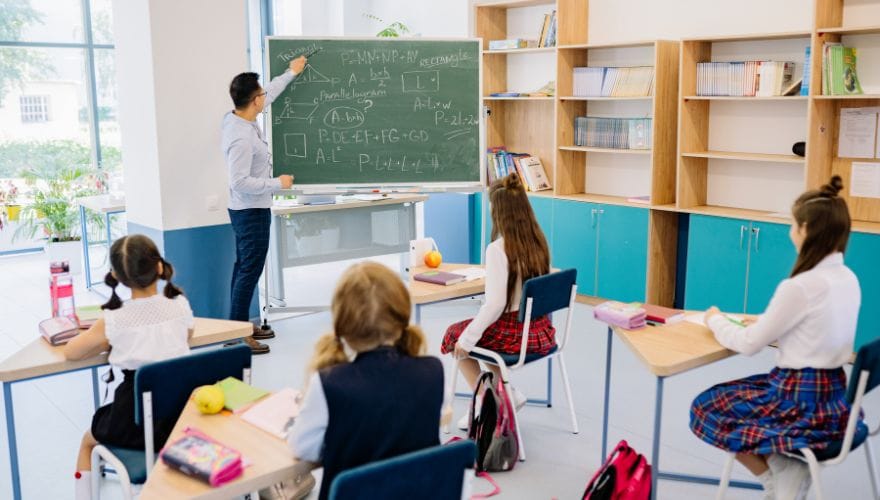
The layout: Desks arranged in straight rows, all facing the front of the room. This is the classic “old school” arrangement.
Why it works: Traditional rows make peer interactions less convenient, which can minimize off-task behavior and maximize focus during individual activities. Teachers often start class in rows because students settle in more quickly and orient toward the front of the room.
What to watch for: Students in the back can feel distant, leading to disengagement and lower participation rates. Assign seats strategically—place students who need extra support closer to the front.
Furniture needed:
-
Desks that can be arranged in straight lines (rectangular desks work best)
-
Chairs with good back support for longer seated periods
-
Optional: a teacher’s desk or podium at the front
Furniture recommendation: Meet&Co Student Desk and Chair Set – durable, stackable, and available in height-adjustable options for growing students. The bright color options also help create a welcoming environment even in a traditional row layout.
Best for: Math drills, grammar instruction, test administration, and any lesson where the teacher is the primary source of information.
Layout 2: Clusters / Pods for Collaborative Learning
Best for: Group projects, peer tutoring, problem-solving activities, and any lesson where students learn from each other.
The layout: Desks arranged in small groups of 3–6 students facing each other. Common configurations include groups of four (two desks facing two desks) or pods of six around a larger table.
Why it works: When students are arranged in clusters rather than rows, conversation and collaboration flourish. Clusters support group discussion, shared materials, and collective problem-solving. Many schools are shifting to this layout to promote 21st-century skills like communication and teamwork.
What to watch for: Clusters can increase off-task talking. Clear expectations and structured group roles help. Also, ensure the teacher can easily circulate to all groups.
Furniture needed:
-
Desks that can be easily grouped (trapezoidal or kidney-shaped desks work best for flexible clustering)
-
Mobile chairs that students can turn to face each other
-
Optional: a central table for shared materials
Furniture recommendation: Meet&Co Adjustable Student Desk – lightweight and mobile, allowing teachers to reconfigure from rows to clusters in minutes. Pair with Meet&Co Ergonomic Student Chairs that swivel, making it easy for students to turn toward groupmates.
Best for: Science labs, language practice, group problem-solving, and project-based learning sessions.
Also see: 10 Creative Classroom Seating Arrangements to Boost Student Engagement
Layout 3: Horseshoe (U-Shape) for Whole-Class Discussion
Best for: Socratic seminars, class debates, book discussions, and any lesson where every student should see and be seen.
The layout: Desks arranged in a U shape (horseshoe), with the open end facing the board or teacher. Students sit around the outside of the U, facing inward.
Why it works: The horseshoe layout improves lines of sight—no heads in the way—and creates a natural setting for conversation and connection. Every student can see the teacher, the board, and each other. The teacher can move inside the U to facilitate discussion.
What to watch for: Requires more floor space than rows or clusters. Not ideal for large classes (best for 20–25 students). The open end can make some students feel more exposed.
Furniture needed:
-
Desks that can be arranged in a continuous curve (trapezoidal desks are ideal)
-
Chairs that allow students to turn toward the center
Furniture recommendation: Meet&Co Trapezoidal Activity Table – designed specifically for U-shape and cluster configurations. The angled edges allow desks to fit together seamlessly.
Best for: Literature discussions, debate classes, philosophy seminars, and any lesson where student voices are the primary content.
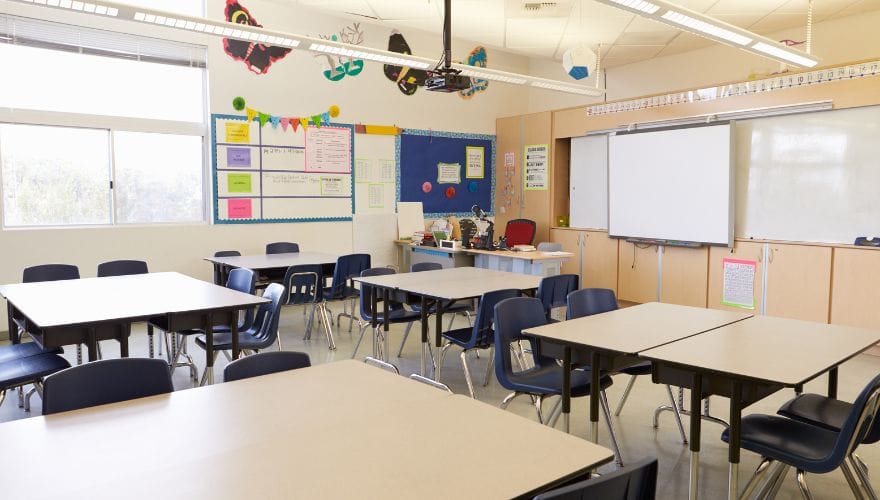
Layout 4: Flexible / Zoned for Project-Based Learning
Best for: Multi-day projects, STEM challenges, maker spaces, and classrooms that host different activities throughout the day.
The layout: No single fixed layout. Instead, the classroom is divided into zones: a direct instruction zone (small rows or a gathering area), a collaborative zone (clusters or large tables), a quiet zone (individual desks or soft seating), and a presentation zone (open floor space).
Why it works: Students need flexible classrooms with multiple learning zones that can be adapted as needed. Moveable furniture allows teachers to quickly shift the space to support different learning activities and seating options. Studies show that flexible classrooms promote student autonomy, giving students more control over their learning environment and increasing engagement.
What to watch for: Requires the right furniture—everything must be on casters or lightweight enough to move. Storage for unused furniture is essential.
Furniture needed:
-
Desks and tables on casters for easy reconfiguration
-
Varied seating types (stools, soft seating, wobble chairs, standard chairs)
-
Mobile whiteboards or dividers for creating zones
-
Stackable chairs for quick storage
Furniture recommendation: Meet&Co Mobile Flip Top Training Table – folds and nests for compact storage when not in use, with casters for easy mobility. Pair with Meet&Co Stackable Chairs that can be stored on dollies to clear floor space for different activities.
Best for: STEM classrooms, maker spaces, elementary classrooms with centers, and any flexible learning environment.
Beyond Layout: Furniture Features for Every Teaching Style
No matter which layout you choose, certain furniture features make reconfiguration easier and support diverse student needs.
| Furniture Feature | Why It Matters |
|---|---|
| Casters (locking) | Allows desks and tables to be moved without heavy lifting; locking casters keep them stable during use |
| Lightweight construction | Teachers and students can reconfigure layouts without strain |
| Height adjustability | Accommodates students of different sizes and allows standing options |
| Trapezoidal or curved shapes | Enables flexible clustering (round, U-shape, pods) that rectangular desks cannot achieve |
| Stackable or nestable design | Saves storage space when clearing the floor for open activities |
| Varied seating types | Wobble stools, soft seating, and standard chairs support different sensory needs and attention spans |
| Writing surfaces on both sides | Allows desks to be used from multiple orientations |
Creating Zones Within One Classroom
If your classroom serves multiple purposes throughout the day, consider dividing it into permanent zones rather than rearranging the entire room each time.
| Zone | Purpose | Furniture |
|---|---|---|
| Direct instruction zone | Teacher-led lessons | Small cluster of desks or a rug area facing the board |
| Collaborative zone | Group work and projects | Large tables or clustered desks with space for materials |
| Quiet zone | Independent work, reading, or testing | Individual desks, soft seating, or carrels with privacy panels |
| Presentation zone | Student presentations or performances | Open floor space with chairs that can be moved or stored |
This zoned approach works especially well in elementary classrooms and specialized learning spaces. It allows different activities to happen simultaneously without constant furniture moving.
Storage Solutions for Flexible Classrooms
The biggest challenge with flexible layouts is where to put furniture when it is not in use. Without adequate storage, flexible classrooms become cluttered classrooms.
Smart storage strategies:
-
Mobile storage carts that double as room dividers or additional workspaces
-
Stackable chairs stored on dollies in a corner or closet
-
Nesting tables that slide into each other like shopping carts
-
Under-desk storage to keep pathways clear
-
Wall-mounted whiteboards or pegboards to store supplies vertically, saving floor space
Furniture recommendation: Meet&Co Stackable Storage Cart – holds 8–10 chairs vertically on a mobile dolly, rolling easily to a storage closet when the floor needs to be cleared.
Neuroinclusive Design: Supporting All Learners
Modern classroom design must consider students with diverse sensory and learning needs. Furniture and layout choices can reduce stress, support self-regulation, and make learning accessible to everyone.
Neuroinclusive classroom features:
-
Varied seating options – chairs with and without arms, wobble stools for sensory feedback, soft seating for calming, and tall stools for those who prefer standing
-
Quiet zones – a corner with soft seating, minimal visual clutter, and neutral colors for students who need a sensory break
-
Adjustable lighting – dimmable options or natural light to reduce visual overstimulation
-
Clear pathways – wide aisles for students using mobility devices or those who need space to move
-
Predictable layouts – consistent furniture placement from day to day helps students with executive function challenges
The University of Oregon has designed innovative classroom spaces with “brain-friendly” features such as dimmable lighting, air filtration systems, moveable furniture on casters, integrated power and USB ports, and multiple seating options including high-top tables and soft seating. These features allow the classroom to be easily reconfigured from a lecture layout to collaborative clusters to exam seating within minutes, supporting both student engagement and well-being.
Quick Reference: Which Layout for Which Activity?
| Activity | Recommended Layout | Why |
|---|---|---|
| Lecture / new concept introduction | Traditional rows | Minimizes distraction, focuses attention forward |
| Group problem-solving | Clusters / pods | Encourages discussion and shared materials |
| Class debate or Socratic seminar | Horseshoe (U-shape) | Every student can see and be seen |
| Test or exam | Traditional rows (spaced apart) | Reduces temptation to look at neighbors |
| Project work (multi-day) | Flexible / zoned | Different activities need different spaces |
| Peer review or editing | Pairs (desks side by side) | Easy collaboration without full group distraction |
| Presentations | Horseshoe or audience-style rows facing presentation area | Clear sightlines to the presenter |
| Quiet reading or independent work | Individual desks or soft seating in quiet zone | Minimizes distraction, supports focus |
Frequently Asked Questions
1. Can I use the same furniture for different layouts?
Yes, but choose furniture designed for flexibility. Desks with casters, lightweight construction, and trapezoidal shapes can be reconfigured from rows to clusters to U-shapes in minutes. Stackable chairs and nesting tables allow you to clear the floor entirely when needed. Fixed, heavy furniture locks you into a single layout.
2. How often should I change my classroom layout?
There is no fixed rule, but many teachers change layouts daily or weekly depending on the lesson. Some start each day in rows for morning instructions, then switch to clusters for group work. Others maintain a zoned classroom where different areas support different activities simultaneously. The key is having furniture that makes reconfiguration quick and easy—not a major production.
3. What is the best layout for large class sizes (30+ students)?
For large classes, traditional rows maximize seating density. However, you can still build in flexibility: use clusters for group work by having students turn their chairs and work with neighbors behind them (pods of 4). Mobile desks on casters allow you to switch between rows and clusters in under five minutes.
4. How do I manage noise in a collaborative layout?
Clusters and flexible layouts are naturally noisier than rows. Set clear expectations for voice levels (e.g., “whisper voice” vs. “group voice”). Use acoustic panels on walls or hanging from the ceiling to absorb sound. Consider soft seating and rugs, which also dampen noise. Most importantly, teach students how to collaborate productively—the layout enables the behavior, but expectations drive it.
5. What furniture do I need to start creating a flexible classroom?
Start with the basics: mobile desks on casters and stackable chairs. These two items alone allow you to switch between rows, clusters, and open floor layouts. Add nesting tables if you need larger workspaces. Over time, introduce varied seating (wobble stools, soft seating) to support different learning styles. You do not need to replace everything at once—add pieces gradually.
6. Can I use soft seating in a high school classroom?
Yes. Soft seating is not just for elementary students. High schoolers appreciate comfortable alternatives to hard plastic chairs. Use bean bags, floor cushions, or upholstered lounge chairs in a designated quiet zone or reading corner. However, ensure you still have enough traditional desks for test-taking and direct instruction.
7. How do I arrange furniture for students with mobility devices?
Ensure aisles are at least 36 inches wide to accommodate wheelchairs. Place accessible desks at the ends of rows or in positions where students can enter and exit easily. Use height-adjustable desks so students can raise or lower the work surface to their needs. Avoid fixed furniture that cannot be moved to create space.
8. What is the best desk shape for flexible layouts?
Trapezoidal desks are the most versatile. Their angled edges allow them to be arranged in rows (straight lines), clusters (circles or pods), U-shapes, and even S-curves. Rectangular desks work well for rows but create awkward gaps in clusters and U-shapes. If you can only choose one shape, choose trapezoidal.
Conclusion: Finding the Right Classroom Layout
The best classroom layout is not a single arrangement—it is the ability to switch between arrangements as your teaching style shifts. Traditional rows focus attention during lectures. Clusters spark collaboration during group work. Horseshoes invite discussion. Flexible zones support project-based learning.
Choose furniture that enables reconfiguration: desks on casters, stackable chairs, and trapezoidal shapes. Add varied seating to support different learning styles and sensory needs. Create storage solutions for furniture not in use. And remember: the physical space sends a message. Make sure yours says, “Learning is dynamic, and every student belongs here.”
Ready to create a flexible classroom that adapts to your teaching? Explore our collection of mobile desks, stackable chairs, and modular tables. Contact us for a free classroom layout consultation.