





 Meet&Co
Reception desk manufacturers in the United States play a critical role in shaping the first impression of commercial interiors such as corporate offices, hotels, healthcare clinics, coworking spaces, and retail environments.
Reception desk manufacturers in the United States are not just furniture suppliers—they are strategic partners that influence branding, spatial efficiency, and customer experience.
As demand for modern office interiors continues to rise in the U.S., businesses increasingly seek reception desks that combine aesthetics, durability, and customization.
However, most existing online resources only list suppliers without providing deep evaluation frameworks, procurement insights, or real manufacturing differences.
This guide fills that gap by offering a structured comparison of leading manufacturers, industry-specific use cases, pricing logic, and global sourcing alternatives.
Why Reception Desks Matter in Commercial Spaces
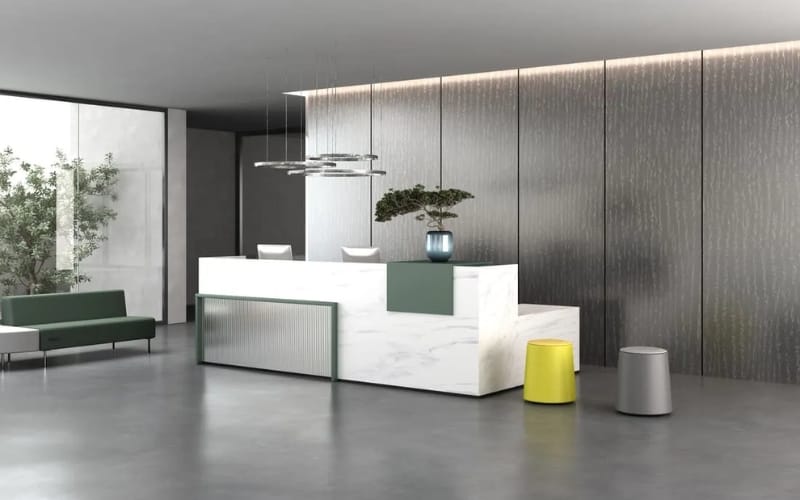
Reception desks are the visual and functional anchor of any entrance area.
They directly impact:
- Brand perception within the first 5–10 seconds of visitor interaction
- Staff workflow efficiency and communication
- Overall spatial organization of lobby environments
Modern reception desks often integrate lighting systems, hidden cable management, storage modules, and branding elements to enhance both usability and visual identity.
Types of Reception Desks in the US Market
Different commercial environments require different reception desk configurations.
Modular Reception Desks
Flexible systems designed for scalability and easy reconfiguration.
Ideal for startups, coworking spaces, and fast-growing companies.
Custom Reception Desks
Fully tailored solutions based on architectural drawings and branding requirements.
Common in headquarters, luxury offices, and high-end hospitality spaces.
Minimalist Contemporary Desks
Clean, geometric designs that prioritize simplicity and modern aesthetics.
Popular in tech companies and creative studios.
Luxury Statement Desks
High-end materials such as marble, engineered stone, solid wood, and metal finishes.
Often used in hotels and premium corporate lobbies.
Top Reception Desk Manufacturers in the United States
The U.S. reception desk manufacturing market can be divided into three main categories: global office furniture leaders, mid-tier commercial manufacturers, and regional custom fabrication studios.
Global Premium Office Furniture Brands
MillerKnoll (Herman Miller + Knoll)

Source: https://www.millerknoll.com/
MillerKnoll is one of the most influential office furniture groups in the world.
Their reception desk systems are typically used in Fortune 500 companies, architecture-driven office spaces, and premium corporate environments.
Their strength lies in design innovation, ergonomic integration, and long-term durability.
However, customization tends to be limited to predefined design systems, and pricing is positioned at the high end of the market.
Steelcase

Source: https://ofr-inc.com/
Steelcase focuses heavily on workplace research and enterprise-level office solutions.
Their reception office desk offerings are designed as part of larger workspace ecosystems rather than standalone furniture pieces.
Steelcase desks are widely used in corporate headquarters and institutional environments.
The company is known for reliability, strong distribution networks, and consistent product quality across large-scale deployments.
Haworth

Source: https://www.pinterest.com/
Haworth specializes in flexible workspace solutions that adapt to hybrid work environments.
Their reception desks for office often emphasize modularity and integration with open office systems.
Compared to MillerKnoll and Steelcase, Haworth offers slightly more design flexibility while maintaining enterprise-grade quality standards.
HON (The HON Company)
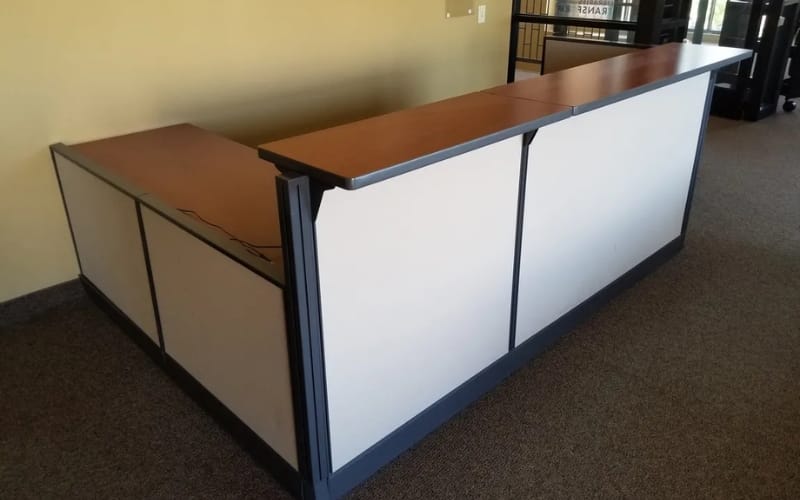
Source: https://madisonliquidators.com/
HON is positioned as a mid-range commercial furniture manufacturer.
Their reception desk systems are practical, durable, and cost-efficient, making them suitable for small to mid-sized businesses.
While design innovation is less advanced than premium competitors, HON is widely appreciated for value-for-money solutions and fast availability.
Regional Custom Fabrication Manufacturers
Across the United States, there are hundreds of small and mid-sized fabrication workshops specializing in custom reception desks.
These manufacturers are often located in industrial hubs such as California, Texas, and the Midwest.
Their key strengths include:
- Fully custom dimensions and shapes
- High flexibility in materials and finishes
- Faster iteration during design phase
- Ability to handle niche industries such as medical clinics, law firms, and boutique hotels
However, these workshops vary significantly in:
- Production consistency
- Lead time reliability
- Quality control standards
For buyers seeking unique design execution, these manufacturers often provide the highest level of customization available in the market.
Mid-Tier Commercial Furniture Suppliers
In addition to large brands and workshops, there is a growing category of mid-tier suppliers that bridge cost and customization.
These companies typically:
- Offer semi-custom reception systems
- Serve regional office projects
- Balance affordability with moderate design flexibility
They are often selected for multi-location businesses that require standardized yet adaptable reception solutions.
Manufacturer Comparison Framework
| Category | Large Brands | Custom Workshops |
|---|---|---|
| Pricing | High | Medium–High |
| Customization | Limited | Extensive |
| Lead Time | Predictable | Variable |
| Design Flexibility | System-based (standardized collections) | Fully custom (project-based) |
| Production Consistency | Very High | Varies by workshop |
| Best For | Enterprises, corporate headquarters, standardized rollouts | Unique projects, boutique offices, architectural interiors |
| Communication & Support | Structured enterprise support system | Direct designer–manufacturer communication |
| Scalability | Excellent for large multi-location deployment | Limited by workshop capacity |
Industry-Specific Applications
Reception desk design varies significantly depending on industry needs.
Corporate Offices
Focus on brand identity, durability, and integrated technology systems.
Healthcare Facilities
Require hygienic surfaces, accessibility compliance, and privacy-focused layouts.
Hospitality Industry
Emphasizes luxury materials and strong visual impact for guest experience.
Retail & Service Spaces
Prioritize compact design and operational efficiency.
Custom Reception Desk Manufacturing Workflow
Understanding production processes helps buyers evaluate suppliers more effectively.
The process typically includes:
- Requirement gathering and spatial planning
- CAD design and 3D visualization
- Material selection and prototyping
- Production and assembly
- Logistics and installation
Pricing Overview in the US Market
Reception area desk pricing depends heavily on materials, size, and customization level.
- Entry-level: $500–$2,000 (standard modular desks)
- Mid-range: $2,000–$8,000 (customized corporate desks)
- High-end: $8,000+ (luxury architectural installations)
US Manufacturing vs Global Supply Options
U.S.-based manufacturers offer strong reliability, shorter communication cycles, and easier compliance with local standards.
However, they often come with higher production costs.
Global manufacturers, particularly in Asia, provide:
- More competitive pricing
- Stronger customization flexibility
- Longer shipping timelines
As a result, many companies now adopt hybrid sourcing strategies.
Global Office Furniture Alternatives for Custom Projects
In addition to U.S.-based suppliers, many businesses explore international manufacturers for more flexible and cost-efficient solutions.
One example is Meet&Co, a global office furniture manufacturer with production facilities in Guangzhou, China, and showroom spaces in Singapore.
Rather than positioning itself as a U.S. manufacturer, Meet&Co focuses on delivering:
- Fully customized reception desk solutions
- Modern minimalist and corporate design systems
- Scalable production for SMEs and enterprise projects
- Cost-efficient manufacturing with global shipping capability
Its reception desk product line is widely used in:
- Corporate office lobbies
- Coworking environments
- Hospitality and service spaces
- Startup and SME office setups
You can explore more integrated workspace solutions through the Meet&Co Office Furniture.
How to Choose the Right Manufacturer
A structured evaluation approach improves procurement success.
Key decision factors include:
- Budget alignment and lifecycle cost
- Design flexibility and branding capability
- Production capacity for large orders
- Communication and design collaboration quality
- Lead time reliability
Key Gaps in Most Online Articles
Most competing content fails to address:
- Real procurement workflows
- True cost breakdown beyond basic pricing
- Manufacturing quality differences between tiers
- Hybrid global sourcing strategies
- ROI and long-term branding value of reception desks
Future Trends in Reception Desk Design
Reception desk manufacturing is evolving toward:
- Smart integration (touch screens, digital check-in systems)
- Sustainable materials and eco-certified production
- Modular expansion systems for growing companies
- Brand-centric architectural furniture design
Frequently Asked Questions
What is the standard size of a reception desk?
Typically 60–72 inches in width, depending on space and usage.
How long does custom production take?
Usually 4–12 weeks depending on complexity and manufacturer capacity.
Can reception desks be branded?
Yes, most manufacturers support logo integration and custom finishes.
What is the most durable material?
Laminate, solid wood, and engineered stone are commonly used for durability.
Conclusion
Selecting the right reception desk manufacturer in the United States requires balancing design quality, budget, customization capability, and delivery timelines.
While premium U.S. brands offer reliability and strong engineering standards, custom workshops and global manufacturers provide greater flexibility and cost advantages.
In today’s global procurement landscape, businesses are increasingly combining local standards with international manufacturing options to achieve optimal results in both design and cost efficiency.
_12.webp)