








 Meet&Co
COLFAX, N.C. — Artificial intelligence is becoming increasingly integrated into everyday business operations, creating new opportunities and challenges for furniture marketers. Beyond using AI to improve internal workflows, marketers also need to consider how the technology is changing the way consumers search for and discover brands.
Matt Ritter, an associate professor of communication at High Point University, discussed both issues during the American Home Furnishings Alliance Marketing & PR Conference last week. In his presentation, “AI Marketing Tools 2.0,” Ritter outlined ways marketers can introduce AI into daily tasks while adapting their digital content to generative search.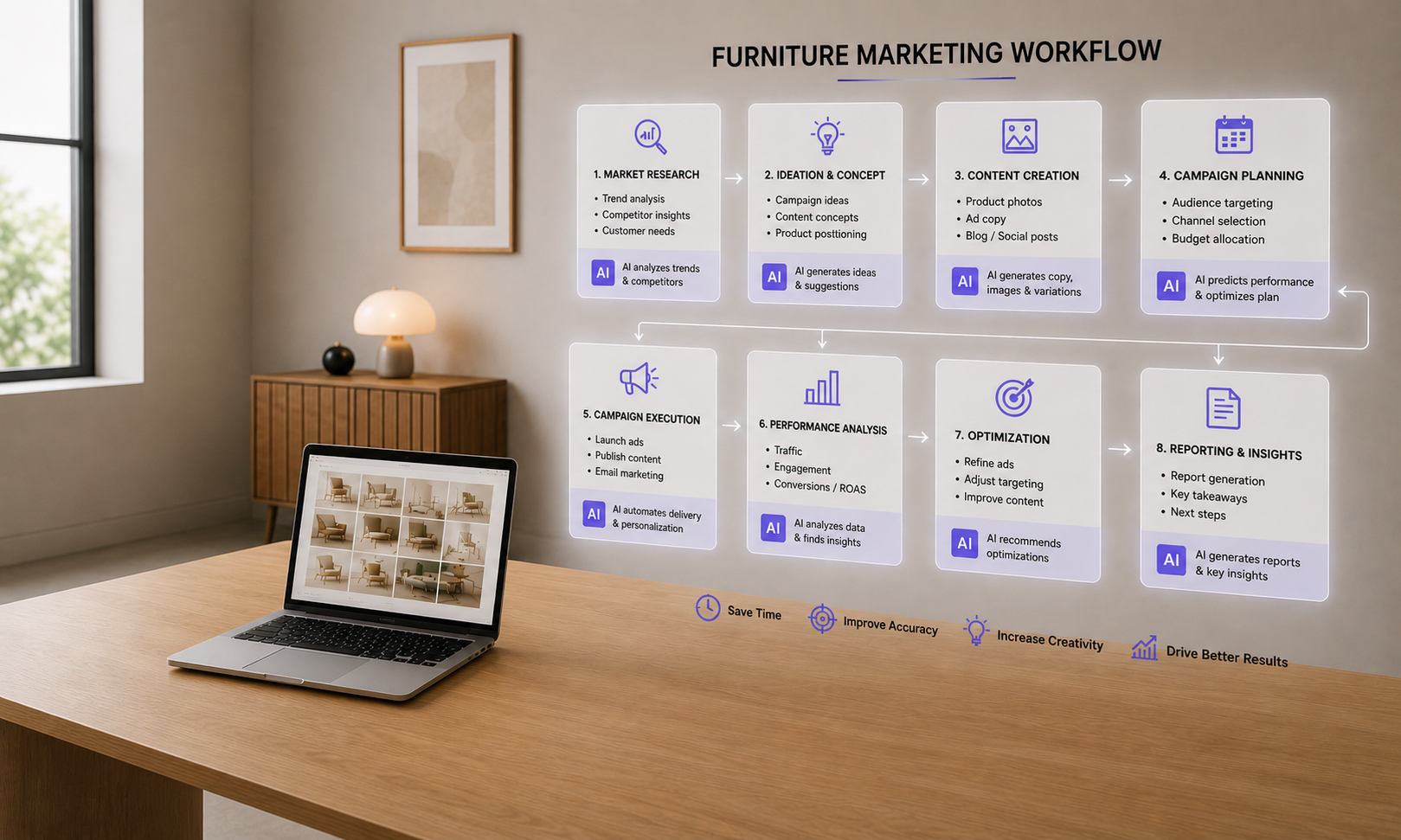
He said the purpose of adopting AI should not simply be to reduce staffing needs. Instead, the technology can help existing teams handle more work, reduce stress and spend more time on tasks that might otherwise be delayed.
“A lot of people, when I talk about AI, are thinking about headcount,” Ritter said. “That’s not how I think about AI. The goal is not fewer people. To me, it’s more and better from the same people who are now less stressed out — better preparation, clearer communication, faster first drafts and hopefully more time to work on the things that we’ve been putting off.”
Speaking at the AHFA event at Guilford Technical Community College, Ritter offered furniture marketers a practical framework for deploying AI in their daily workflows and preparing their brands for the rise of generative search.
“What I have is 40 hours a week on a good week,” Ritter said. “Headcount is the same. Expectations are increasing, ever increasing. Then, on the other side, is the aspiration: what I would like to accomplish. What are some ways that we can use AI to bridge that gap between what we have and what we want to accomplish?”
Treat AI As A Fast but Imperfect Assistant
Ritter compared AI to an intern who can work quickly but still needs clear instructions and human oversight.
“In fact, I think of it as the best intern that I’ve ever had,” he said. “It’s fast. It’s eager. Sometimes it’s confidently wrong. It can absolutely be wrong. My layer is that expertise layer that says, ‘Yes, this is a thumbs up,’ or, ‘No, this is something that we need to try again.’”
He also noted that AI tools have made significant progress over the past year, particularly in memory and their ability to handle multiple steps. AI agents, which were still emerging a year ago, are now being used in practical applications.
At the same time, marketers need to select an appropriate model for each task. Ritter demonstrated this with a simple example: he asked several AI models whether he should walk or drive to a car wash 50 meters away. Some quick-response modes recommended walking without accounting for the fact that he needed to take the car there. The reasoning-focused models recommended driving.
“We want to match the task to the model that we are using. Save the heavy model for reasoning and drafting,” Ritter said.
Start With The Workflow, Then Refine It
For businesses adopting AI agents, Ritter said one of the biggest obstacles is not the technology itself but understanding and documenting existing workflows.
“Documenting workflows is the asset right now,” he said. “I think that is the holdup for companies integrating agentic AI into their workflows. We don’t know where to start because we don’t know how to document our workflows.”
He shared an example involving his wife, a financial-sector CEO, who created an AI agent to help manage information across Outlook, Teams and her calendar. She initially gave the agent only four sentences of instructions:
“Act as my chief of staff,” she told the agent. “Each morning, give me a prioritized daily briefing based on my Outlook calendar, my emails and my Teams messages. Be direct, concise and ruthlessly prioritize. No fluff. I want clarity on what I must do today.”
Instead of trying to create a complete set of instructions immediately, she refined the system by observing where it failed. During the first week, she instructed the agent to ignore automatically generated system emails from platforms her team no longer used. The following week, she asked it to compare email and Teams messages before identifying something as unresolved.
In the third week, she added another instruction: the agent should review her sent messages from the previous seven days for commitments she had made but not completed, such as promising to send something or follow up later.
The system was subsequently expanded to recommend questions for meetings using agendas, recent message threads and unresolved issues. It now creates morning and evening briefings that track both her responsibilities and outstanding commitments between her and her employees.
“Four sentences at the beginning, eight weeks of iteration, and her prompt now has more than 32 instructions,” Ritter said. “One person built it. No IT, no consultants. She didn’t sit down and write it. She discovered it, and that’s how we discover our workflows. We watch what breaks.”
Ritter said the same approach could be applied to tasks such as retailer communications, account preparation, competitive intelligence and tracking outstanding commitments.
Generative Search Changes Brand Discovery
AI is also changing how consumers find furniture brands. Ritter explained that traditional search engine optimization, or SEO, focuses on improving a brand’s position within search results, while generative engine optimization, or GEO, focuses on getting a brand included in an AI-generated response.
“The buyer is asking before they click,” Ritter said. “People are going straight to generative AI and these AI chatbots. They’re asking them the same questions, and the AI is providing them with what it thinks is the answer.”
Ritter cited data showing that 43% of Google searches in the U.S. now include an AI overview. He also said AI-referred traffic to U.S. retail websites increased 393% between the first quarters of 2025 and 2026.
“It’s the same game,” he said. “With SEO, the goal was getting in the list. Now the goal is getting named in the answer — getting named in the synthesis.”
To explore how AI platforms select brands, Ritter asked ChatGPT, Claude and Gemini which mid-priced upholstery brands an independent furniture store should carry and which American-made case goods manufacturers were best.
Rowe and England appeared consistently in the upholstery responses. For case goods, Stickley, Gat Creek, Copeland and Vaughan-Bassett stood out. Ritter also found differences in the sources used by the three platforms.
ChatGPT relied primarily on manufacturer websites. Gemini gave greater weight to how retailers and dealers described brands, while Claude relied more heavily on outside commentary, including trade media.
“For ChatGPT, ChatGPT reads you,” Ritter said. “It was looking at manufacturer websites almost exclusively. If your site doesn’t say it plainly, ChatGPT won’t say it either.”
“Claude wanted to know what everybody else said about you,” Ritter said. “Claude was particularly interested in what the trade press was saying. One good trade story can carry a brand into the answer.”
Make Product Information Clear And Verifiable
According to Ritter, brands that appeared consistently in the AI responses tended to have clear, specific claims that could easily be cited. He pointed to several examples: Gat Creek products are signed by the builder; Stickley states the percentage of its production that is domestic; and Vaughan-Bassett highlights its U.S. production, number of craftspeople and the proportion of lumber sourced nearby.
“It was these factual statements that are indisputable,” Ritter said. “There’s no one who can dispute that a Gat Creek piece of furniture is signed by the builder, but they might be able to dispute ‘best in North Carolina’ or ‘the world’s greatest.’”
Ritter said two other well-regarded upholstery brands did not appear in the AI responses. Their websites used broader messaging, including phrases such as “built with integrity, crafted with heart,” but did not prominently provide details about construction, product origin or warranties.
“The bots completely ignored them,” Ritter said. “It needs cold, hard facts and statistics. What it’s looking for is specific information: facts, how they’re phrased and whether other people are saying them.”
For marketers, Ritter recommended regularly checking how different AI platforms describe their brands and major collections. Companies can save the responses and their sources and repeat the process each month. He also advised standardizing product information across online listings, including construction details, fabric specifications, certifications and warranty terms.
At the same time, Ritter said traditional SEO, editorial coverage and credible participation in consumer discussions remain relevant. He cautioned against excessive keyword use and unsupported superlative claims.