







 Meet&Co
How does an electric standing desk work? It utilizes a motorized linear actuator system to convert electrical energy into mechanical movement.
A control box triggers the motor to rotate a lead screw, which extends or retracts telescopic columns to precisely adjust the desk’s height.
Key Takeaways
Core Mechanism: The system relies on linear actuators that transform rotational motor force into vertical lift via lead screws.
Precision Control: Advanced control boxes and Hall sensors ensure that legs remain synchronized within a 0.1mm tolerance.
Energy Efficiency: Modern units consume less than 0.5W in standby mode, making them highly cost-effective for long-term use.
Safety Integration: Built-in anti-collision software monitors motor current to stop movement if an obstruction is detected.
What Is an Electric Standing Desk?
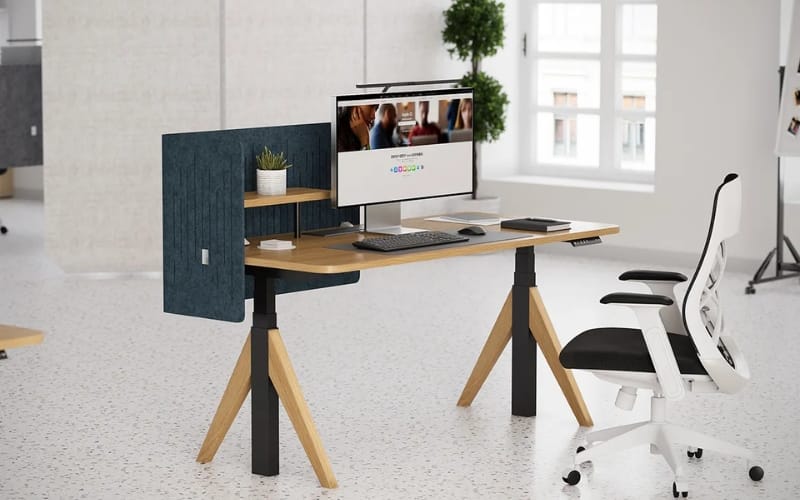
An electric standing desk is a sophisticated piece of desk in office furniture that allows users to transition between sitting and standing positions via an automated motorized system.
Unlike traditional fixed-height desks, these units prioritize ergonomic health by allowing for movement throughout the workday.
Difference Between Electric and Manual Standing Desks
While manual desks use a hand crank to lift the surface, electric desks use high-torque motors.
Manual desks typically adjust at a rate of 3-5mm per revolution, requiring significant physical effort.
In contrast, electric desks move at 30–40mm per second.
This speed difference is a primary factor in user adoption; studies show that users with electric desks adjust their height 5.6 times more often than those with manual cranks.
Main Components Overview
The engineering of a Meet&Co standing desk involves several high-precision parts:
The Motor: Usually a DC motor (Permanent Magnet) because it offers high torque and precise speed control.
Control Box: The motherboard that manages power distribution and synchronizes multiple motors.
Lifting Columns: The steel telescopic legs that house the drive mechanism.
Frame: The structural chassis, often made of cold-rolled steel (SPCC).
Control Panel: The user interface, often featuring a digital OLED display and memory presets.
How Does an Electric Standing Desk Work?
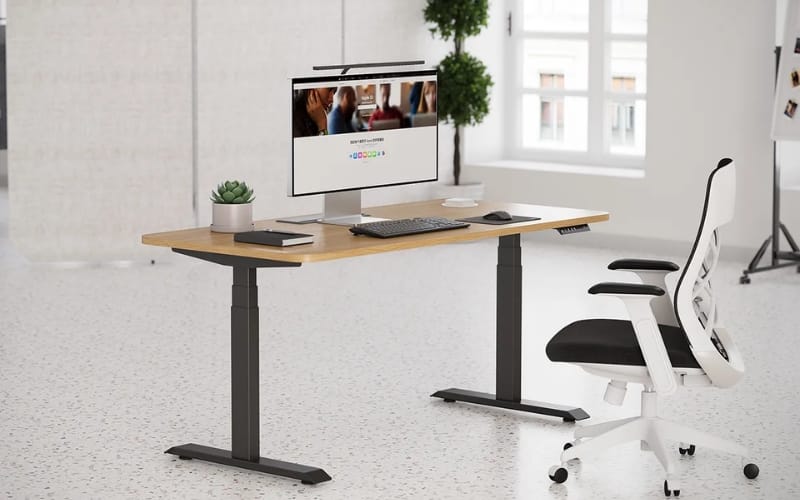
To understand the workflow, we must look at the path of energy. When a user presses a button, the system initiates a “command-to-motion” sequence.
Step-by-Step Working Process
Command: The control panel sends a low-voltage signal (usually 5V) to the control box.
Processing: The control box converts standard AC power (110V/220V) into DC power (24V or 32V).
Rotation: The motor begins to spin at high RPM (often 3,000+ RPM).
Torque Conversion: A gearbox reduces the RPM while increasing the torque (lifting power).
Linear Motion: The gearbox turns a lead screw. A drive nut travels along the screw, pushing the inner leg segments upward.
How Electricity Powers the Desk
The efficiency of the power supply is critical.
High-quality desks use Switching Mode Power Supplies (SMPS), which are 20-30% more efficient than traditional transformers.
This efficiency ensures that the office desk with adjustable height remains cool even during multiple height cycles.
How Height Memory Presets Work
Memory presets rely on pulse-width modulation (PWM) and Hall Effect sensors.
The sensor detects the rotation of the motor’s magnetic field and sends pulses to the microchip.
For example, 100 pulses might equal 10mm of travel.
The control box stores these pulse counts in its non-volatile memory, allowing it to return to the exact same spot every time.
Understanding the Standing Desk Lift Mechanism
This is the core engineering that separates a premium desk from a budget model. The sit and stand up desk relies heavily on the quality of its linear actuators.
What Is a Linear Actuator?
In physics, a linear actuator is a device that creates motion in a straight line. In a standing desk, this is achieved by a “screw and nut” mechanism.
As the screw is turned by the motor, the nut (which is fixed to the inner leg stage) is forced to move along the threads.
How the Gearbox Converts Torque
A typical standing desk motor doesn’t have the raw power to lift 100kg directly. The gearbox acts as a mechanical multiplier.
By using a worm gear or a planetary gear set, the motor can trade high speed for high force. This allows a relatively small motor to lift hundreds of pounds with ease.
2-Stage vs 3-Stage Lifting Columns
The number of stages determines the “stroke” (the total range of movement).
2-Stage: Two segments. These are simpler and cheaper but have a limited range, often starting at 700mm and ending at 1200mm.
3-Stage: Three segments. These offer a wider range (600mm to 1250mm), allowing the desk to go lower for shorter people and higher for tall users. They also provide approximately 30% more stability at high heights due to the overlap between the three segments.
Product Spotlight: Sendi E Height Adjustable Standing Desk
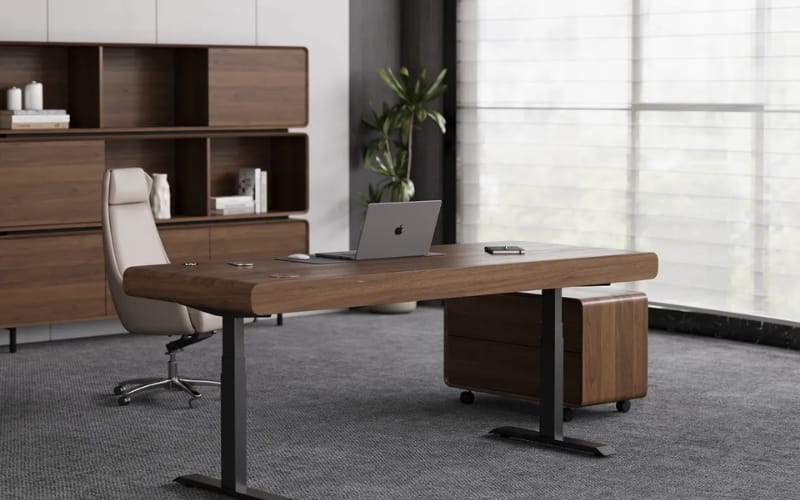
For those seeking a professional-grade solution, the Sendi E Height Adjustable Standing Desk utilizes a dual-motor 3-stage system.
It is engineered with a high-strength steel frame that can handle up to 127kg, moving at a whisper-quiet noise level of less than 45dB—equivalent to a quiet library.
How Dual-Motor Standing Desks Stay Synchronized
If you have a dual-motor desk, the biggest engineering challenge is keeping the legs level.
Role of Hall Sensors
Hall sensors are small semiconductors placed on the motor shaft. They track the RPM of each motor individually.
If one leg encounters more friction (perhaps due to an unevenly distributed load like a heavy CPU on one side), the control box detects the slight decrease in RPM via the Hall sensors.
Control Box Synchronization Logic
The control box uses a feedback loop. If Leg A is 2mm higher than Leg B, the control box will slightly reduce the voltage to Motor A or increase it to Motor B.
This happens hundreds of times per second. This is why a high-quality adjustable height ergonomic desk never looks tilted during movement.
Why Desks Don’t Tilt During Movement
Without this synchronization, a desk could tilt and cause a “binding” effect, where the inner legs jam against the outer tubes.
Quality desks ensure synchronization within a deviation of less than 1mm across the entire 600mm+ range of travel.
Electric vs Pneumatic vs Hydraulic Standing Desks
| Feature | Electric | Pneumatic (Gas Spring) | Hydraulic |
|---|---|---|---|
| Adjustment Speed | 35mm/s (Consistent) | Very Fast (Variable) | Slow |
| Weight Capacity | High (100kg – 150kg) | Low (15kg – 30kg) | Very High (200kg+) |
| Noise Level | <50dB | Silent | Silent to Moderate |
| Power Source | Wall Outlet | Physical Effort | Physical Effort/Electric Pump |
| Ease of Use | One-touch | Manual Lever | Manual Pump/Button |
The electric mechanism is generally preferred for its ability to handle heavy monitor arms and multi-screen setups that would overwhelm a pneumatic gas spring.
How Much Power Does an Electric Standing Desk Use?
Data shows that electric desks are surprisingly low-energy devices.
Active Motion: Uses 150W to 200W. However, since a desk only moves for ~15 seconds to reach full height, it uses only 0.0008 kWh per adjustment.
Standby Mode: High-quality control boxes use less than 0.5W.
Annual Cost: If you adjust your desk 10 times a day, the total annual energy cost is approximately $0.45 to $0.75 USD, based on global average electricity rates.
How Long Do Standing Desk Motors Last?
Average Motor Lifespan
Industrial-grade motors are rated for 20,000 cycles. A cycle is defined as one full trip from the bottom to the top and back.
If you adjust your desk 4 times per work day, the motor is designed to last for over 19 years.
What Causes Motor Failure?
The most common cause is exceeding the “Duty Cycle.” Most motors have a 10% duty cycle (e.g., 2 minutes on, 18 minutes off).
Constant movement for 10 minutes straight can cause thermal buildup, which may degrade the copper windings in the motor.
Maintenance Tips
To extend the life of your sit stand electric height adjustable desk, avoid overloading one side.
While the sync logic is good, unbalanced loads put extra strain on the gearbox of the “heavy” side.
Common Electric Standing Desk Problems Explained
Desk Won’t Go Up
This is usually not a motor failure but an error code (like E01 or E07). It often means the legs are out of sync or the desk needs a reset.
Uneven Height Adjustment
If a cable is loose, one motor might stop while the other continues. The control box detects this instantly and shuts down both for safety.
Resetting the Desk
A standard reset involves holding the “Down” button until the desk hits its lowest point and “rebounds.” This recalibrates the zero-point of the Hall sensors.
Are Electric Standing Desks Safe?
Safety is managed through three primary systems:
Anti-Collision: Gyroscopic sensors or current-monitoring software detect if the desk hits a chair or a window sill.
Overload Protection: If you try to lift 200kg on a 100kg-rated desk, the control box will stop the motors to prevent permanent gear damage.
Overheat Protection: Sensors monitor the PCB (Printed Circuit Board) temperature.
What Reddit Users Say About Electric Standing Desks
Synthesizing feedback from r/StandingDesk and r/OfficeSetups:
Stability is King: Users frequently mention that “wobble” at max height is the biggest differentiator between cheap brands and professional ones like Meet&Co Furniture.
Dual Motor is a Must: Reddit users overwhelmingly recommend dual motors for anyone with more than one monitor.
Noise Concerns: While most don’t mind the motor hum, “whining” sounds in budget motors are a common complaint. High-end brands use dampened motor housings to mitigate this.
Conclusion
Understanding how an electric standing desk work reveals a complex symphony of electrical engineering and mechanical physics.
From the precision of the Hall sensors to the raw power of the DC motors, every component is designed to facilitate a healthier, more active workday.
By choosing a high-quality standing desk mechanism, you are investing in a system that offers 20,000+ cycles of reliability and precise ergonomic control.
Whether you are outfitting a home office or a corporate space, the motorized height-adjustable system remains the pinnacle of modern workspace design.
_2.webp)
_2.webp)

_12.webp)
