






 Meet&Co
To effectively answer how do I remove the filing cabinet drawers and unit, start by emptying all contents, fully extending the top drawer, and locating the plastic release levers or friction tabs on the side rails.
Press the levers (usually one up, one down) while pulling outward to disengage the drawer from the cabinet frame.
Key Takeaways
Safety First: Always empty drawers before removal; a loaded 4-drawer lateral cabinet can exceed 450 lbs.
Mechanism Identification: Check if your unit uses ball-bearing slides (lever-based) or roller tracks (lift-and-tilt).
Strategic Sequence: Always remove drawers from the top down to maintain a low center of gravity and prevent tipping.
Professional Support: For complex office redesigns, consulting experts like Meet&Co can prevent equipment damage and workplace injury.
Identification: Understanding Different Filing Systems
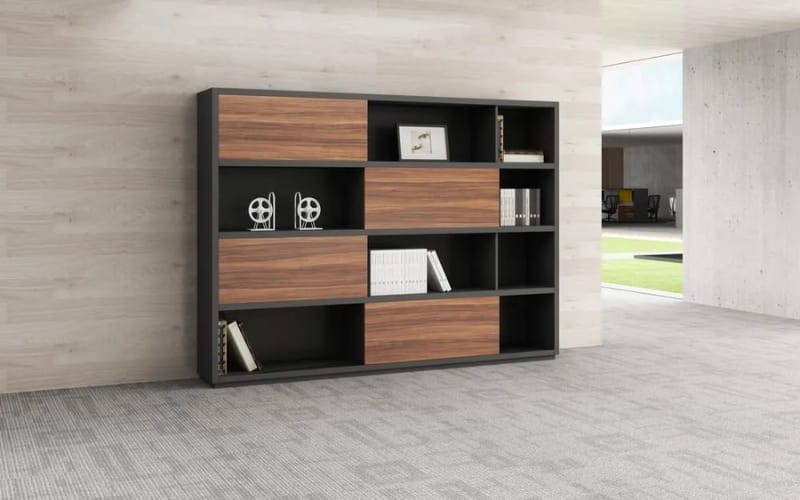
Before tackling the physical task, you must identify what you are working with. Not all cabinets for filing are engineered the same way.
The removal process for a 1950s steel vertical cabinet differs significantly from a high-end lateral wood unit.
According to industry data from the Business and Institutional Furniture Manufacturers Association (BIFMA), approximately 70% of high-quality office furniture utilizes telescopic ball-bearing slides.
These systems offer smooth operation but require a specific “release” action.
Conversely, entry-level or older units often use simple nylon roller tracks, where gravity and a specific tilt angle are your primary tools for removal.
Slide Mechanism Comparison Table
| Feature | Ball-Bearing Slides | Roller Track Systems |
|---|---|---|
| Typical Use | Modern/High-end | Budget/Vintage |
| Release Method | Plastic levers or tabs | Lift-and-tilt |
| Weight Capacity | 75–150+ lbs per drawer | 30–50 lbs per drawer |
| Visual Cue | Metal rails with tiny balls | Exposed wheel on a track |
Step 1: Safety Checklist and Preparation
Removing a heavy steel structure is a high-risk activity for back strain and floor damage.
Statistics from the Bureau of Labor Statistics (BLS) indicate that over 30% of workplace injuries are related to musculoskeletal disorders caused by improper lifting.
When considering how do I remove the filing cabinet, preparation is 90% of the battle. You will need:
A pair of work gloves (to protect against sharp metal edges).
A flathead and Phillips head screwdriver.
A furniture dolly or sliders.
A second person (essential for lateral units wider than 30 inches).
The Anti-Tip Rule: Never have more than one drawer extended at a time during the emptying process.
Once empty, the center of gravity shifts, making the unit more prone to falling forward if handled aggressively.
Step 2: How to Remove Filing Cabinet Drawers
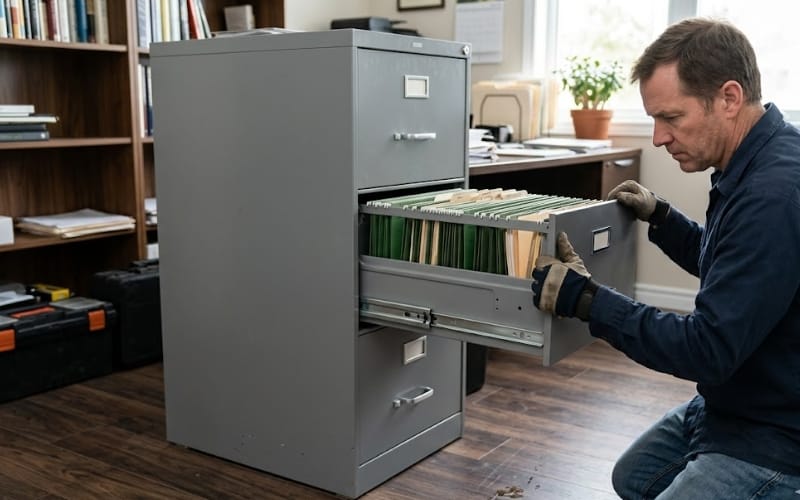
The secret to home office filing cabinets is usually hidden inside the metal railing. Follow these sub-steps for the most common types:
The Release Lever Method (Ball-Bearing)
This is the standard for most corporate environments. Extend the drawer fully. Look at the black plastic strip inside the metal rail.
On the right side, try pushing the lever down; on the left, try pulling it up.
While holding both in their “released” positions, pull the drawer toward you. It should slide out of the track entirely.
The Lift-and-Tilt Method (Roller Tracks)
Common in older vertical units, this requires no levers. Pull the drawer out until it hits the “stop” point. Lift the front of the drawer at a 30-degree angle.
This aligns the roller wheels with the exit notch in the track. Once tilted, pull straight out.
The No-Tab Friction System
Some modern units use a friction-based stop. To bypass this, you simply need a firm, sudden tug once the drawer is at its furthest point.
However, use caution: if there is resistance, do not force it, as you may have a hidden screw-secured system.
Step 3: Troubleshooting Stubborn Drawers
Sometimes, the answer to how do I remove the filing cabinet isn’t straightforward because of age or damage. In office filing cabinets, the most common issue is a “stuck” rail.
Bent Rails: If the cabinet was overloaded (exceeding the typical 25-lb-per-square-foot limit), the steel rails might have bowed. You may need to use a flathead screwdriver to gently pry the rail away from the drawer body.
Misaligned Anti-Tip Interlocks: Higher-end cabinets have a “one-drawer-only” lock. If one drawer is slightly open, the others will remain locked. Ensure every other drawer is slammed shut and locked before trying to remove the target drawer.
Debris in the Track: Paperclips and staples are the enemies of smooth slides. Use a flashlight to inspect the rear of the track for obstructions.
Step 4: Removing the Entire Cabinet Frame
Once the drawers are out, the frame is significantly lighter, but still awkward.
For a standard 4-drawer vertical cabinet, the empty shell weighs approximately 40–60 lbs.
For lateral units, the shell alone can still weigh over 120 lbs.
The Tip-and-Slide: If moving on carpet, place plastic sliders under the four corners.
The Dolly Method: For long distances, tilt the cabinet back and have a partner slide a furniture dolly underneath. Secure the unit with a strap to prevent it from sliding off during transit.
Top-to-Bottom Strategy: When removing multiple units, always work from the top floor down to avoid fatigue and maximize elevator efficiency.
Step 5: Moving and Floor Protection
One of the most expensive mistakes in office transitions is damaging the flooring.
High-performance modern filing cabinets often have leveling glides that can gouge hardwood or snag commercial carpet if dragged.
Hardwood: Use felt pads or thick moving blankets.
Carpet: Use heavy-duty plastic sliders.
Stairs: Never attempt to move a filing cabinet frame down stairs alone. Use a stair-climbing dolly or professional movers. According to moving industry surveys, 40% of DIY office moves result in at least one item of property damage.
Step 6: Disposal and Recycling Options
What do you do once the cabinet is removed? Steel is one of the most sustainable materials in an office.
Scrap Metal: Steel filing cabinets are 100% recyclable. Most scrap yards will take them and even pay a small fee based on the current price of “light iron.”
Donation: If the unit is functional, charities like Habitat for Humanity often accept them.
Liquidation: For large offices, contact a furniture liquidator who can buy the units in bulk.
Common Mistakes to Avoid
Forcing a Locked Unit: Many people forget that cabinets often have a central locking bar. If the key is lost, the drawers won’t budge. You may need to drill out the lock cylinder before removal.
Removing While Loaded: A single drawer of letter-sized files weighs roughly 50-70 lbs. Removing a loaded drawer is a recipe for a crushed foot.
Ignoring the “Safety Stop”: Some industrial cabinets have a screw at the back of the rail specifically to prevent removal. If it won’t move after the lever is pressed, check for this screw.
Expert Tips for Longevity
Having handled office transitions for over 5 years, I recommend the following for maintaining or upgrading your storage:
Lubrication: Never use WD-40 on cabinet slides; it attracts dust. Use a dry silicone spray or white lithium grease for ball-bearing tracks.
Weight Distribution: Always place the heaviest items (like catalogs or thick binders) in the bottom drawer. This lowers the center of gravity and reduces the strain on the cabinet’s anti-tip mechanism.
The Upgrade Path: If your current cabinets are failing, consider switching to lateral files or mobile pedestals from Meet&Co Office Furniture, which offer superior ergonomics and safety interlocks.
Conclusion: Mastering the Removal Process
In conclusion, knowing how do I remove the filing cabinet boils down to three core steps: identifying the slide mechanism (usually ball-bearing or roller), removing drawers from the top down to ensure safety, and using proper equipment like dollies for the frame.
By following these professional protocols, you reduce the risk of injury and protect your office environment.
Always remember that for large-scale office changes, professional assistance is the safest investment.
Once removed, you are free to upgrade to more efficient, modern storage solutions that better fit your current workflow.