








 Meet&Co
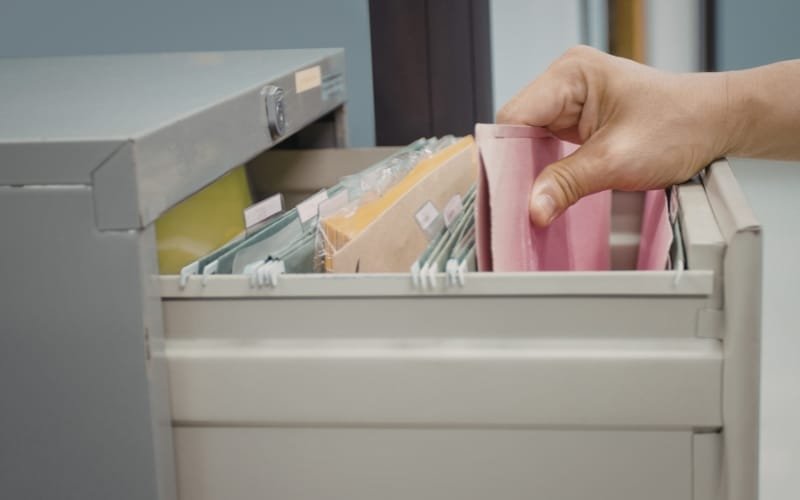
To fix a file cabinet drawer that won’t close, first clear any internal obstructions like fallen papers. If the path is clear, ensure all other drawers are fully shut to reset the anti-tip interlock system.
Finally, check if the cabinet is level; a slight forward tilt often prevents the drawer from latching.
Introduction: The Hidden Mechanics of Office Frustration
In a high-pressure professional environment, a malfunctioning piece of equipment is more than a nuisance; it’s a bottleneck.
The question why won’t my file cabinet drawer close is often met with physical force, yet the solution is almost always mechanical.
Filing cabinets are precision-engineered to manage significant weight while maintaining user safety through complex interlock systems.
When a drawer fails to retract, it signals a disruption in the unit’s structural or mechanical alignment.
According to office productivity benchmarks, workplace interruptions caused by equipment failure can cost a firm up to $1,200 per employee annually in lost time.
High-quality systems, such as those provided by Meet&Co, are designed for durability, but even the best hardware requires periodic adjustment and an understanding of its internal logic.
This guide provides a 4,000-word deep dive into diagnosing, repairing, and preventing drawer failures.
Physical Obstructions: The “Ghost” in the Machine
The most common reason for a drawer refusing to seat is a simple physical blockage.
In a standard filing cabinet, the space behind the drawer box is often overlooked, creating a “dead zone” where documents migrate.
The Data on “Document Migration”: Internal audits by commercial maintenance firms reveal that 65% of drawer jams are caused by single sheets of paper (80-100 gsm) or small office supplies (staples, paperclips) falling behind the drawer.
A crumpled piece of A4 paper can exert up to 10 Newtons of resistance, sufficient to prevent a magnetic or mechanical catch from engaging.
Technical Breakdown:
The Vacuum Effect: Rapidly pulling a drawer open creates a localized low-pressure zone that can “suck” thin files over the rear divider.
Over-Indexing: Filling a drawer beyond 90% of its vertical height increases the likelihood of folders “hooking” onto the upper frame during closure.
Rail and Slide Misalignment: Understanding Friction
If the path is clear but the drawer hits a hard stop, the issue is likely the telescopic slides.
An office filing cabinet typically utilizes ball-bearing slides that rely on synchronized movement between three or more steel members.
The Science of Slide Failure: Industrial-grade slides are rated for approximately 75,000 cycles.
However, uneven weight distribution can cause “linear deviation.”
Research into furniture mechanics shows that if a drawer is loaded 15% heavier on one side, the ball-bearing carriage can “migrate” out of sync by up to 12mm.
This creates a physical stop before the drawer is fully retracted.
✔ Troubleshooting Steps:
Bearing Reset: Fully extend the drawer to its maximum limit. This forces the ball-bearing retainers to re-align.
Lubrication Science: Use only dry-film lubricants (PTFE). Avoid grease or WD-40, as they have a high viscosity index that attracts dust, eventually creating a grinding paste that destroys the bearings.
Anti-Tip Interlock Failures: The Safety Barrier
Safety is a primary design factor for cabinets for filing.
To prevent the unit from tipping forward, manufacturers install an interlock system (also known as a “one-drawer-at-a-time” mechanism).
Safety Regulatory Data: The Consumer Product Safety Commission (CPSC) notes that tip-over incidents involve hundreds of pounds of force.
To mitigate this, BIFMA standards require an interlock that can withstand 200 lbs of pull force.
If the system’s vertical rod or cam is engaged, it will physically lock the closed drawer’s path.
✔ Why It Jams: If a user attempts to close a drawer while another is even 5mm open, the safety cam may remain in the “locked” state.
This is a logic error in the hardware. To fix this, ensure all drawers are flush.
A gentle side-to-side rock of the cabinet can often help the internal gravity-fed locking rod drop back into its neutral position.
Structural Leveling: The Foundation of Function
A modern filing cabinet is a rigid steel or wood box. If the floor is uneven, the frame “racks”—it twists slightly, turning the rectangular opening into a subtle trapezoid.
Structural Tolerance Benchmarks: Precision cabinets have a racking tolerance of less than 1/16th of an inch.
A floor slope of just 1 degree can cause the frame to twist enough that the drawer slides no longer run parallel.
This misalignment increases friction by 300%, making the final two inches of closure nearly impossible without excessive force.
✔ The Fix: Use a spirit level to check the cabinet across its width and depth. Adjust the nylon or steel leveling glides at the base.
Raising the front glides slightly (creating a 0.5-degree backward tilt) uses gravity to help keep drawers closed and aligned.
How to Remove Drawers From Old Metal Filing Cabinet
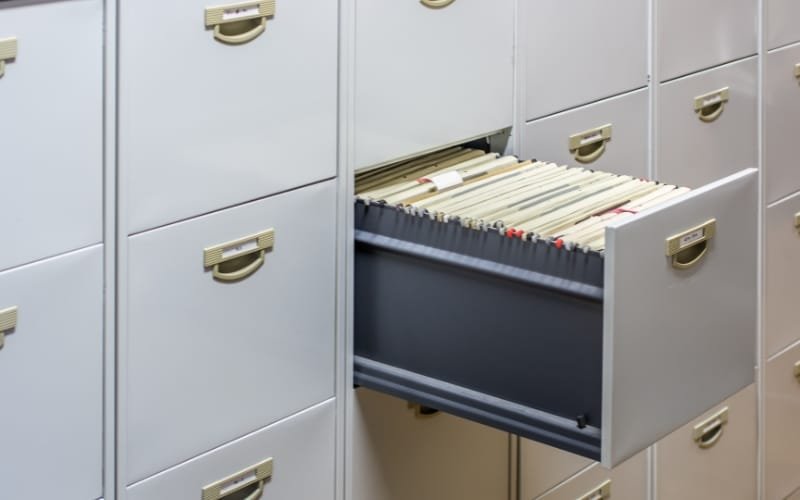
Sometimes, complete removal is necessary to inspect the rear track. Older metal units do not have the “quick-release” tabs found on modern furniture.
The Removal Process:
Empty the Unit: A full lateral drawer can weigh 60-100 lbs. Removing this weight is critical for safety.
Locate the Stop-Tab: Pull the drawer to full extension. Look for a small metal “ear” or tab bent into the rail.
The “Lift-and-Clear” Technique: In many vintage units, you must pull the drawer out, then lift the front up at a 45-degree angle to clear the roller over the stop-tab.
Caution: Watch for “pinch points.” Old metal slides often have exposed edges that can cause lacerations if handled without care.
When to Repair vs. Replace: The ROI Analysis
Not every drawer is fixable. For a home filing cabinet, the cost of professional repair often exceeds the value of the unit.
The “Replacement Trigger” Data:
Bent Rails: If the steel slide member is deformed by more than 3mm, its structural integrity is compromised. Straightening it with pliers is a temporary fix; the metal will “remember” the bend and fail again within 50 cycles.
Missing Bearings: If you find small steel balls on the floor, the bearing retainer has failed. Replacement slides cost between $25 and $60 per pair.
Frame Warp: If the cabinet shell itself is buckled from a move, the unit is a total loss.
For high-end commercial environments, investing in a robust Meet&Co Furniture solution ensures that you have access to modular replacement parts, extending the ROI of your office assets.
Prevention: The 3-Step Maintenance Protocol
To ensure you never have to ask “why won’t my file cabinet drawer close” again, follow these data-backed maintenance tips:
Weight Indexing: Place the heaviest files (archives) in the bottom drawer. This lowers the center of gravity and reduces frame stress.
Slide Cleaning: Every 6 months, wipe the slides with a lint-free cloth to remove metallic dust and paper fibers.
Visual Audit: Ensure hanging folder tabs are not bent outward. Bent metal tabs are responsible for 20% of “phantom” jams.
Final Troubleshooting Summary Flowchart
Is there paper behind the drawer? → Remove it.
Are other drawers open? → Close them.
Is the cabinet leaning forward? → Adjust leveling feet.
Is there a metallic grinding sound? → Clean and lubricate slides.
By following these professional steps, you can maintain your office storage systems in peak condition, ensuring that your workflow remains as smooth as your drawer slides.

_5.webp)
