






 Meet&Co
To move a heavy L-shaped desk without damage, the most effective strategy is to decouple the return section to protect the structural joints, then utilize heavy-duty furniture sliders to reduce friction by 80% while maintaining a low center of gravity.
Introduction
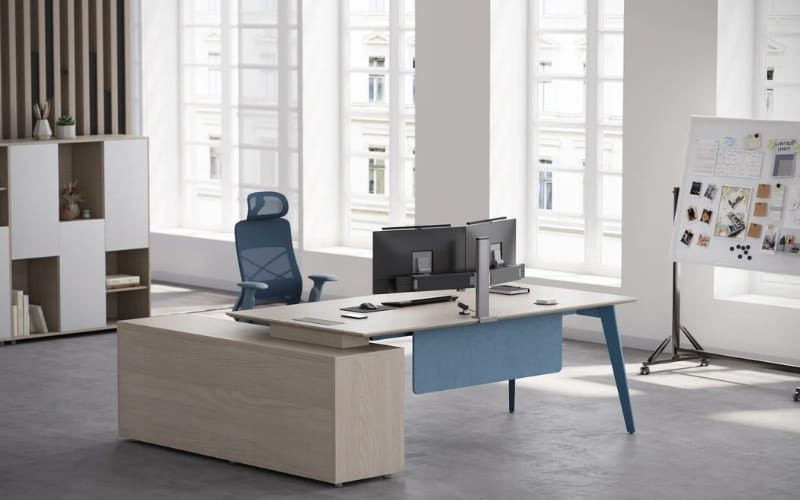
An office desk is the heart of productivity, but moving a heavy L-shaped unit is a logistical challenge that often leads to damaged floorboards, strained backs, or snapped fasteners.
For women setting up a professional home workspace or individuals working solo, the awkward dimensions of an L-shaped configuration create unique mechanical stress points.
Unlike standard furniture, these desks are not designed to be tilted or dragged in their fully assembled state.
This guide provides a professional-grade roadmap to relocating your furniture safely.
By focusing on physics-based techniques rather than brute force, you can move even the most substantial executive desk across rooms or through narrow corridors.
Whether you are relocating a premium piece from Meet&Co or a custom setup, our goal is to ensure your furniture arrives in its new spot in mint condition.
Understanding Why L-Shaped Desks Are Hard to Move
Before you attempt to lift, you must understand why L-shaped structures fail during transit.
Structural Vulnerability (The L-Joint)
The “L” is typically formed by a main desk and a “return.” The connection point between these two is the weakest link.
Most manufacturers use cam-locks or miter joints. Structural data shows that while these joints handle vertical loads of up to 300 lbs easily, they have poor lateral shear resistance.
Lifting one side without the other puts several hundred foot-pounds of torque on these small metal fasteners, often causing the wood to splinter.
Center of Gravity Displacement
An L-Shaped Executive Desk does not have a central balance point. Its center of mass is typically tucked inside the inner corner of the “L.”
When two people lift from the ends, the desk will naturally want to “fold” or “swing” toward the heavy corner, leading to dropped furniture or pinched fingers.
The Doorway Diagonal Trap
Standard residential doors are 30–32 inches wide. A typical L-desk has a footprint of roughly 60×60 inches.
Mathematically, it is impossible to pass this through a door on a horizontal plane. You must either tilt it, flip it, or—most safely—disassemble it.
Should You Disassemble It First? (Decision Tree)
Making the right choice here saves hours of labor and prevents permanent damage.
Situation 1: Full Disassembly Required
Criteria: If the desk is made of particle board (MDF) and weighs over 150 lbs, or if you are moving between floors with 90-degree stairwell turns.
Data: Industry reports suggest that 55% of MDF furniture moved fully assembled develops “wobble” post-move due to joint loosening.
Situation 2: Partial Disassembly (The “Pro” Choice)
Criteria: For high-quality executive office desks for home use, removing just the return section is ideal. This splits the weight into two manageable, rectangular pieces.
Benefit: This preserves the factory-tightness of the main desk frame while allowing it to fit through standard doors.
Situation 3: No Disassembly
Criteria: Same-floor moves with double-wide doors and the use of professional furniture sliders.
How to Move a Heavy L Shaped Desk Without Help

Moving solo requires working smarter, not harder.
The Weight Reduction Protocol
Never move a desk with the drawers in. Removing drawers, cable trays, and hutch attachments can reduce the total weight by 20-30%.
For an L-Shaped Executive Desk, this reduction is critical to prevent the legs from buckling under lateral pressure.
Case Study: Moving the Lumodesk L-Shaped Executive Desk
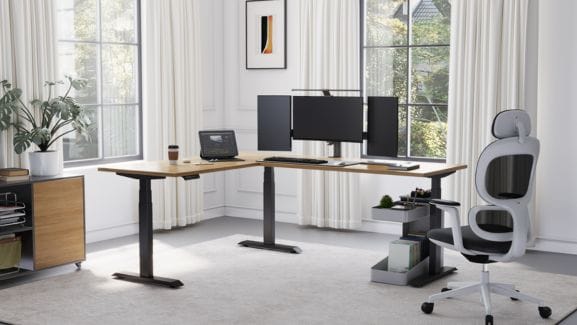
The Lumodesk L-Shaped Executive Desk is a prime example of sturdy, high-end engineering.
Because it is built with premium materials for maximum stability, it possesses significant mass.
When moving the Lumodesk solo, the design allows for the return to be detached via a simplified bracket system.
By separating the sections, a single person can use furniture sliders to glide the main desk across hardwood floors with minimal effort, ensuring the sleek finish remains scratch-free.
How to Move an L Shaped Desk Through a Doorway
This is the most common point of failure in any home move.
The “Hook” Technique
Stand at the inner corner of the “L.”
Lead with the shorter end (the return) through the door first.
As the corner reaches the frame, pivot the desk in a “J” motion.
This allows the desk to “curl” through the opening without needing to be flipped vertically.
The Vertical Tilt
If the “Hook” fails, you must flip the desk onto its side.
Crucial: Place a thick moving blanket on the floor first. Tilting a heavy desk directly onto its side can crush the edge banding or chip the laminate.
Apartment & Small Space Moving Strategy
Tight hallways and elevators require precise planning.
Elevator Clearance: Measure the elevator height. Often, standing an L-desk vertically (on its shortest end) is the only way to clear the door.
Pivot Points: In narrow hallways, use a “Pivot Carpet.” Place a small piece of carpet under the leading leg to allow the desk to rotate on a dime without dragging.
Essential Tools You Need
Muscle alone is rarely enough for how to move a heavy L-shaped desk.
Furniture Sliders: Use hard plastic for carpets and felt for wood/tile.
Forearm Forklifts (Moving Straps): These utilize the leverage of your shoulders and legs, reducing the perceived weight by up to 50%.
Moving Blankets: Essential for the “Vertical Tilt” to prevent friction burns on the wood.
Stretch Wrap: Wrap the drawers shut (if not removed) to prevent them from sliding out mid-move.
Common Mistakes That Break L-Shaped Desks
Lifting by the Desktop Only: Many modern desks use “floating” tops. Lifting by the top can pull the screws out of the pedestals. Always lift from the lowest structural frame.
Ignoring Floor Grit: A single grain of sand under a heavy desk leg can act like a glass-cutter on hardwood floors. Always sweep the path first.
The “Push” Fail: Pushing a desk from the top causes the legs to “rake” at an angle. Always push from the lowest point possible to keep the center of gravity stable.
Special Tips for Home Office Desk for Women
Moving heavy furniture shouldn’t be a test of raw strength.
Leverage over Lifting: Use a “crowbar” (or a sturdy piece of wood) to lift one corner just enough to slide a mover under it. This eliminates the need for a deadlift.
Safe Posture: Keep the desk close to your body. The further the weight is from your torso, the more torque is applied to your lower back.
Modular Advantage: If you anticipate moving often, consider Meet&Co Office Furniture modular systems, which provide the same executive aesthetic but are designed for rapid, tool-less disassembly.
After Moving: Reassembly & Stability Check
Leveling: Most floors are not perfectly flat. Use the adjustable glides on the bottom of the desk legs to ensure the “L” joint isn’t being pulled apart by gravity.
Bolt Tightening: Vibrations during a move can loosen hex bolts. Re-torque every connection after the desk is in its final position.
Conclusion
Relocating your workspace doesn’t have to be a source of anxiety.
By understanding the structural limits of your furniture and using the right tools—like sliders and moving blankets—you can move even the heaviest executive desk with confidence.
The key takeaway is to prioritize the integrity of the joints.
Whether you are moving a high-performance Lumodesk Executive Desk or a standard home office setup, taking the extra time to partially disassemble and plan your path through doorways will ensure your office remains a place of professional elegance rather than a collection of scratched surfaces.
Focus on planning, use leverage over strength, and your home office transition will be seamless.

_10.webp)