








 Meet&Co
COLFAX, N.C. — As artificial intelligence moves from workplace experiment to everyday business infrastructure, furniture marketers face two immediate challenges: putting the technology to productive use inside their organizations and keeping their brands visible as consumers increasingly turn to AI-generated answers before clicking traditional search results.
High Point University associate professor of communication Matt Ritter addressed both at last week’s American Home Furnishings Alliance Marketing & PR Conference, offering attendees a practical blueprint for building AI workflows and adapting their digital content for generative search in his presentation: “AI Marketing Tools 2.0.”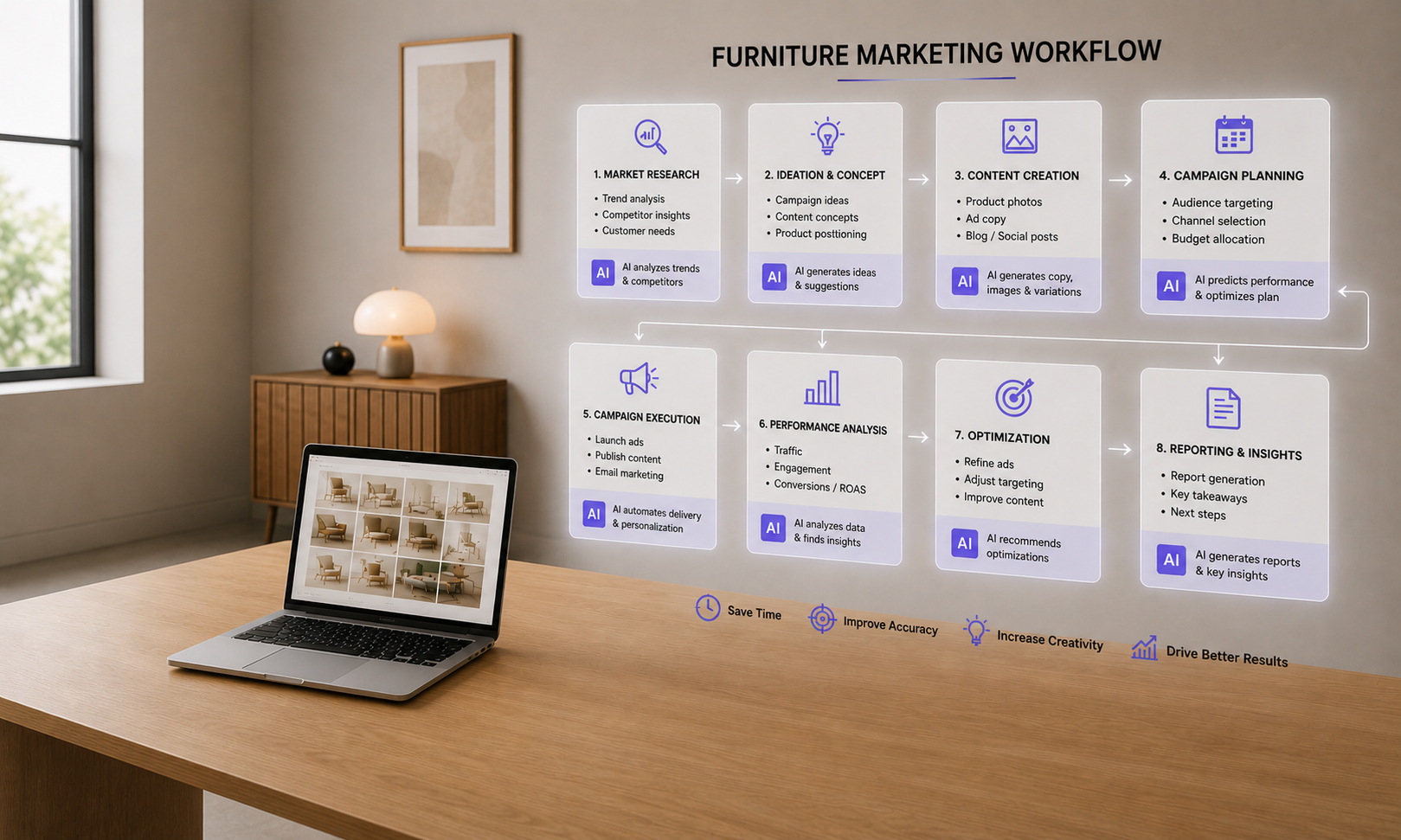
“A lot of people, when I talk about AI, are thinking about headcount,” Ritter said. “That‘s not how I think about AI. The goal is not fewer people. To me, it‘s more and better from the same people who are now less stressed out — better preparation, clearer communication, faster first drafts and hopefully more time to work on the things that we‘ve been putting off.”
Speaking at the AHFA event at Guilford Technical Community College, Ritter offered furniture marketers a practical framework for deploying AI in their daily workflows and preparing their brands for the rise of generative search.
“What I have is 40 hours a week on a good week,” Ritter said. “Headcount is the same. Expectations are increasing, ever increasing. Then, on the other side, is the aspiration: what I would like to accomplish. What are some ways that we can use AI to bridge that gap between what we have and what we want to accomplish?”
The‘best intern,’ but not an infallible one
Ritter encouraged attendees to think of AI as an intern requiring clear direction and human supervision.
“In fact, I think of it as the best intern that I‘ve ever had,” he said. “It‘s fast. It‘s eager. Sometimes it‘s confidently wrong. It can absolutely be wrong. My layer is that expertise layer that says, ‘Yes, this is a thumbs up,’ or, ‘No, this is something that we need to try again.’”
The tools have advanced substantially in the past year, particularly in memory and their ability to perform multistep tasks, Ritter said.
But the model selected for a task still matters. Ritter illustrated that point by asking several AI models whether he should walk or drive to a car wash only 50 meters away. Several quick-response modes advised him to walk, overlooking the inconvenient fact that the car needed to go with him.
“We want to match the task to the model that we are using. Save the heavy model for reasoning and drafting,” Ritter said.
‘Delegate it badly’ and learn from failure
The larger challenge for companies, Ritter said, is understanding their own workflows well enough to automate them.
“Documenting workflows is the asset right now,” he said. “I think that is the holdup for companies integrating agentic AI into their workflows. We don‘t know where to start because we don‘t know how to document our workflows.”
Ritter described how his wife, a CEO in the financial sector, built an AI agent to manage competing demands across Outlook, Teams and her calendar. She started with a four-sentence instruction:
“Act as my chief of staff,” she told the agent. “Each morning, give me a prioritized daily briefing based on my Outlook calendar, my emails and my Teams messages. Be direct, concise and ruthlessly prioritize. No fluff. I want clarity on what I must do today.”
Rather than trying to anticipate every instruction at the outset, she watched what the agent missed.
“In week one, she said, ‘Ignore auto-generated system emails. I’m getting noise from platforms that my team no longer uses,’” Ritter said. “Week two, she said, ‘Cross-reference email and Teams before flagging anything as unresolved.’ Week three: ‘Scan my sent items from the past seven days for commitments I’ve made that I haven’t completed’ — things like, ‘I’ll send that over,’ or, ‘Let me check and get back to you.’”
She later instructed it to recommend questions for meetings based on agendas, recent message threads and unresolved issues. The agent now produces morning and evening briefings that track not only assignments, but also what she owes employees and what they owe her.
“Four sentences at the beginning, eight weeks of iteration, and her prompt now has more than 32 instructions,” Ritter said. “One person built it. No IT, no consultants. She didn’t sit down and write it. She discovered it, and that’s how we discover our workflows. We watch what breaks.”
Marketers can apply the same method to retailer correspondence, account preparation, competitive intelligence and unfulfilled commitments, he said.
From appearing in a list to getting named in the answer
AI is also reshaping how consumers discover brands, according to Ritter. Traditional search engine optimization sought to move a company higher in a list of Google results. Generative engine optimization, or GEO, seeks to make a brand part of the answer an AI platform gives the consumer.
“The buyer is asking before they click,” Ritter said. “People are going straight to generative AI and these AI chatbots. They’re asking them the same questions, and the AI is providing them with what it thinks is the answer.”
Ritter cited figures showing that 43% of U.S. Google searches now include an AI overview and that AI-referred traffic to U.S. retail sites increased 393% between the first quarters of 2025 and 2026.
“It’s the same game,” he said. “With SEO, the goal was getting in the list. Now the goal is getting named in the answer — getting named in the synthesis.”
To examine what influences those answers, Ritter asked ChatGPT, Claude and Gemini which mid-priced upholstery brands an independent furniture store should carry and which American-made case goods manufacturers were best.
Rowe and England consistently surfaced in the upholstery results, while Stickley, Gat Creek, Copeland and Vaughan-Bassett stood out in case goods. Just as importantly, Ritter found that the platforms relied on different kinds of sources.
“For ChatGPT, ChatGPT reads you,” he said. “It was looking at manufacturer websites almost exclusively. If your site doesn’t say it plainly, ChatGPT won’t say it either.”
Gemini placed greater weight on how retailers and dealers described a brand, while Claude looked more heavily at outside commentary.
“Claude wanted to know what everybody else said about you,” Ritter said. “Claude was particularly interested in what the trade press was saying. One good trade story can carry a brand into the answer.”
Give AI facts it can quote
The brands that appeared most consistently had “a crisp, quotable claim,” Ritter said. Gat Creek products are signed by the builder. Stickley states the percentage of its production that is domestic. Vaughan-Bassett prominently identifies its U.S. production, number of craftspeople and the share of lumber sourced nearby.
“It was these factual statements that are indisputable,” Ritter said. “There’s no one who can dispute that a Gat Creek piece of furniture is signed by the builder, but they might be able to dispute ‘best in North Carolina’or‘the world‘s greatest.’”
By contrast, two well-regarded upholstery brands failed to appear in any answer. Their sites relied on broad language such as “built with integrity, crafted with heart,” but offered no prominent construction, origin or warranty information.
“The bots completely ignored them,” Ritter said. “It needs cold, hard facts and statistics. What it‘s looking for is specific information: facts, how they‘re phrased and whether other people are saying them.”
Ritter advised marketers to ask several AI tools how they describe the brand and its leading collections, save the answers and sources, and repeat the audit monthly. Product data should be standardized across listings, with construction details, fabric specifications, certifications and warranty terms stated plainly.
Brands should also continue their SEO efforts, pursue editorial coverage and participate credibly in consumer discussions. What they should not do is stuff pages with keywords or make unsupported superlative claims about their products.