





 Meet&Co
To learn how to reduce office furniture procurement costs, businesses must consolidate vendors, buy factory-direct, standardize specifications, and prioritize total cost of ownership (TCO) over low initial price tags.
Key Takeaways
Source Directly: Cut out middleman markups by purchasing directly from established office furniture manufacturers.
Prioritize TCO: Avoid the trap of the lowest upfront price; consider maintenance, lifespan, and warranty.
Standardize & Bulk Buy: Group your orders and standardize product lines to maximize volume discounts.
Optimize Logistics: Plan space and installation early to eliminate costly shipping delays and on-site retrofitting.
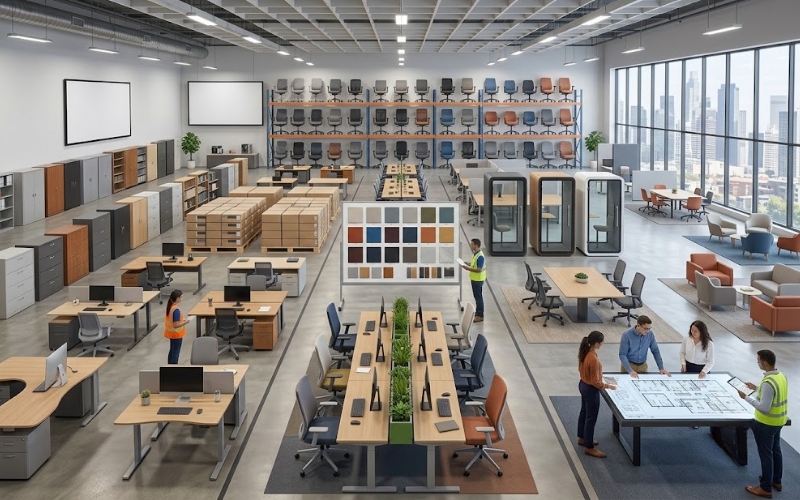
Where Does Office Furniture Procurement Cost Come From?
Procurement expenses consist of both obvious upfront invoices and long-term hidden operational costs.
Organizations often fail to budget for the secondary expenses that accumulate throughout the furniture lifecycle.
To control your budget, you must analyze direct costs alongside indirect logistical and maintenance strains.
| Cost Category | Elements Included | Impact on Budget |
|---|---|---|
| Direct Costs | Furniture units, freight shipping, professional installation | High upfront cash outflow; easiest to negotiate initially. |
| Hidden Costs | Warehousing, early replacements, maintenance, delivery delays | Long-term operational drain; can increase total costs by 30-40%. |
10 Proven Ways to Reduce Office Furniture Procurement Costs
Standardize Furniture Specifications
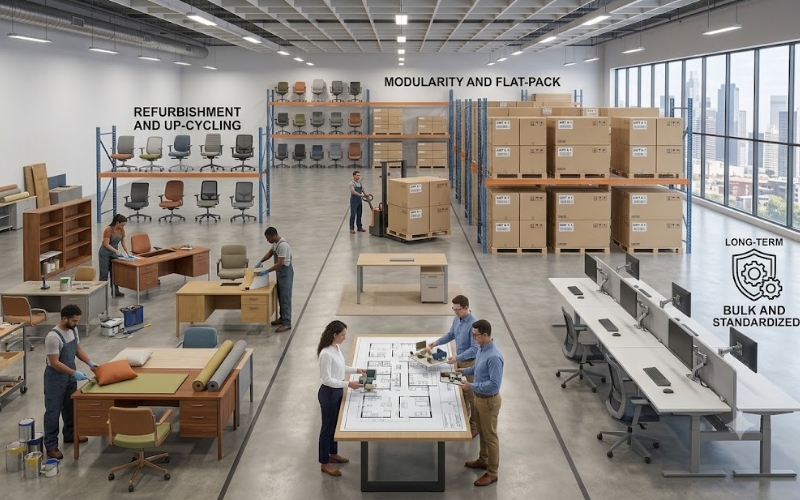
Standardizing your furniture specifications drives down costs by drastically reducing your total SKU count.
When a company limits choices to specific modular desks or ergonomic chairs across all departments, it simplifies inventory management.
This uniformity grants higher purchasing leverage for those specific items, minimizing administrative confusion during future expansions.
Consolidate Suppliers
Consolidating your supplier network reduces procurement costs by eliminating redundant administrative work and maximizing contract values.
Managing dozens of separate vendors creates massive invoicing, tracking, and communication overhead.
Partnering with a comprehensive provider like Meet&Co streamlines operations, lowers shipping fees, and unlocks premium multi-category discount tiers.
Compare Multiple RFQs
Comparing multiple Requests for Quotes (RFQs) ensures you secure highly competitive market pricing.
Do not accept the first baseline estimate; instead, issue detailed RFQs with precise technical specifications to at least three vendors.
This structured bidding process forces suppliers to present their best pricing, transparent terms, and value-added services.
Buy Directly from Manufacturers
Purchasing directly from original equipment manufacturers cuts out trading companies, wholesalers, and local showroom markups.
Factory-direct sourcing ensures transparent pricing structures and opens up avenues for custom modifications without exponential cost increases.
Working with an established global Meet&Co Manufacturer guarantees robust product warranties and direct access to replacement parts.
Purchase in Bulk
Bulk purchasing remains one of the most reliable ways to slash per-unit furniture costs.
Manufacturers operate on economies of scale; production runs become significantly cheaper when setups are optimized for massive quantities.
Even if your office rollout happens in progressive phases, contracting the entire volume upfront secures deep wholesale discounts.
Choose Modular Office Furniture
Modular office furniture reduces long-term rearrangement, relocation, and reconfiguration costs.
Unlike traditional heavy static fixtures, modular systems can be adapted, expanded, or moved easily as teams grow or shrink.
This flexibility prevents companies from needing to buy entirely new setups when office layouts change.
Optimize Shipping and Installation
Optimizing your logistics timeline avoids expensive split shipments, storage fees, and emergency weekend installation labor.
Coordinate with your project managers to ensure building construction finishes before the furniture arrives on site.
Aligning freight delivery directly with the installation team prevents double-handling and costly third-party warehousing fees.
Consider Refurbished Furniture for Non-Critical Areas
Using refurbished furniture in low-traffic, non-critical zones preserves capital for client-facing spaces.
Breakrooms, secondary storage zones, and internal training rooms do not always require premium, brand-new design collections.
Mixing high-quality remanufactured items with new inventory significantly lowers the average cost per square foot.
Negotiate Long-Term Supplier Agreements
Long-term supplier agreements lock in stable pricing and predictable service terms over multi-year periods.
In volatile economic markets, strategic partnerships shield your corporate budget from sudden raw material or shipping inflation.
Vendors prioritize contracted long-term partners, offering them preferential production scheduling, faster lead times, and free extended warranties.
Focus on Total Cost of Ownership (TCO)
Focusing on the Total Cost of Ownership (TCO) protects your business from the financial traps of “cheap” furniture.
A budget chair that breaks in two years costs far more in replacements and downtime than a commercial-grade option.
Evaluate the true lifecycle cost by calculating initial price, warranty coverage, and expected durability.
Common Mistakes That Increase Procurement Costs
Choosing the Lowest Price Only
Selecting assets based solely on the lowest sticker price consistently leads to inflated long-term expenditures.
Ultra-cheap commercial furniture typically utilizes low-grade particle board, weak mechanisms, and subpar fabrics that degrade under daily use.
The resulting rapid replacement cycles, employee discomfort, and constant repair claims quickly wipe out any initial savings.
Ordering Without Space Planning
Ordering furniture before completing accurate architectural space planning results in severe layout errors and expensive returns.
Mismatched dimensions lead to blocked walkways, restricted natural light, and unusable workstations.
Rectifying these errors requires rushed return shipping, restocking fees, and project delays that derail company operational timelines.
Purchasing from Too Many Vendors
Sourcing different items from too many separate vendors inflates logistical management costs and creates visual misalignment.
When desks, chairs, and storage units come from different sources, shipping fees multiply and project coordination becomes chaotic.
Furthermore, mismatched wood grains and paint finishes diminish the professional aesthetic of the office.
Ignoring Lead Times
Ignoring factory production and shipping lead times triggers expensive rush fees and prolonged operational downtime.
Custom or imported corporate furniture often requires several weeks for manufacturing, transit, and customs clearance.
Forgetting to factor in these timelines forces companies into making panicked, overpriced local purchases to meet opening deadlines.
Conclusion
Optimizing office procurement requires a strategic shift toward supplier consolidation, direct factory sourcing, modular asset selection, and rigorous TCO management.
The most effective way to reduce office furniture procurement costs is not simply buying cheaper furniture—it is optimizing the entire procurement process from initial space planning to final installation.