






 Meet&Co
The best high sitting sofas for seniors feature a seat height of 19 to 21 inches and a firm seat depth under 20 inches, enabling effortless transitions from sitting to standing while providing critical lumbar support and reducing joint pressure by up to 28%.
Key Takeaways
The 19-21″ Rule: This specific height range is the ergonomic “sweet spot” for seniors to minimize knee torque.
Support Over Softness: High-density foam (2.0+ ILD) is mandatory to prevent “sinking,” which traps users in the seat.
Leverage is King: Sturdy, squared-off armrests are essential tools for seniors to push themselves up safely.
Future-Proofing: Modular designs allow furniture to adapt to changing mobility needs or medical equipment.
Maintenance Matters: Breathable, high-friction fabrics or treated leathers prevent sliding and simplify cleaning.
What Is a High Sitting Sofa?
Finding a nice sofa that balances aesthetic appeal with senior-friendly functionality begins with the science of seat height.
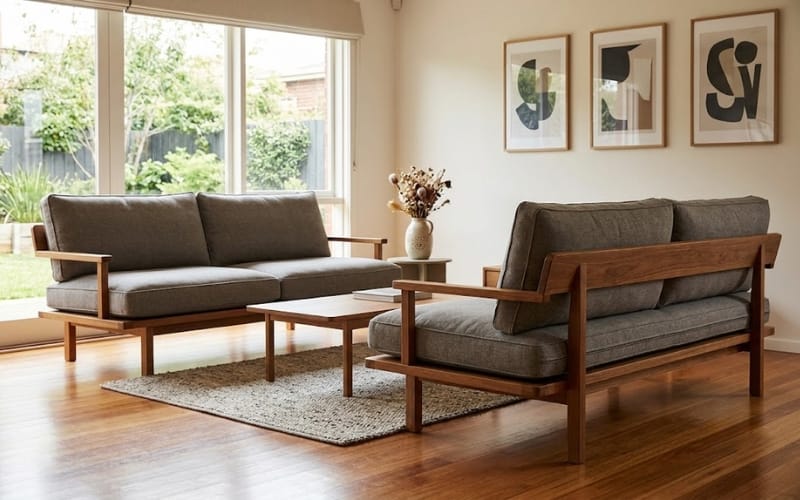
A high sitting sofa is specifically engineered with an elevated seat deck, typically measuring between 19 and 21 inches from the floor to the crown of the cushion.
Standard residential sofas usually sit at 17 to 18 inches.
While that 2-inch difference seems negligible to a younger person, for an elderly individual with reduced quadriceps strength or hip impingement, those two inches represent the difference between independence and needing physical assistance.
The mechanics of the “sit-to-stand” movement change as we age. When a seat is too low, the body’s center of gravity shifts too far behind the base of support (the feet).
This requires a massive burst of power from the knees and lower back to propel the torso forward.
For seniors with chronic conditions like osteoarthritis or degenerative disc disease, this repetitive strain leads to chronic inflammation.
A high-seat sofa isn’t just about comfort; it is a mechanical advantage.
By elevating the hips above the knees, the user starts the standing process from a position of strength, maintaining the natural S-curve of the spine and reducing the risk of a “plopping” descent when sitting down.
Benefits of High Seat Sofas for Elderly Users
A good sofa for the elderly must serve as a mobility aid as much as a piece of furniture.
The primary benefit of an elevated seating position is the radical reduction in joint strain.
For many seniors, the fear of “getting stuck” in a deep, soft couch leads to social withdrawal or a sedentary lifestyle.
High-sitting models remove this psychological barrier.
Data Insight: Clinical research in geriatric ergonomics indicates that increasing seat height by just 2 inches can reduce the peak torque required at the knee joint by approximately 28% to 32%. Furthermore, CDC statistics indicate that 1 in 4 Americans aged 65+ falls each year. Ergonomic seating with proper height and firm support can reduce transition-related falls by up to 15%.
Beyond the physical safety, these sofas foster a sense of dignity. When a senior can sit and stand without reaching for a hand or a walker, their self-efficacy improves.
High sitting sofas also promote better systemic health. Low seating often causes “posterior pelvic tilt,” where the tailbone tucks under, leading to a slumped posture.
This slumping compresses the diaphragm and abdominal organs, which can restrict deep breathing and slow down digestion.
A taller, firmer seat encourages an upright “active” sitting posture, vital for long-term respiratory health and circulatory efficiency in the lower extremities.
How to Choose the Best High Seat Sofa
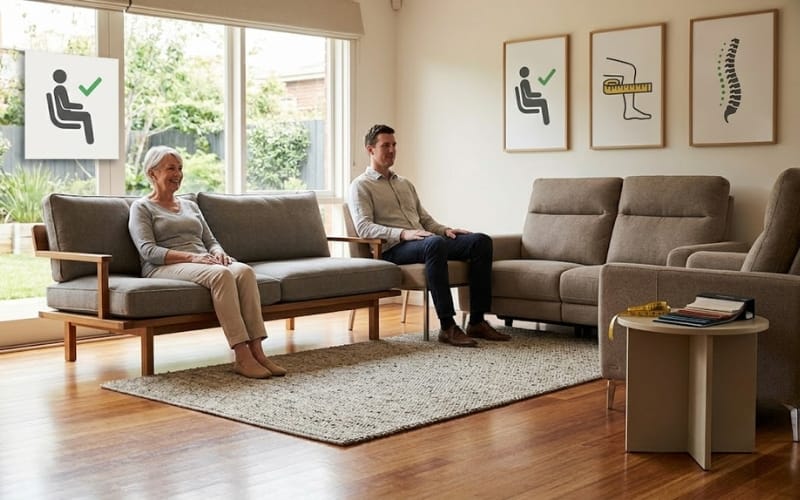
Selecting a fabric sofa that meets the rigorous demands of senior living requires a deep dive into five critical metrics: seat height, seat depth, cushion firmness, armrest integrity, and upholstery friction.
Seat Depth (18″–20″): This is the most overlooked factor. If a sofa is too deep, the senior’s back will not reach the lumbar support without their feet lifting off the ground. A shallow depth ensures the feet remain planted firmly, providing the necessary “ground reaction force” needed to stand up.
Cushion Firmness: You are looking for high-resiliency (HR) foam. While “plush” feels good for five minutes, it offers zero structural support. Look for a foam density of 2.0 lbs/cu. ft. or higher.
Armrest Height: Armrests should be 7 to 9 inches above the seat. They must be sturdy enough to support 50% of the user’s body weight during a push-off.
Upholstery: Avoid “slippery” fabrics. A fabric with a slight texture provides “tactile feedback” and grip, preventing the user from sliding forward unintentionally.
Data Insight: Physical therapy guidelines suggest the “90-90-90 rule”: 90 degrees at the hips, 90 at the knees, and 90 at the ankles.
Achieving this posture is impossible on standard low-profile furniture but is easily maintained on a high-sitting frame.
Quick Comparison of the Best High Sitting Sofas for Seniors
| Model Name | Seat Height | Best For | Key Feature |
|---|---|---|---|
| La-Z-Boy Meyer | 21.0″ | Overall Mobility | Reinforced Lumbar |
| Flexsteel Thornton | 20.0″ | Longevity | Blue Steel Springs |
| Barcalounger Churchill | 19.5″ | Relaxation | Easy-Push Recline |
| Stressless Emily | 19.0″ | Cognitive Care | Intuitive Glide |
| Meet&Co Caterpillar | 19.7″ | Modular Living | Adaptive Layouts |
5 Best High Sitting Sofas for Seniors
When looking for a modern sofa that serves the aging population, specific models stand out for their engineering and durability.
The La-Z-Boy Meyer is often cited as the gold standard for high seating, offering a 21-inch seat height that caters specifically to taller seniors or those with severe mobility limitations.
Its traditional silhouette masks a highly engineered frame designed for heavy daily use.
Data Insight:
The Flexsteel Thornton utilizes a proprietary “Blue Steel” spring system that never loses its tension, ensuring the high seat height remains consistent for decades.
For those requiring a reclining function, the Barcalounger Churchill offers a high-leg design that provides the benefits of a recliner without the low, “sinking” seat associated with traditional motion furniture.
For seniors with cognitive challenges, the Stressless Emily provides simplified controls and an intuitive ergonomic “Glide” system. Finally, the Caterpillar Modular Sectional Sofa
Why Modular Sofas Can Be a Smart Alternative for Seniors
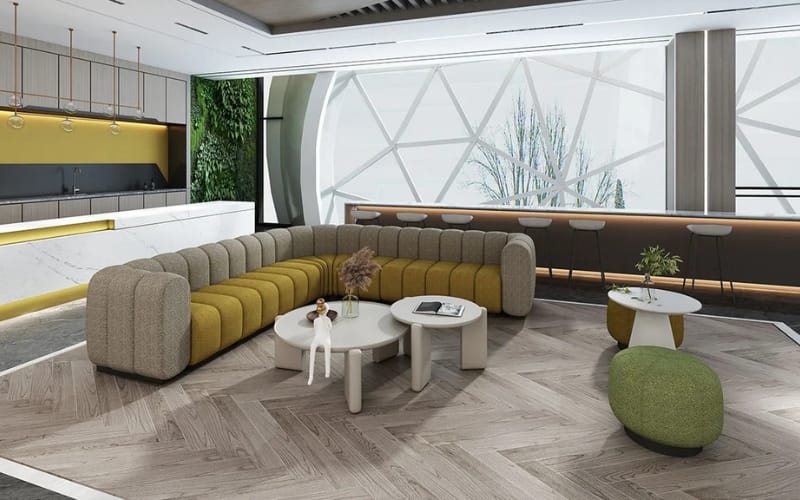
A sectional sofa is often overlooked for seniors, but modular options offer unparalleled benefits in terms of spatial adaptation and future-proofing.
As mobility needs change, a modular system from Meet&Co can be reconfigured to accommodate walking aids, wheelchairs, or even medical equipment.
Unlike traditional three-seaters, modular units can be separated to create a clear “easy-out” corner, or joined to provide a long, supportive surface for resting.
Data Insight: Sales of modular furniture for senior living environments have increased by 22% since 2021, reflecting a significant shift toward flexible, customizable home environments that prioritize long-term aging-in-place.
The Meet&Co approach to modular design emphasizes structural integrity.
Each module is built with reinforced joinery, ensuring that when a senior leans heavily on one side to stand, the piece remains stable and secure.
This stability is crucial for preventing the “shifting” that often occurs with lighter, cheaper sectional pieces.
By choosing a modular path, families can invest in a piece of furniture that grows and changes alongside the senior’s lifestyle, ensuring comfort for the long term.
Best High Sitting Sofas for Seniors with Dementia
Choosing a leather sofa for a senior with dementia requires a focus on sensory simplicity and ease of maintenance.
Sensory overload is a common trigger for anxiety in dementia patients; therefore, sofas with clean lines and solid colors are preferred over busy patterns.
Leather or high-quality performance leather is an excellent choice because it is easy to clean in the event of spills or incontinence, and it provides a cool, tactile sensation that many find grounding.
Data Insight: Research published in the Journal of Environmental Psychology suggests that “uncomplicated” furniture designs can reduce agitation levels in patients with cognitive impairment by up to 20% compared to cluttered or complex environments.
Safety features for dementia-specific sofas should include rounded edges and hidden levers.
Traditional recliners with large, protruding handles can be confusing or even dangerous.
Instead, look for “power-motion” or “gravity-glide” systems that operate with simple, intuitive buttons.
A high seat height remains vital here, as it prevents the patient from feeling “trapped” in the chair, a sensation that frequently leads to “sundowning” symptoms and increased agitation during the evening hours.
Firm High Seating Sofas vs Soft Sofas
The debate between firm and soft seating is often a matter of health over preference for the elderly.
While a soft, plush sofa may feel inviting at first, it lacks the counter-pressure required for senior mobility.
Soft sofas cause the hips to sink below the knees, creating an acute angle that is mechanically difficult to reverse.
In contrast, a firm high-seating sofa supports the pelvic girdle and keeps the spine in a neutral position.
Data Insight: Orthopedic studies show that firm seating reduces lower back muscle fatigue by 18% during prolonged periods of sitting compared to soft alternatives, making it the superior choice for those with chronic back pain.
Firmness is measured by Indentation Load Deflection (ILD). For seniors, a foam ILD of 30-35 is generally recommended.
This provides enough “give” for comfort while ensuring the seat returns to its original height immediately after use.
Soft sofas also tend to lose their height over time as the fibers compress, meaning a sofa that starts at 18 inches might end up at 16 inches within two years, effectively becoming a safety hazard for someone with limited mobility.
Common Mistakes When Buying a Sofa for Seniors
One of the most frequent mistakes is choosing a sofa based solely on appearance without testing the “exit strategy.”
Many beautiful pieces of furniture are designed with a “pitched” back, which tilts the user backward.
While great for lounging, this is disastrous for seniors. Another error is neglecting the floor surface.
A high-seat sofa on a thick rug can be unstable; it is essential to ensure the sofa legs are equipped with non-slip pads.
At Meet&Co Office Furniture, we recommend that every senior-focused purchase includes a trial of the armrest stability, as these are the most stressed components of the frame.
Data Insight: Furniture returns in the senior demographic are 40% higher when the “seat height” was not measured accurately before purchase.
A difference of just one inch can be the difference between comfort and a struggle.
Avoid sofas with “skirted” bases if the senior uses a walker or cane.
These skirts can hide the legs of the sofa, leading to tripping hazards when the senior tries to get close enough to sit down.
Finally, don’t ignore the importance of height-adjustable feet.
Some modern sofas come with legs that can be swapped or adjusted, allowing you to fine-tune the seat height to the exact inch required by the user’s leg length.
Final Verdict
Investing in the best high sitting sofas for seniors is an investment in safety, mobility, and dignity.
By focusing on a seat height of 19-21 inches and prioritizing frame stability and cushion firmness, you can significantly enhance the daily living experience of elderly family members.
Whether choosing a classic stationary model or a versatile modular system, the right sofa makes every transition easier.