






 Meet&Co
Why outdoor couch cushions are so expensive is primarily due to the high-performance engineering required to resist UV degradation, moisture, and microbial growth.
Unlike indoor versions, these cushions use solution-dyed acrylics and specialized open-cell foams that increase manufacturing costs by up to 300% to ensure multi-season durability and structural integrity.
Key Takeaways
Fabric Engineering: Premium textiles like Sunbrella undergo chemical bonding that ensures colorfastness for over 1,500 direct sunlight hours.
Specialized Fillings: Reticulated (open-cell) foam allows 100% water drainage, preventing the “sponge effect” and mold growth common in cheap alternatives.
Precision Labor: Features like reinforced piping and UV-bonded threading require specialized machinery that standard indoor factories lack.
Lifetime Value: High-end cushions typically last 5–10 years, offering a lower “cost per season” compared to budget options that fail within 12 months.
The Chemistry of Performance Fabrics
The high price of outdoor cushions starts with the molecular makeup of the fabric, which must withstand environmental stressors that would destroy standard textiles within weeks.
When you source from specialized manufacturers like Meet&Co, you aren’t just buying a cover; you are buying advanced material science.
Standard polyester is “surface dyed,” meaning the color only sits on the outside of the fiber. In contrast, premium outdoor fabrics are “solution-dyed.”
During this process, UV-stable pigments are mixed into the liquid polymer before the fiber is even spun.
Industry data shows that solution-dyed acrylic retains its color intensity 10 times longer than surface-dyed polyester.
While standard fabric might cost $5 per yard, performance-grade textiles range from $40 to $90 per yard.
This price hike is justified by the fabric’s ability to resist fading under 1,500 to 2,000 “lightfast” hours, ensuring your new couch retains its aesthetic appeal even in high-UV climates like Florida or Australia.
Filling Technology: Why What’s Inside Matters
Internal foam engineering accounts for nearly 40% of the total cushion cost because it must balance plush comfort with rapid water drainage.
Indoor cushions usually contain standard polyurethane foam. If exposed to rain, this foam acts as a giant sponge, trapping moisture and becoming a breeding ground for mold.
To avoid this, a high-quality couch for outdoor use requires reticulated foam.
| Feature | Standard Poly-Foam | Reticulated (Open-Cell) Foam |
|---|---|---|
| Porosity | Low (Traps water) | High (Water flows through) |
| Mold Resistance | Poor | Excellent (Antimicrobial) |
| Cost Comparison | Baseline ($) | 3x – 4x Cost ($$$$) |
| Density (lb/ft³) | 1.2 – 1.5 | 1.8 – 2.5 |
Reticulated foam goes through a “thermal quenching” process where the cell membranes are literally blown out, leaving only the skeletal structure.
This allows air and water to pass through freely. Furthermore, high-density foam (above 1.8 lbs) is required to prevent the cushion from “bottoming out” after a few months of use.
The raw material cost for this industrial-grade foam is significantly higher, directly impacting the retail price.
The Impact of Size and Customization on Pricing
Larger dimensions and bespoke shapes require significantly more material and specialized cutting layouts, which removes the cost-saving benefits of mass production.
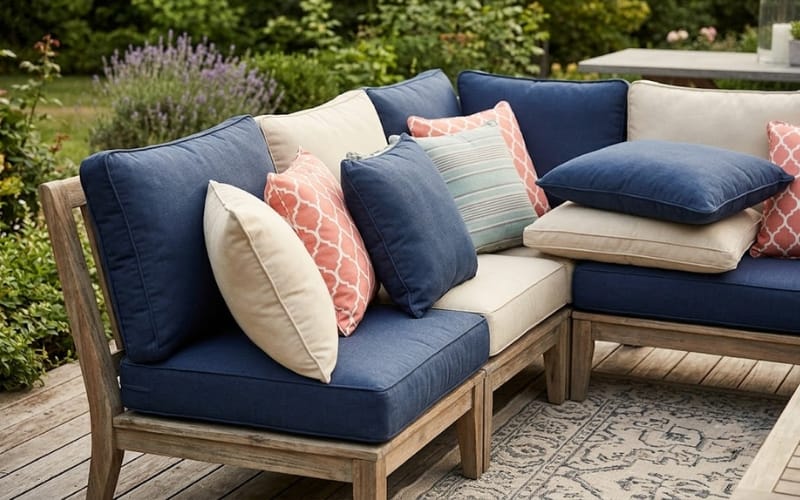
Outdoor furniture trends have shifted toward “deep seating,” which requires thicker and wider cushions than traditional dining chairs.
A typical comfortable couch on a terrace might use cushions that are 5 to 8 inches thick. This increased volume exponentially raises the cost.
Fabric Volume: A standard deep-seat chair requires roughly 3.5 yards of fabric. A 3-seater sofa can easily require 15+ yards.
Custom Labor: Custom-made cushions involve manual pattern-making. For every unique curve or corner, a skilled technician must adjust the CNC cutting machine or hand-cut the foam, increasing labor costs by 40-60% compared to standard, off-the-shelf sizes.
Craftsmanship: The Hidden Details of Durability
Professional-grade outdoor cushions are constructed with specialized components like UV-bonded thread and rust-proof zippers that are invisible to the eye but vital for longevity.
Standard nylon thread will literally disintegrate when exposed to UV rays for an extended period.
High-end manufacturers use PTFE (Teflon) or bonded polyester thread, which costs roughly $50 per spool—ten times the price of standard thread.
Additionally, the complexity of the design—such as boxed edges, self-piping (welting), and reinforced ties—adds hours to the sewing process.
Piping isn’t just a decorative “hook”; it acts as a structural reinforcement for the seams, preventing them from bursting under the pressure of weight.
These labor-intensive details are a major reason why premium retailers like Meet&Co Furniture command a higher price point for their outdoor collections.
Maintenance and the Total Cost of Ownership
Evaluating the cost of outdoor cushions requires a “per-year” analysis rather than a one-time purchase price.
While the initial price tag is high, the return on investment (ROI) is far superior to budget alternatives.
Data from consumer furniture reports indicates the following lifespan comparison:
Budget Cushions ($50-$150): Typically last 1-2 seasons before the foam flattens and the color fades.
Premium Cushions ($400-$700): Typically last 7-10 years with basic maintenance.
When you factor in the “replacement cost” of buying cheap cushions every two years, the premium option becomes 30% cheaper over a decade.
Furthermore, high-end cushions are treated with fluorocarbon finishes that repel oil and water, reducing the need for professional deep cleaning, which can cost $100+ per session.
Buying Guide: Finding the Sweet Spot
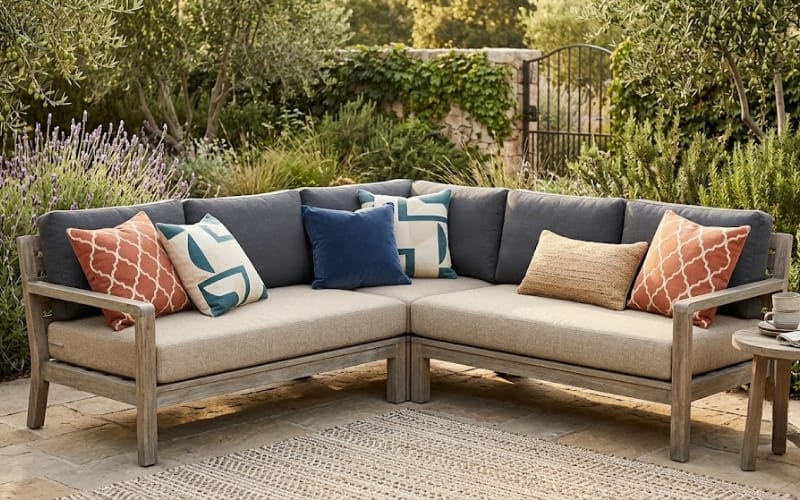
Investing in the right price range depends on your climate, usage frequency, and the specific material certifications provided by the retailer.
When searching for “where to buy outdoor couch cushions,” look for transparency in specs. A high-value purchase should offer:
Certification: Look for GREENGUARD Gold or Oeko-Tex labels, ensuring no harmful chemicals were used in the UV-treatment process.
Warranty: Reliable brands offer a minimum 5-year warranty against fabric fading.
Zipper Construction: Ensure zippers are made of heavy-duty plastic or marine-grade brass to prevent corrosion in salt-air environments.
Summary & Actionable Tips
Why outdoor couch cushions are so expensive is a direct result of the industrial-grade materials required to fight nature’s elements.
You are paying for chemical engineering, high-density reticulated foam, and UV-stable threading.
Expensive cushions provide a significantly lower long-term cost because they resist the mechanical and chemical breakdown caused by sun and rain.
Statistics show that 85% of budget cushions are discarded within 3 years due to mold or fading, whereas 92% of high-performance acrylic cushions remain in use after 5 years.
To maximize your investment, always store cushions in a dry box during the winter and use a mild, pH-neutral soap for spot cleaning.
Avoiding harsh detergents will preserve the fabric’s factory-applied water-repellent coating for several additional years.