






 Meet&Co
A successful training session depends on more than the quality of the instructor or the content being presented. The physical environment and supporting facilities also influence seating comfort, note‑taking experience, device operation, and activity‑mode transitions.
It is therefore critical to furnish training spaces with high‑quality chairs. While training chairs appear to be normal furniture items, details including tablet arms, casters, storage and nesting features have a major impact on the functional performance of a training room.
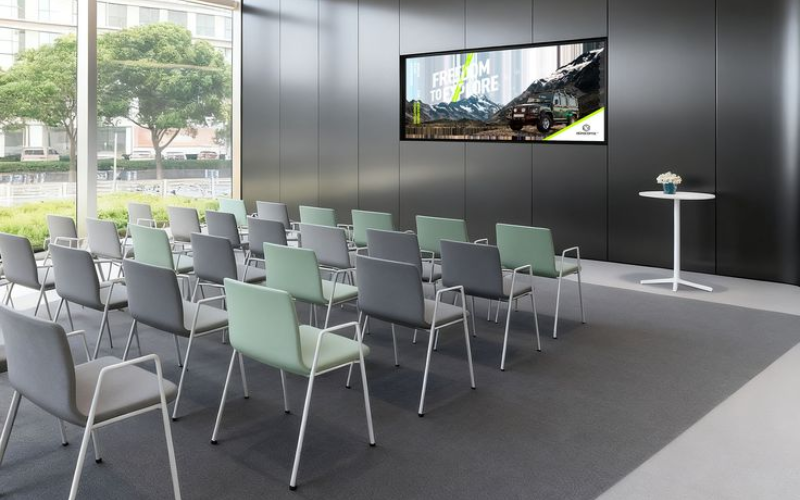
Rather than treating a training chair as simply a place to sit, it is more useful to consider how its design supports the activities taking place around it. Well‑designed seating allows rooms to support varied sessions, instead of being constrained by fixed‑desk layouts.
Key Takeaways
- A training chair with writing pad provides an individual work surface without installing a full-size desk.
- Tablet dimensions determine whether the chair supports handwriting, exams, tablets, or laptop-based training.
- Stackable and foldaway designs reduce storage volume and support faster room reconfiguration.
- Reinforced steel frames, tested load ratings, and replaceable components matter in institutional environments.
- Supplier evaluation should include certifications, inspection records, delivery terms, spare parts, installation, and warranty coverage.
Small Training Chair Details That Make a Big Difference
The most useful features of a training chair are not always the most visually obvious ones. A small writing surface, a place to store personal belongings, or a set of casters can change how participants interact with the chair and how quickly staff can reorganize the room.
● Training Chair With Writing Pad / Tablet
A training chair with an integrated writing pad or tablet arm combines seating and a personal work surface in one unit. This is particularly useful when participants need to take notes, read handouts, or use a laptop or tablet without requiring a full-size desk at every seat. The writing surface also gives each participant a clearly defined individual workspace.
The design of the tablet itself matters. Its size, height, stability, and position can affect whether participants can write comfortably or use a device without awkward posture.
Checking the manufacturer’s stated maximum load capacity for the tablet surface is also very important. A capacity of around 10–15 kg (22–33 lbs) can provide a practical margin for a laptop, books, and other learning materials, although the appropriate specification depends on the tablet’s size, structure, and intended use. The mounting mechanism should also be strong enough to keep the pad stable during writing or typing, particularly when users apply pressure to the surface.
Another noteworthy detail is that “writing pad,” “writing tablet,” “tablet arm,” and “training tablet” often used to describe similar products, but the construction can differ. A writing pad may refer to a compact surface intended mainly for paper and note-taking. A writing tablet usually describes a larger or more structured work surface that can accommodate a tablet computer, keyboard, or small laptop.
Feature | Compact Writing Pad | Training Writing Tablet |
Typical use | Notes and handouts | Notes, tablets, selected laptops |
Approximate width | 12–16 inches | 16–18 inches or customized |
Movement | Fixed or flip-up | Fixed, pivoting, or flip-up |
Storage | Chair stacking or folding | Chair stacking, nesting, or folding |
Reconfiguration | Fast | Fast to moderate |
Best application | Short sessions and exams | Training, seminars, and flexible classrooms |
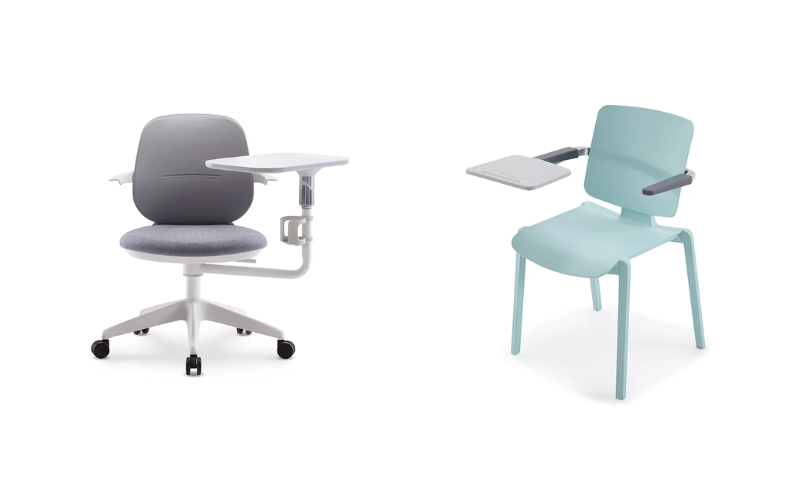
A larger tablet does not automatically provide a better user experience. Increasing the surface area can add weight to the chair, increase the turning radius, reduce aisle clearance, and create more stress at the mounting bracket. Buyers should compare the tablet’s usable area rather than its overall dimensions because rounded corners, cup holders, raised edges, and mounting hardware reduce the actual workspace.
● Training Chair With Under-seat Storage
Personal belongings can quickly become an overlooked problem in a busy training room. Bags, notebooks, coats and other small personal belongings often take up precious floor space and risk getting soiled. Training chairs with under-seat storage provide a designated place for some of these items while keeping the surrounding area relatively clear.
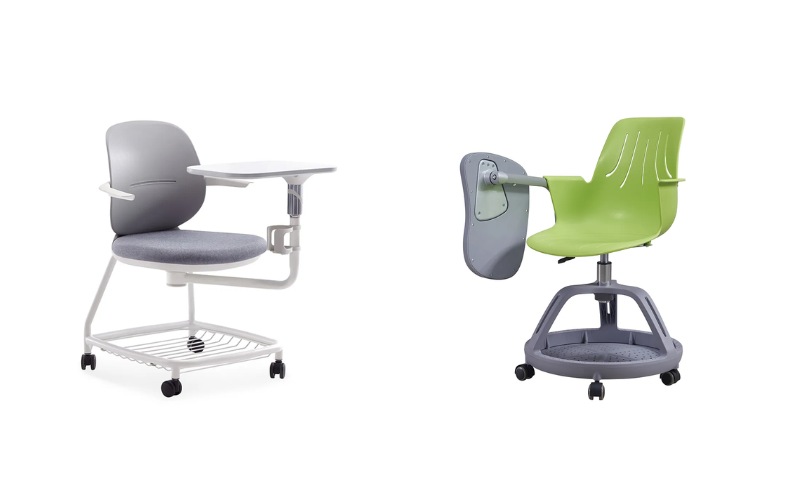
This feature is especially relevant in rooms where there is limited space between seating rows. The goal is not to turn the chair into a storage unit, but to provide a convenient solution for the small items participants need during a session.
● Training Chair With Casters
Mobility is another small detail with a surprisingly large effect on room flexibility. Chairs with casters can be moved more easily when participants need to form groups, turn toward a presenter, create discussion circles, or clear part of the room for an activity. This makes the seating itself part of the room’s reconfiguration process.
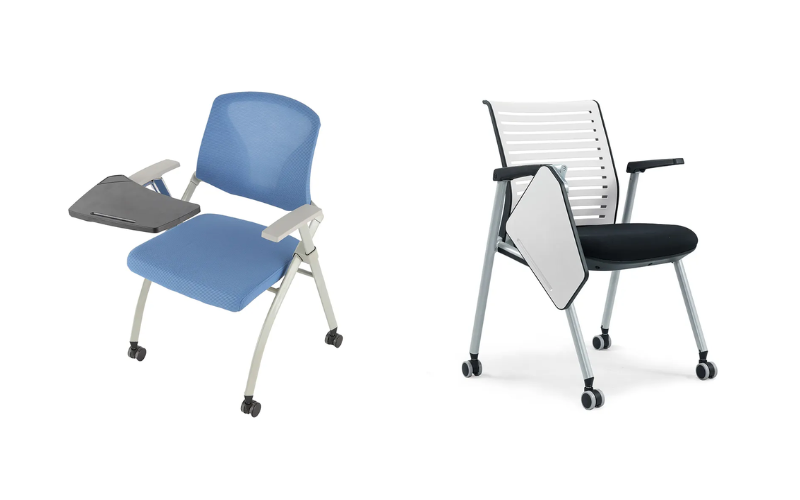
However, mobility should not come at the expense of stability. Casters need to support smooth movement while keeping the chair secure during normal use. The right balance allows a chair to move when needed but remain dependable once a participant is seated.
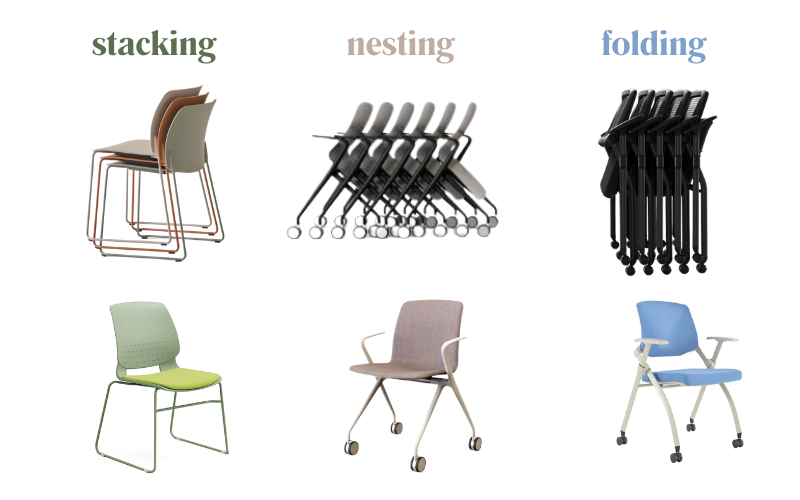
● Nesting, Stacking And Folding Training Chairs
Training rooms are rarely used in exactly the same way every day. A space may host a lecture in the morning, a workshop in the afternoon, and a group activity later in the day. Chairs that can be nested, stacked, or folded give facility managers more options when the room needs to change between different uses.
These mechanisms also influence storage efficiency. Nesting chairs can occupy less floor area when arranged together, while stacking and folding designs can make it easier to clear a room when the seating is temporarily unnecessary. The appropriate solution depends on how often the room is reconfigured and what type of storage area is available.
Ergonomic Training Room Chairs for Long Sessions
When participants remain seated for extended periods, the seat, backrest, seat height, and overall posture support can influence how well the chair accommodates the activity.
Ergonomic training chair does not necessarily mean adding complicated adjustment mechanisms. Proper seat proportions, supportive backrest design, adequate movement, and a comfortable writing position can already make a meaningful difference. The goal is to support a natural working posture without making the chair unnecessarily complex.
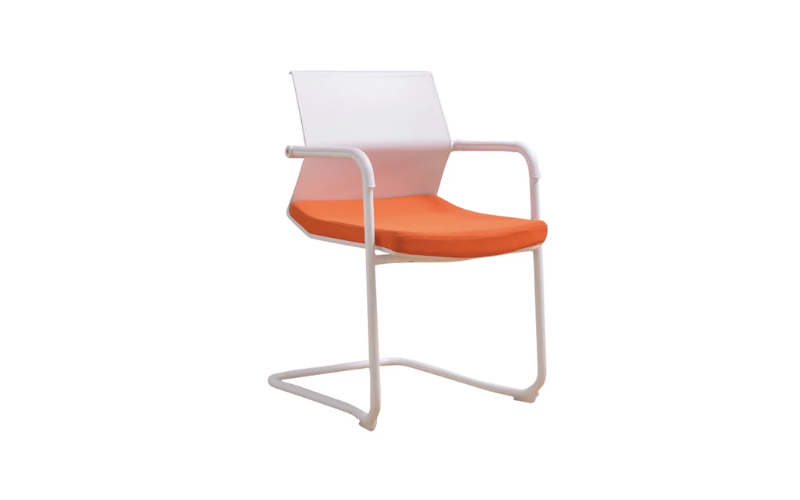
For training environments, ergonomics should also be considered together with mobility and writing surfaces. A chair may have a comfortable seat but still be inconvenient if its tablet arm forces users into an awkward position. Likewise, a highly mobile chair is less useful if its movement makes it difficult to maintain a stable working posture.
Training Chair With Writing Pad vs Separate Desk
A training chair with a writing pad and a conventional desk-and-chair setup serve slightly different purposes. A separate desk provides a larger and more stable working surface, making it useful when participants need multiple documents, larger laptops, books, or other materials. It also provides more freedom for arranging equipment on the work surface.
The advantage of a tablet-arm training chair is different. By combining the seat and writing surface, it can reduce the amount of furniture required in the room and make individual seating easier to move. This can be particularly useful when the primary activities involve listening, taking notes, short computer tasks, or group discussion.
Economic Benefits vs. Total Cost of Ownership
The initial price of a training chair is only one part of its financial impact. Basic chairs can seem like a cost‑effective choice for bulk orders. Yet their long‑term value diminishes when accounting for years of storage, maintenance, replacements and room reconfiguration. That said, maintenance costs are not entirely straightforward to compare. After all, the integrated mechanisms on functional training chairs tend to be more costly to repair than simple chairs.
We can assess long‑term spending with this formula: Total Cost of Ownership = Purchase Price + Freight + Installation + Storage Costs + Maintenance Parts + Labor − Residual Value.
For example, assume a chair with writing pad costs $120, freight and handling add $18, installation adds $8, and expected maintenance parts and labor total $12 over five years. The five-year cost is approximately $158 per chair before residual value. If a separate chair costs $55 and a desk costs $75, the initial furniture cost is already $130, before adding desk storage, room setup labor, and replacement costs.
Total cost of ownership is therefore a more useful way to evaluate training chairs for frequently used facilities. Instead of asking only, “How much does this chair cost?”, facility managers can also consider how the design affects daily use, storage, maintenance, durability, and the ability to adapt the room to different activities.
Conclusion
A training chair does not need to be complicated to be effective. What matters is whether its design responds to the real conditions of the space and the activities taking place within it. The right chair is not necessarily the one with the longest feature list, but the one whose features make sense for the way people learn, work, move, and interact in that particular space.
For professional buyers, the supplier decision should include model-specific testing, applicable certifications, inspection records, replacement parts, installation documents, warranty terms, delivery milestones, and ownership costs. Request a sample, complete a room-layout test, approve a written specification, and calculate freight, labor, maintenance, and storage before placing a bulk order.