





 Meet&Co
The modern coworking movement thrives on a paradox. Members flock to flexible workspaces for the energy of a community, yet they need quiet corners to take client calls, focus deeply, or work on confidential projects. Striking this balance is the defining challenge of community design in shared offices.
If a space feels too open, members struggle with noise and lack of privacy. If it becomes too compartmentalized, the sense of connection disappears. The solution lies in partitions—not as walls that separate, but as elements that subtly define zones while preserving visual and social connectivity.
In this guide, we’ll explore the best partition solutions, from semi-private zones to modular partitions, and show you how to create a layout that supports both focused work and spontaneous interaction.
Why Is Privacy Important in a Flexible Workspace?

Privacy in a coworking environment is not about isolation; it is about control. Members need to feel they have a place to retreat to without leaving the building. Research shows that a lack of acoustic and visual privacy is one of the top reasons people abandon shared workspaces.
Privacy serves three essential functions:
- Acoustic privacy: Reduces distracting noise, enabling deep work.
- Visual privacy: Allows members to work without feeling watched, which is crucial for sensitive tasks.
- Territorial privacy: Gives individuals a sense of ownership over their immediate environment.
When you address these needs with thoughtfully placed partitions, you increase member retention and satisfaction—turning a transient visitor into a loyal subscriber.
Also see: Modern Open Office Layouts: How to Balance Collaboration with Privacy Partitions
Top Partition Solutions for Coworking Spaces in 2026
Not all partitions are created equal. The best solutions for flexible workspaces are those that can adapt as the community grows. Here are the most effective options.
| Partition Type | Privacy Level | Key Benefit | Best For |
| Half-Height Screens | Low to Medium | Preserves sightlines while reducing noise | Open desks, breakout areas |
| Glass Partitions | Medium to High | Offers sound insulation without blocking light | Private offices, meeting rooms |
| Modular Systems | Adjustable | Fully reconfigurable; grows with the space | Rapidly changing floor plans |
| Mobile Plant Walls | Low to Medium | Adds biophilia; easy to reposition | Creating soft boundaries |
| Acoustic Curtains | Medium | Affordable, flexible, and great for sound absorption | Multi-purpose zones, event spaces |
Half-Height Screens: The Soft Boundary
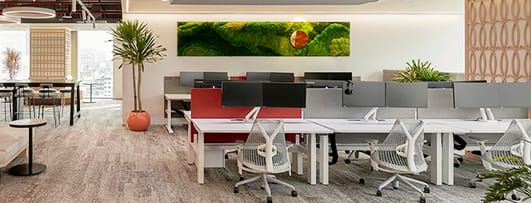
These are typically 110–140 cm tall, allowing seated privacy while letting people see over them when standing. They work well in open-plan desks to create semi-private zones without killing the community vibe. Materials like felt or fabric also absorb sound, addressing acoustic concerns.
Glass Partitions: Light-Filled Privacy
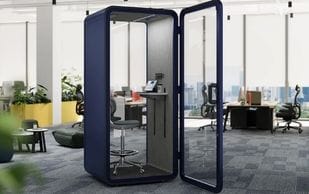
Full-height glass partitions with floor-to-ceiling frames offer the best of both worlds: soundproofing for phone booths or meeting rooms, yet complete visual transparency. Frosted or switchable smart glass can add an extra layer of visual privacy when needed.
Modular Partitions: The Future-Proof Choice
Modular partitions are freestanding panels that can be connected, separated, and reconfigured without tools. They are ideal for coworking spaces where membership numbers and layout needs shift frequently. You can start with a few panels to carve out a quiet nook and later expand into a full team suite.
Mobile Plant Walls: Biophilic Boundaries
Living walls on casters bring nature indoors while acting as visual buffers. Plants reduce stress, improve air quality, and soften the industrial feel of many shared offices. A row of planter boxes can subtly separate the “quiet zone” from the “collaboration zone” without a sense of barrier.
Acoustic Curtains: Instant Flexibility
For spaces that host events after hours, ceiling-track curtains allow you to open up the entire floor or quickly section off a quiet area. Heavy acoustic curtains can absorb up to 50% more sound than drywall, making them a practical tool for managing noise in flexible workspaces.
Also see: Freestanding vs. Folding vs. Glass Partitions: Which Is Right for Your Office?

How to Achieve “Dynamic Zoning” for Better Flow
Installing partitions without a zoning strategy can create a maze-like floor plan that confuses members. Instead, use community design principles to guide movement and activity.
1. Define Activity Zones
Map out three primary zones:
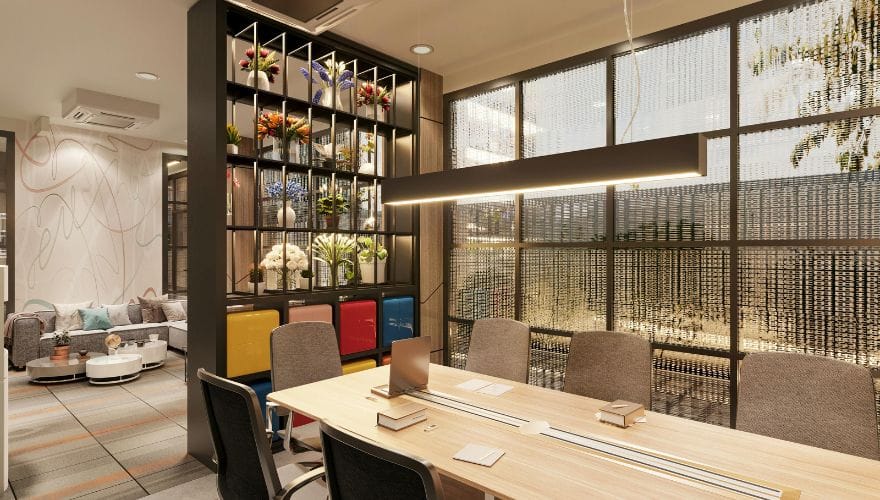
- Active Zone: High-energy collaboration, communal tables, and lounge areas. Use minimal partitions here—perhaps a mobile plant wall to soften edges.
- Quiet Zone: Deep work and individual focus. Use half-height screens or acoustic curtains to reduce noise and visual distractions.
- Semi-Private Zone: Small team meetings, phone calls, or private conversations. Glass booths or modular panels work best.
2. Create Gradual Transitions
Avoid abrupt shifts from loud to quiet. Place semi-private zones between active and quiet areas to act as a buffer. For example, a row of phone booths or a modular panel system can serve as a “transition layer” that catches sound before it reaches the silent area.
3. Keep Sightlines Intentional
The community feeling relies on occasional eye contact and visible movement. Even when using partitions, maintain key sightlines—such as a clear view to the entrance, the coffee bar, or a central gathering point. This ensures that privacy measures don’t create a sense of isolation.
What Are the Benefits of Modular Partitions?
Among all partition types, modular partitions stand out for coworking environments because they align with the very definition of flexible workspaces.
- Scalability: As you onboard new members, you can expand private areas without renovation.
- Cost Efficiency: Reconfiguring panels is far cheaper than building new drywall every time a layout changes.
- Sustainability: High-quality modular systems are reusable, reducing construction waste.
- Personalization: Panels come in various finishes—felt, glass, whiteboard surfaces—allowing you to match branding and functionality.
Many modular systems also integrate power and data cabling, so you can add outlets exactly where members need them without cutting into floors or walls.
How to Choose the Right Partitions for Your Coworking Space?
Selecting partitions involves balancing aesthetics, budget, acoustics, and adaptability. Use these criteria to guide your decision.
1. Assess Your Noise Profile
Walk through your space at peak hours. If noise is the biggest complaint, prioritize acoustic partitions like felt screens, double-glazed glass, or acoustic curtains. If visual distraction is the main issue, half-height screens or frosted glass may suffice.
2. Consider Future Growth
If you expect your membership to double in the next year, avoid permanent floor-to-ceiling walls. Instead, invest in modular partitions that can be reconfigured or mobile plant walls that can be moved to create new zones.
3. Match Aesthetics to Brand Identity
Partitions are not just functional—they are design features. A coworking brand that emphasizes nature may lean into living walls and wood-framed glass. A tech-focused space might prefer sleek metal frames and writable surfaces. Consistency in materials across partitions helps create a cohesive look.
4. Budget Wisely
- Low cost: Acoustic curtains, half-height screens, mobile planters.
- Medium cost: Modular panel systems, felt screens.
- High cost: Full-height glass partitions, custom joinery.
Often a combination of low and medium-cost solutions yields the best result, reserving high-cost elements for spaces that truly need acoustic isolation.
Frequently Asked Questions
1. How do I balance open community areas with enough private zones?
A common rule of thumb is to allocate 60% of the floor area to open, collaborative zones and 40% to private or semi-private zones. Use a mix of partition types to create a gradient: transparent glass near the social hub, transitioning to solid or high-felt screens deeper in the quiet zone. This way, members naturally gravitate to the environment that suits their task.
2. What is the most cost-effective way to add privacy to an existing coworking space?
The quickest and most budget-friendly approach is a combination of acoustic curtains and mobile plant walls. Curtains can be installed on ceiling tracks in a few hours, instantly creating bookable quiet nooks. Rolling planters or modular screens can then be positioned to break up sightlines without construction dust or downtime.
3. Can modular partitions really improve acoustics?
Yes, but it depends on the material. Modular partitions with felt, fabric-wrapped panels, or acoustic foam cores absorb sound, reducing reverberation. However, they are not soundproof. For true sound isolation—such as for podcast booths or private offices—you will need full-height glass or solid walls with sealed edges. For most coworking applications, the goal is to lower ambient noise to a comfortable level, which modular acoustic panels do effectively.
Wrapping Up
Designing a successful coworking space means mastering the art of balance. Semi-private zones, thoughtful modular partitions, and a clear zoning strategy allow you to offer the privacy members need without sacrificing the vibrant community they come for.
Start by assessing your space’s acoustics and growth plans. Then choose a mix of solutions—half-height screens for desk areas, glass for meeting rooms, and mobile plant walls to add life and flexibility. With the right partitions, your flexible workspace can become a place where focus and connection coexist seamlessly.
Need help selecting the right partitions for your coworking project? Contact our team for tailored recommendations.
_2.webp)