







 Meet&Co
You’ve invested in a quality ergonomic chair, adjusted it perfectly, and set up your dream home office. But there’s one thing you probably overlooked—the tiny wheels at the bottom of your chair.
Those unassuming casters are actually the only connection between your body and the floor. And if they’re wrong for your flooring, they’re silently causing problems. Maybe your chair feels like it’s stuck in mud on carpet, requiring extra effort to move. Or perhaps you’ve noticed fine scratches appearing on your beautiful hardwood floors. Worse, your chair might slide uncontrollably when you sit down, or wobble when you lean back.
The good news? This is one of the easiest problems to fix. Swapping your chair’s casters takes about five minutes and costs less than a nice dinner. This Meet&Co chair guide walks you through exactly which casters you need for hardwood versus carpet—and why it matters more than you think.
Why Caster Choice Matters for Your Health and Floor
Most people don’t realize that standard office chairs ship with casters designed for one specific surface: low-pile commercial carpet. If your home has anything different—hardwood, tile, laminate, or even plush residential carpet—those stock casters are probably wrong for you.
1. The Health Connection
When your chair doesn’t roll smoothly, your body compensates. If casters sink into carpet or skid on hardwood, you exert extra force to move or stabilize yourself. This involves your core, lower back, and legs in ways that lead to premature fatigue.
According to the U.S. National Institute for Occupational Safety and Health (NIOSH), musculoskeletal disorders often result from repetitive tasks and awkward postures. An unstable chair foundation adds a fourth risk factor: static load. When your body constantly micro-adjusts to an unstable chair, muscles remain in low-level contraction, restricting blood flow and causing that familiar afternoon ache in your lower back.
2. The Floor Protection Factor
Hardwood floors are expensive to install and even more expensive to repair. Standard hard plastic casters can trap grit and debris, acting like sandpaper as you roll. Over months, this creates micro-scratches that accumulate into visible trails. According to the National Wood Flooring Association, “Using inappropriate casters is one of the most common causes of avoidable hardwood floor damage in home offices”.
The Golden Rule of Caster Selection
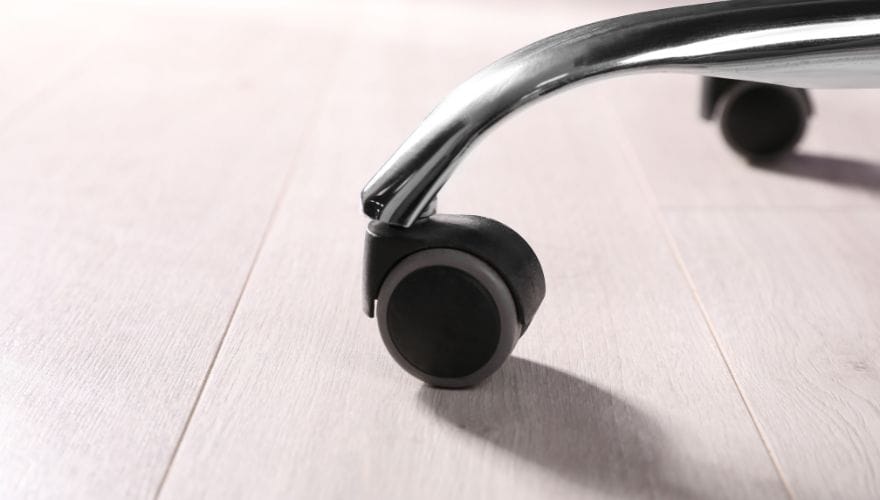
Here’s the fundamental principle: use soft wheels on hard floors and hard wheels on soft floors. This inverse relationship is the key to both floor protection and smooth mobility.
| Floor Type | Recommended Caster Material | Why It Works |
| Hardwood, Laminate, Tile | Soft Polyurethane | Protects finish, absorbs debris, quiet operation |
| Low-Pile Carpet | Hard Nylon/Plastic | Rolls over fibers without sinking |
| Medium/High-Pile Carpet | Hard Nylon (Large Diameter) | Prevents sinking, maintains mobility |
The Science Behind It
Caster performance comes down to material hardness, measured on the Shore A durometer scale :
- Hardwood surfaces require medium-soft polyurethane casters (around 55A–65A). This provides grip without marking, and the slight softness allows the wheel to roll over small debris instead of grinding it into your floor.
- Carpeted surfaces benefit from harder wheels (85A–95A). This prevents the wheel from deforming under weight, which would increase surface area and create “sinkage” into the carpet fibers.
How to Choose Casters for Hardwood Floors
If you have hardwood, laminate, tile, or polished concrete, you need soft casters—typically made from polyurethane or thermoplastic rubber (TPR).
What Makes a Good Hardwood Caster?
| Feature | Why It Matters |
| Soft material (PU or TPR) | Cushions impact, won’t scratch finish |
| Non-marking formulation | No residue or stains on flooring |
| Smooth rolling | Controlled movement without excessive slip |
| Debris absorption | Rolls over small particles instead of grinding them |
Standard hard plastic casters on hardwood are a disaster waiting to happen. They act like sandpaper, especially when grit gets trapped. Over time, they’ll dull your floor’s finish and create permanent scratches.
Top Hardwood Caster Recommendations
| Product | Material | Key Feature | Best For |
| Iris Ohyama Chair Casters | Thermoplastic Rubber (TPR) | Ultra-quiet, zero residue | General hardwood protection |
| Hbada Heavy-Duty TPR Wheels | Thermoplastic Rubber | 2.2″ size, 300+ lb capacity | Heavy users on hardwood |
| Gabrylly SilentRoll PU Casters | Polyurethane | Near-silent, anti-static | Noise-sensitive environments |
| Officemate Soft-Glide TPR Casters | Thermoplastic Rubber | Reinforced core, minimal noise | Value pick |
Real-World Example
Mark, an architect working from his 1920s Craftsman home, noticed fine scratches radiating from his desk within three months. The original nylon casters were slowly marring his original oak flooring. He replaced them with 2-inch TPR casters, and within a week, the scratching stopped. Two years later, his floors remain unblemished.
How to Choose Casters for Carpeted Floors
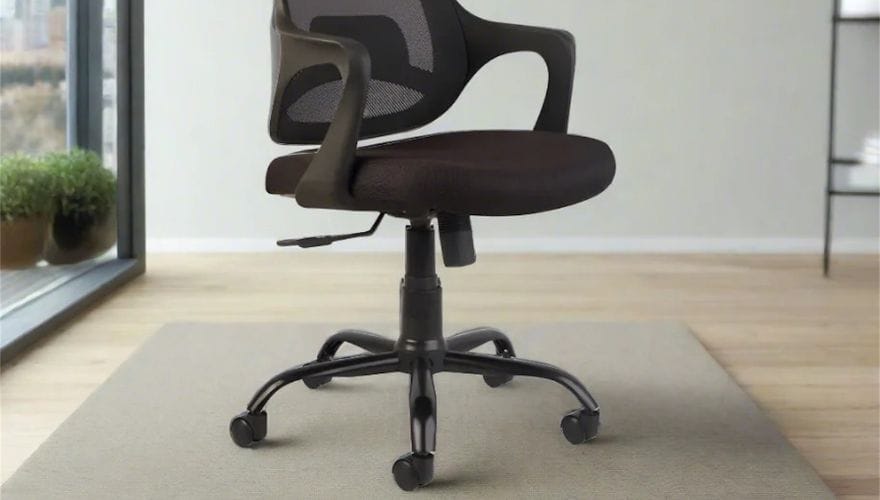
For carpet, you need hard casters—typically nylon or hard plastic. The goal is to roll over the carpet fibers, not sink into them.
The Carpet Challenge
Carpet presents the most complex challenge for chair stability. The depth of the pile and thickness of underlay determine how much a caster will sink.
For low-pile carpet (typical office carpet): Standard hard nylon casters work well. They’re durable and roll smoothly with minimal friction.
For medium to high-pile carpet (residential plush carpet): You need larger diameter wheels (2.5 inches or more). Larger wheels increase the “attack angle,” allowing them to roll over fibers rather than pushing through them. Dual-wheel designs also help by distributing weight across two contact points, reducing load per square inch by up to 50%.
Quick Comparison: Caster Types at a Glance
| Caster Type | Best For | Material | Floor Protection | Noise | Price |
| Carpet Casters | Low-medium pile carpet | Hard nylon/plastic | Poor on hard floors | Loud on hard floors | $ |
| Hard Floor Casters | Wood, laminate, tile, vinyl | Soft polyurethane/TPR | Excellent | Very quiet | $$ |
| Dual-Surface Casters | Mixed flooring | Hybrid soft coating | Excellent | Quiet | $$ |
| Rollerblade Style | Premium hard floors | Polyurethane wheels | Superior | Silent | $$$ |
| Locking Casters | Stationary work needs | Varies | Depends on material | Varies | $$-$$$ |
Legend: $ = Budget, $$ = Mid-range, $$$ = Premium
Also see: Best Office Chairs for Carpet in 2026
How Much Weight Can Your Casters Handle?
This is a critical safety consideration that most people overlook. Every caster has a maximum load rating. Exceeding it can cause wheel cracking or bearing failure.
1. Calculate Your Required Load Rating
Here’s a simple formula :
(Your Weight + Chair Weight + Any Attached Gear) ÷ Number of Casters × 1.25 = Minimum Load Rating Per Caster
The 1.25 multiplier adds a 25% safety margin, accounting for uneven weight distribution when you lean.
Example scenario:
- Your weight: 180 lbs
- Chair weight: 50 lbs
- Gear: 10 lbs
- Total: 240 lbs
- Casters: 5
Calculation: (240 ÷ 5) × 1.25 = 60 lbs minimum per caster
High-quality casters often support 100 lbs or more per wheel, easily meeting this requirement. Some heavy-duty options support up to 130 lbs per wheel or 550 lbs per set.
2. Installation: Swapping Casters in 5 Minutes
Good news: replacing casters is one of the easiest DIY upgrades you’ll ever do.
Step-by-Step Guide
- Flip the chair upside down on a soft surface (rug or towel) to protect the frame and floor.
- Remove old casters: Grip each wheel firmly and pull straight down. If stuck, wiggle gently or use a flathead screwdriver wrapped in cloth for leverage.
- Clean the socket: Wipe any dust or debris from the mounting hole.
- Insert new casters: Align the stem with the socket and press firmly until it clicks into place. You should feel resistance followed by a secure fit.
- Test roll: Turn the chair upright and roll it across different areas of your floor.
3. Universal Fit?
Most office chairs use a standard 7/16-inch (11mm) diameter stem with a length of about 7/8 inch (22mm). This fits approximately 99% of office chairs. However, premium brands like Herman Miller may use specific stems, so check compatibility if you own a high-end chair.
Tip: Test one caster first. Roll the chair in a discreet corner for 24–48 hours to check for noise, resistance, or marking before committing to all five.

Advanced Options: Beyond Basic Casters
1. Dual-Surface Casters
If your home office has both carpet and hardwood—or if you might move rooms in the future—consider dual-surface casters. These hybrid designs use soft coatings that perform adequately on both surfaces. While they may not excel as much as specialized casters on either surface, they offer genuine versatility.
2. Rollerblade-Style Casters
These single-wheel casters use larger, wider polyurethane wheels inspired by inline skates. They’re popular in creative studios because they :
- Don’t collect hair and debris like twin-wheel designs
- Roll exceptionally smoothly over small cracks or cables
- Offer a modern aesthetic
- Are exceptionally gentle on delicate floors
3. Locking Casters
For tasks requiring absolute stability—recording audio, detailed design work, or presentations—locking casters prevent any chair movement. A simple lever on one or two casters anchors you in place.
How to Maintain Office Casters?
Your new casters aren’t “set it and forget it.” Simple maintenance prevents floor damage and extends caster life :
| Frequency | Task |
| Monthly | Wipe wheels with cloth; remove hair/debris from axles |
| Quarterly | Inspect for cracks, flat spots, or increased resistance |
| As needed | Clean with mild soapy water and soft brush (avoid harsh chemicals) |
A common oversight is hair and dust buildup in the caster housing. This can seize the swivel mechanism within 3–6 months, causing jerky movements that create sudden spinal jolts.
Common Mistakes to Avoid
| Mistake | Why It’s Problematic | Better Approach |
| Using carpet casters on hardwood | Scratches and marks floors permanently | Switch to soft polyurethane/TPR casters |
| Using soft casters on thick carpet | Wheels sink, chair becomes difficult to move | Use hard nylon with larger diameter |
| Ignoring weight capacity | Casters can crack or fail under load | Calculate required rating with safety margin |
| Buying without checking stem size | Casters won’t fit or will wobble dangerously | Measure old caster stem (standard is 7/16″) |
| Never cleaning casters | Debris buildup causes jerky movement, floor scratches | Clean monthly, remove hair from axles |
FAQ
1. Can I use carpet casters on my hardwood floor if I’m careful?
No—it’s strongly discouraged. Even careful use will eventually scratch and dull the finish. The hard plastic acts like sandpaper, especially with any debris present.
2. Do soft casters work on carpet?
Yes, but with more resistance. They’ll roll, but you’ll exert more effort. For best performance on carpet, stick with hard carpet casters.
3. How do I know what casters my chair needs?
Check your floor type first. Hardwood? Soft polyurethane. Carpet? Hard nylon. If unsure or you have both, consider dual-surface casters.
4. How much do quality casters cost?
Hard floor casters typically range from $20–50 per set. Premium rollerblade-style or heavy-duty options run $50–100. Given they protect floors costing thousands, it’s money well spent.
5. How long do casters last?
With proper use on the correct surface, quality casters last 3–5 years or longer. Factors like weight, floor cleanliness, and rolling frequency affect lifespan.
6. Will new casters fit my chair?
Most chairs use standard 7/16″ (11mm) stems. Check by pulling one out and measuring, or verify compatibility before buying.
7. What are the best casters for mixed flooring?
Dual-surface casters (sometimes called freestyle casters) are designed for both carpet and hard floors. While they may not be absolute best on either, they offer genuine versatility.
Conclusion
The right casters transform your office chair experience. On hardwood, soft polyurethane wheels protect your investment and glide silently. On carpet, hard nylon wheels roll effortlessly without sinking.
This five-minute, $30 upgrade delivers immediate benefits:
- Your floors stay pristine—no scratches, no marks, no regrets
- Your chair moves smoothly—no more fighting to reposition
- Your body works less—reduced strain means better focus
- Your workspace looks better—no bulky floor mat required


