





 Meet&Co
You’re on an important video call, trying to sound professional, when your partner walks through the background in pajamas. Or perhaps you’re drafting a sensitive document while your family watches TV in the same open-plan living space. Sound familiar?
For millions of remote workers, the dream of working from home has collided with the reality of shared spaces. Privacy isn’t just about confidentiality—it’s about focus, professionalism, and the psychological boundary between work and home life. When those boundaries blur, stress rises and productivity falls.
The good news? You don’t need to knock down walls or hire a contractor to create a private workspace. With the right furniture, clever layouts, and a few strategic additions, you can carve out a dedicated work zone in almost any home. Our guide covers practical, affordable solutions that deliver privacy without permanent changes—perfect for renters, small spaces, and anyone who wants flexibility.
Why Privacy Matters in a Home Office
| Challenge | Impact |
| Visual distractions | Family members passing behind you breaks focus and interrupts calls |
| Background noise | Household sounds bleed into meetings, reducing professionalism |
| Sensitive conversations | Client calls, performance reviews, or confidential work feel exposed |
| Work-life boundary | Seeing your desk from the couch makes it hard to “clock out” |
According to a 2026 workplace study, remote workers who have a designated, visually separated workspace report 40% higher satisfaction and significantly lower stress than those working in open, multi-use areas. Privacy isn’t a luxury—it’s a productivity essential.
Solution 1: Freestanding Privacy Screens and Room Dividers
Freestanding screens are the workhorses of home office privacy. They require no installation, move when you need them, and come in a range of styles to match your decor.
Types of Privacy Screens
| Type | Best For | Pros | Cons |
| Folding screens (2–4 panels) | Blocking background views, defining zones | Portable, decorative, no installation | Limited height, minimal sound blocking |
| Acoustic panels on stands | Reducing noise bleed, home offices near living areas | Absorbs sound, professional look | Heavier, less decorative |
| Desk-height screens | Creating privacy while seated, Zoom background | Compact, affordable, fits small spaces | Only blocks seated view |
| Floor-to-ceiling tension screens | Full visual separation in rental spaces | No drilling, complete privacy | Requires proper floor-to-ceiling fit |
What to Look For
- Height: For seated privacy, 48–60 inches works. For full separation, look for 72+ inches.
- Base stability: Weighted bases prevent tipping—important if you have pets or children.
- Material: Fabric screens absorb sound; wood or metal offer durability but reflect noise.
- Portability: Casters make moving easy; hinged panels fold flat for storage.
Top Placement Ideas
- Behind your desk to block kitchen or living room views during calls
- Between your desk and a doorway to signal “do not disturb”
- Creating a U-shape around your desk for full visual enclosure
Solution 2: Bookshelves as Room Dividers
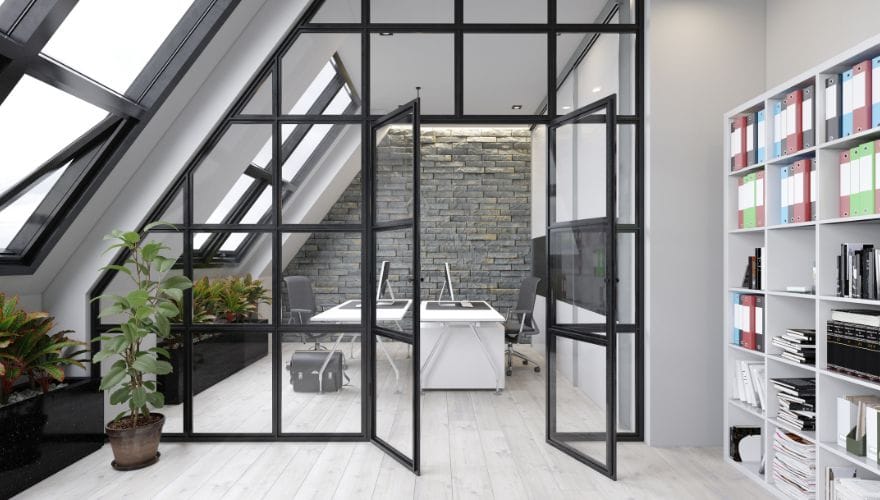
A bookshelf is one of the most elegant ways to divide a room. It creates visual separation while adding storage and personality. The key is choosing the right type and positioning it strategically.
Bookshelf Division Strategies
| Approach | How It Works | Best For |
| Full-height bookshelf | Freestanding unit placed perpendicular to wall | Larger rooms, creating distinct zones |
| Double-sided shelves | Open shelves that look good from both sides | Shared spaces, maintaining light flow |
| Modular cube systems | Stackable units that can be configured to your space | Rental flexibility, custom heights |
| Low bookshelf (4–5 ft) | Blocks seated view while maintaining openness | Small spaces, preserving light |
What to Look For
- Depth: Standard bookshelves (12–14 inches) work well. For better sound blocking, consider deeper units or fill with books.
- Stability: Anchor tall units to the wall if you have children or live in earthquake zones.
- Open vs. closed back: Open-back shelves preserve light; closed-back offer more privacy.
- Material: Solid wood or MDF blocks sound better than wire or open metal.
Styling Tips
- Fill shelves with books, plants, and decor to create a “wall” that feels intentional
- Leave gaps at the top to maintain light flow and visual connection
- Use matching units on both sides of a room to create a hallway effect
Solution 3: Curtains and Drapes
Curtains offer surprising versatility as room dividers. They’re affordable, easy to install, and can be opened or closed in seconds—perfect for spaces that need to switch between private and open.
Curtain Division Options
| Type | How It Works | Best For |
| Ceiling-mounted track | Curtains hang from track mounted to ceiling | Full room division, rental-friendly (no wall damage) |
| Tension rod | Rod that presses between walls or between floor and ceiling | Small spaces, temporary setups |
| Freestanding curtain frame | Curtains hang from a self-supporting frame | Open floor plans, no mounting at all |
| Sliding panel system | Rigid fabric panels that slide like doors | Modern aesthetic, cleaner look |
What to Look For
- Fabric weight: Heavier fabrics (velvet, canvas, blackout) block light and sound better than lightweight cotton.
- Length: Floor-to-ceiling curtains create the strongest visual separation.
- Opacity: Blackout or room-darkening curtains offer full privacy; sheer options provide gentle separation with light flow.
- Track quality: For ceiling mounts, look for smooth-gliding systems that can support fabric weight.
Installation Without Drilling
- Tension rods: Expand between walls or floor to ceiling—no tools required
- Adhesive hooks: Heavy-duty adhesive hooks can support lightweight curtains (check weight limits)
- Freestanding frames: Curtains hang from a self-supporting frame that sits on the floor
Solution 4: High-Back Furniture
Sometimes the best privacy solution is built into the furniture itself. High-back sofas, tall bookcases, and strategic furniture placement can create natural boundaries without adding anything new.
Furniture as Privacy
| Furniture Type | How It Creates Privacy | Best For |
| High-back sofa or armchair | Blocks sightlines behind you during calls | Living room offices, Zoom backgrounds |
| Tall bookcase | Acts as a room divider while adding storage | Separating desk from living areas |
| Desk with integrated privacy panel | Built-in screen blocks view from doorways | Compact home offices |
| Storage credenza | Placed behind desk, blocks entry views | Entryway offices, studio apartments |
Strategic Furniture Placement
- Desk facing away from room: Place your desk so you face a wall, not the main living area—your back is to the room, and anyone walking behind you isn’t on camera.
- Sofa back to desk: Position a sofa with its back to your desk, creating a natural boundary between work and living zones.
- Bookshelf as anchor: Use a tall bookshelf to define the edge of your work zone, with your desk tucked behind it.
Solution 5: Acoustic Treatments for Sound Privacy
Visual privacy matters, but so does sound. If household noise bleeds into your calls or you’re worried about being overheard, acoustic treatments can help.
Sound Solutions Without Construction
| Solution | How It Works | Best For |
| Acoustic panels | Fabric-wrapped foam panels absorb sound | Reducing echo, dampening voices |
| Heavy rugs | Absorb footstep and room noise | Hardwood floors, apartments |
| Weatherstripping | Seals gaps around doors | Blocking sound from hallway or adjacent rooms |
| Door draft stopper | Filled fabric tube at door base | Blocking sound under door |
| Books filled shelves | Books are natural sound absorbers | Bookshelf dividers, wall units |
Quick Acoustic Fixes
- Add a thick rug under your desk and chair
- Hang heavy curtains even if you don’t close them—they absorb sound
- Position bookshelves along shared walls to dampen noise from neighbors
- Use a white noise machine or fan during sensitive calls
Comparison: Privacy Solutions at a Glance
| Solution | Privacy Type | Cost | Installation | Flexibility | Best For |
| Folding screen | Visual | $ | None | High | Quick privacy, Zoom backgrounds |
| Bookshelf divider | Visual | $$ | Minimal | Medium | Permanent zones, storage |
| Ceiling track curtains | Visual + sound | $$ | Low (mounting) | High | Full room division |
| Tension rod curtains | Visual | $ | None | High | Temporary, rental-friendly |
| High-back furniture | Visual | $$-$$$ | None | Medium | Dual-purpose spaces |
| Acoustic panels | Sound | $$ | Low | Medium | Noise control, echo reduction |
| Weatherstripping | Sound | $ | Low | Permanent | Door gaps, sound leakage |
*Cost: $ = under $100, $$ = $100–300, $$$ = over $300*
Creating Visual Boundaries: Work vs. Living Zones
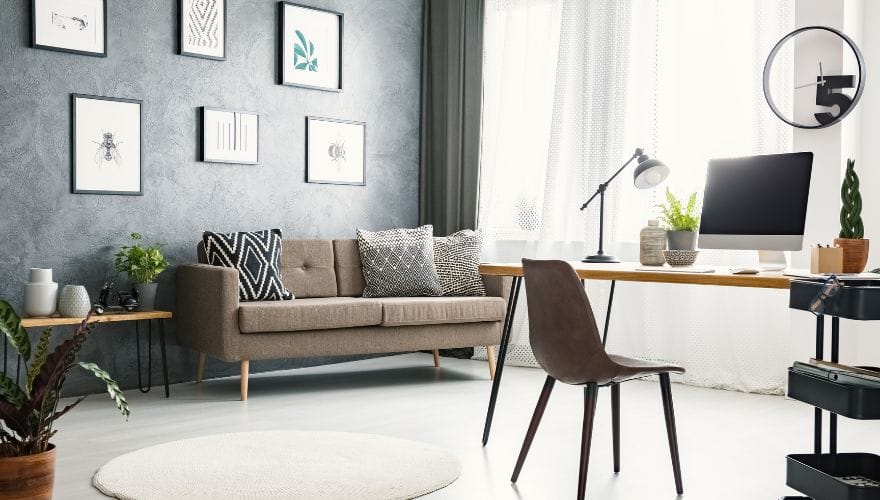
Even if you can’t fully enclose your workspace, visual cues help separate work from home life. When you can see your desk from the couch, your brain never fully disconnects. Here’s how to create psychological boundaries.
Visual Separation Strategies
- Use color: Paint your work wall a different color or add a large area rug that defines the work zone
- Lighting zones: Use task lighting for your desk that creates a distinct pool of light, separate from ambient room lighting
- Plant barriers: Tall plants or plant stands create natural, attractive boundaries
- Art as divider: Hang a large piece of art behind your desk that visually anchors the space
The “End of Day” Ritual
Physical boundaries work best when paired with behavioral ones. Create a routine that signals the workday is over:
- Close your laptop and put it away
- Pull a curtain or fold your screen
- Move your chair to a “neutral” position
- Change from work clothes to home clothes
FAQ
1. What’s the cheapest way to create home office privacy?
A tension rod with a lightweight curtain costs under $50 and requires no tools. For even less, a folding screen can be found for $60–100. For sound privacy, a door draft stopper ($10–20) and weatherstripping ($10) make a noticeable difference.
2. Can I create privacy in a studio apartment?
Yes. Use a combination of a tall bookshelf or freestanding screen to define the work zone, position your desk facing a wall (not the bed), and use lighting to create separate zones. Ceiling-mounted curtain tracks work well in studios.
3. How do I add privacy without blocking natural light?
Frosted or sheer curtains, open-back bookshelves, and low screens (4–5 feet) maintain light flow while providing seated privacy. Consider placing your divider perpendicular to windows rather than across them.
4. What’s the best solution for Zoom background privacy?
A folding screen behind your desk is ideal—it creates a professional backdrop and blocks any household activity behind you. Desk-height screens also work if you need to block views from the side.
5. Can I use multiple privacy solutions together?
Absolutely. Many home offices combine a bookshelf divider with a ceiling curtain track—the bookshelf provides permanent separation; the curtain offers on-demand enclosure. This layered approach gives you flexibility for different work modes.
6. How do I soundproof a home office without construction?
Focus on sealing gaps first (door sweeps, weatherstripping). Add soft surfaces (rugs, curtains, acoustic panels) to absorb sound. For voice privacy, a white noise machine outside your door masks conversation.
7. What if I need to share the space with family during the day?
Create a “bookable” system—a curtain or screen that closes when you’re on calls, opens when you’re done. Use visual signals (like a sign or light) to indicate when you shouldn’t be interrupted.
Conclusion
Home office privacy doesn’t require renovation or a dedicated room. With the right combination of screens, furniture, and acoustic treatments, you can create a focused, professional workspace in almost any home.
Start by identifying your biggest privacy challenge:
- Visual distractions on calls: A folding screen or high-back furniture behind your desk
- Noise from household: Weatherstripping, door sweeps, and acoustic panels
- No dedicated room: Bookshelf dividers or ceiling curtains to carve out a zone
- Blurred work-life boundaries: Visual separation and end-of-day rituals
Mix and match solutions based on your space, budget, and needs. Most home offices benefit from a layered approach—curtains for on-demand privacy, a screen for Zoom backgrounds, and rugs for sound absorption.
The goal isn’t to build a fortress. It’s to create a space where you can focus when needed, disconnect when the workday ends, and maintain professionalism during calls—all without permanent changes that complicate renting or future moves.
Your home office should work for you, not against you. With these solutions, it will.