






 Meet&Co
You’ve made the decision: your office needs pods. The open-plan layout isn’t working for private calls, focused work, or small meetings. But now you face a new question: what size pod do you actually need?
Walk into any office furniture showroom, and you’ll find an overwhelming array of options. Single-person phone booths that look like sleek telephone boxes. Double pods designed for quick collaboration. Team-sized meeting rooms on wheels that seat four to six people. Each serves a different purpose, and choosing wrong means either wasting space on a pod that’s too large or creating a cramped experience with one that’s too small.
Meet&Co breaks down the three main office pod sizes—single, double, and team—and helps you match them to your workplace needs. By the end, you’ll know exactly which sizes to order and how many of each your office requires.
Why Office Pod Size Matters More Than You Think
The wrong pod size creates problems that go beyond simple discomfort:
| Issue | Too Small | Too Large |
| User experience | Cramped, claustrophobic | Feels empty, underutilized |
| Space efficiency | May work for one use but not others | Eats up valuable floor space |
| Usage patterns | Gets abandoned if uncomfortable | Sits empty because it feels “too much” |
| Cost per use | Wasted investment if wrong fit | Higher upfront cost, lower utilization |
The goal is matching pod size to the actual activities that will happen inside. A pod that’s perfect for a 15-minute private call is miserable for a two-hour strategy session. A team pod that works for project meetings is overkill for a quick HR conversation.
Single Pods: The Focus and Privacy Solution
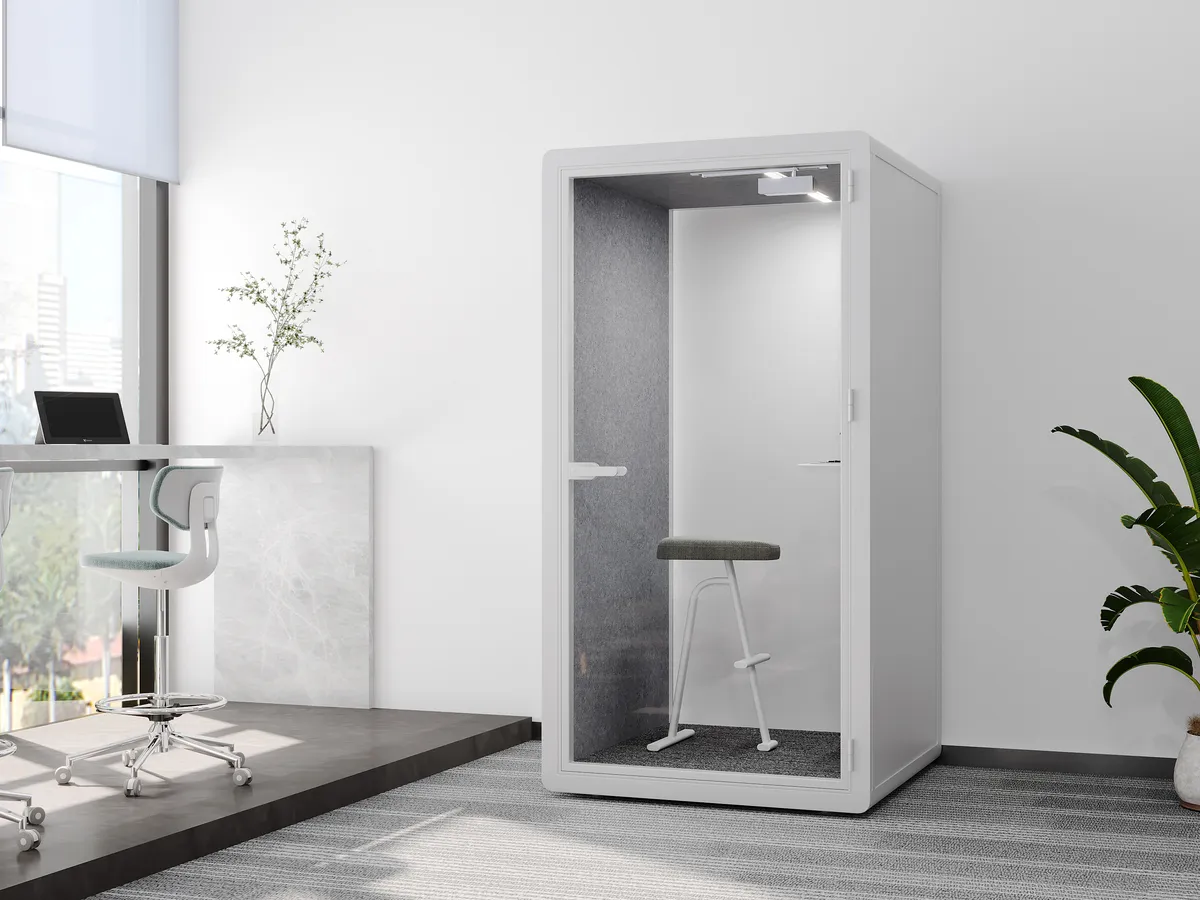
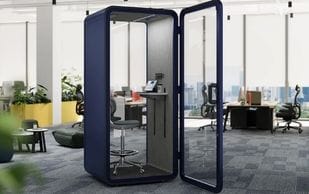
Meet&Co Office Pod Series A
What They Are
Single pods are compact, enclosed spaces designed for one person. Typical footprints range from 4’x4′ to 4.5’x4.5′ (16–20 square feet). They include a small desk or shelf, power outlets, ventilation, and often a simple seat—sometimes a stool, sometimes a small chair.
What They’re Best For
| Use Case | Why It Works |
| Private phone calls | Isolates conversations, prevents spillover noise |
| Video conferences | Quiet background, professional appearance on camera |
| Focused work sessions | Blocks visual distractions for 30–90 minute blocks |
| Quick confidential discussions | Manager-employee check-ins, HR conversations |
| Noise-sensitive tasks | Audio editing, detailed analysis, coding sprints |
What to Look For
- Ventilation: Single pods need active ventilation to prevent stuffiness. Look for fans rated at 20+ liters per second.
- Seat comfort: If used for longer than 30 minutes, a proper chair matters—not a backless stool.
- Table space: Enough for a laptop and notepad (minimum 24 inches wide).
- Acoustic rating: DS,A 30–35 for speech privacy during calls.
How Many Do You Need?
Industry benchmarks suggest 1 single pod per 20–30 employees in open-plan offices. For call-heavy teams (sales, support, recruiting), increase to 1 per 10–15 employees.
Who Should Consider Single Pods
- Open offices with high call volume
- Teams with remote or hybrid workers needing quiet video spaces
- Any workplace where employees currently take calls at their desks
Also see: Top 10 Best Office Phone Booths in 2026
Double Pods: The Collaboration Sweet Spot
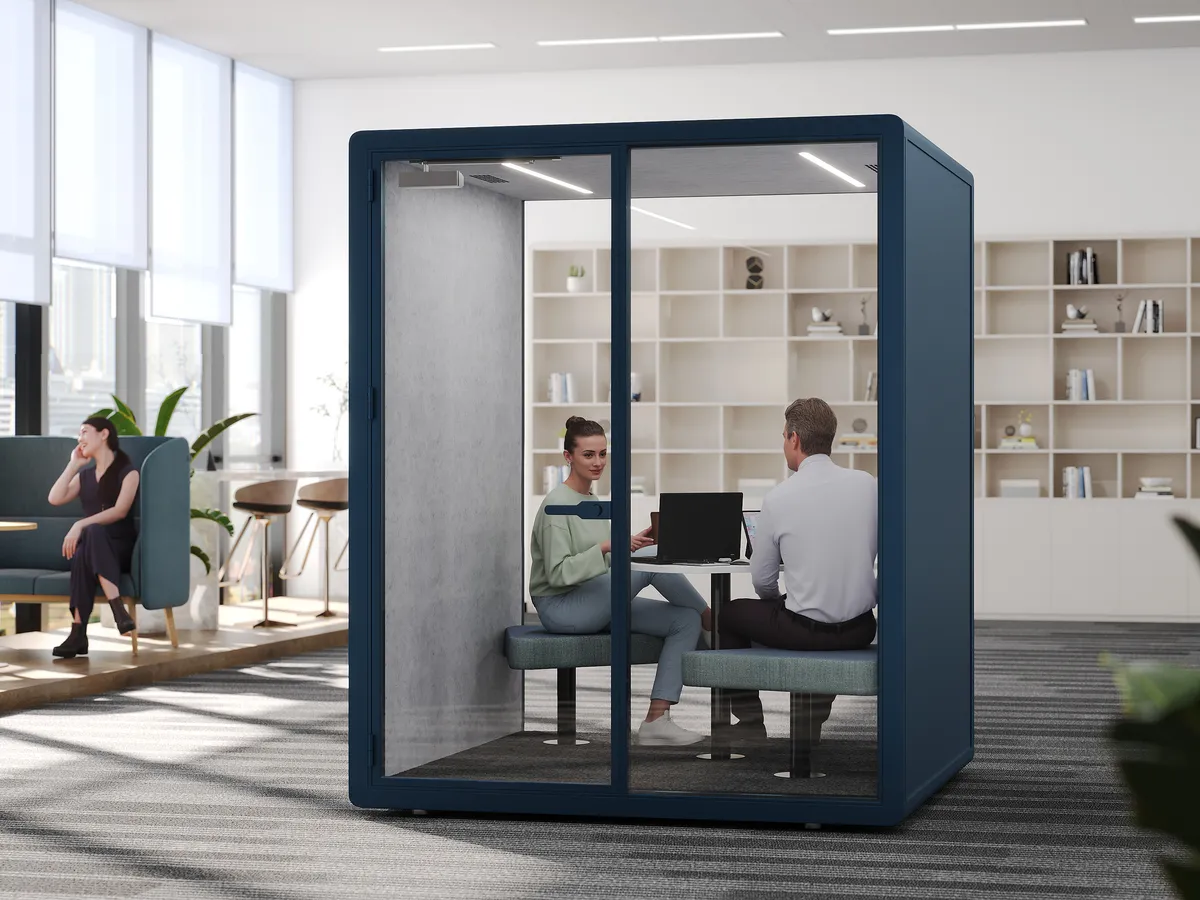
Meet&Co Office Pod Series A
What They Are
Double pods accommodate two people comfortably, typically with a 5’x5′ to 6’x6′ footprint (25–36 square feet). They include a small table, two chairs, power for both users, and upgraded ventilation compared to single pods. Some models feature a whiteboard on one wall or a small display mount.
What They’re Best For
| Use Case | Why It Works |
| One-on-one meetings | Manager-employee check-ins, performance reviews |
| Pair programming | Developers working together on code |
| Quick client calls | Two people joining a video call together |
| Peer collaboration | Design reviews, document editing, brainstorming |
| Interview space | Candidate interviews without booking a full conference room |
What to Look For
- Acoustic separation: Double pods need higher isolation since conversations are two-way. Look for DS,A 35+.
- Screen visibility: Ensure the table placement allows both users to see a laptop screen or mounted display.
- Entry/exit: Door width matters for two people entering together—minimum 28 inches.
- Table size: At least 36 inches wide to accommodate two laptops and notes.
How Many Do You Need?
For most offices, 1 double pod per 30–40 employees works well. If you have many manager-direct report meetings or pair-intensive teams (design, development), increase to 1 per 20–25 employees.
Who Should Consider Double Pods
- Organizations with frequent one-on-one meetings
- Tech companies with pair programming culture
- Any office where employees currently take two-person meetings in open areas
Also see: Where to Buy Modern Office Pods: A 2026 Complete Buyer’s Guide
Team Pods: The Small Meeting Room Alternative
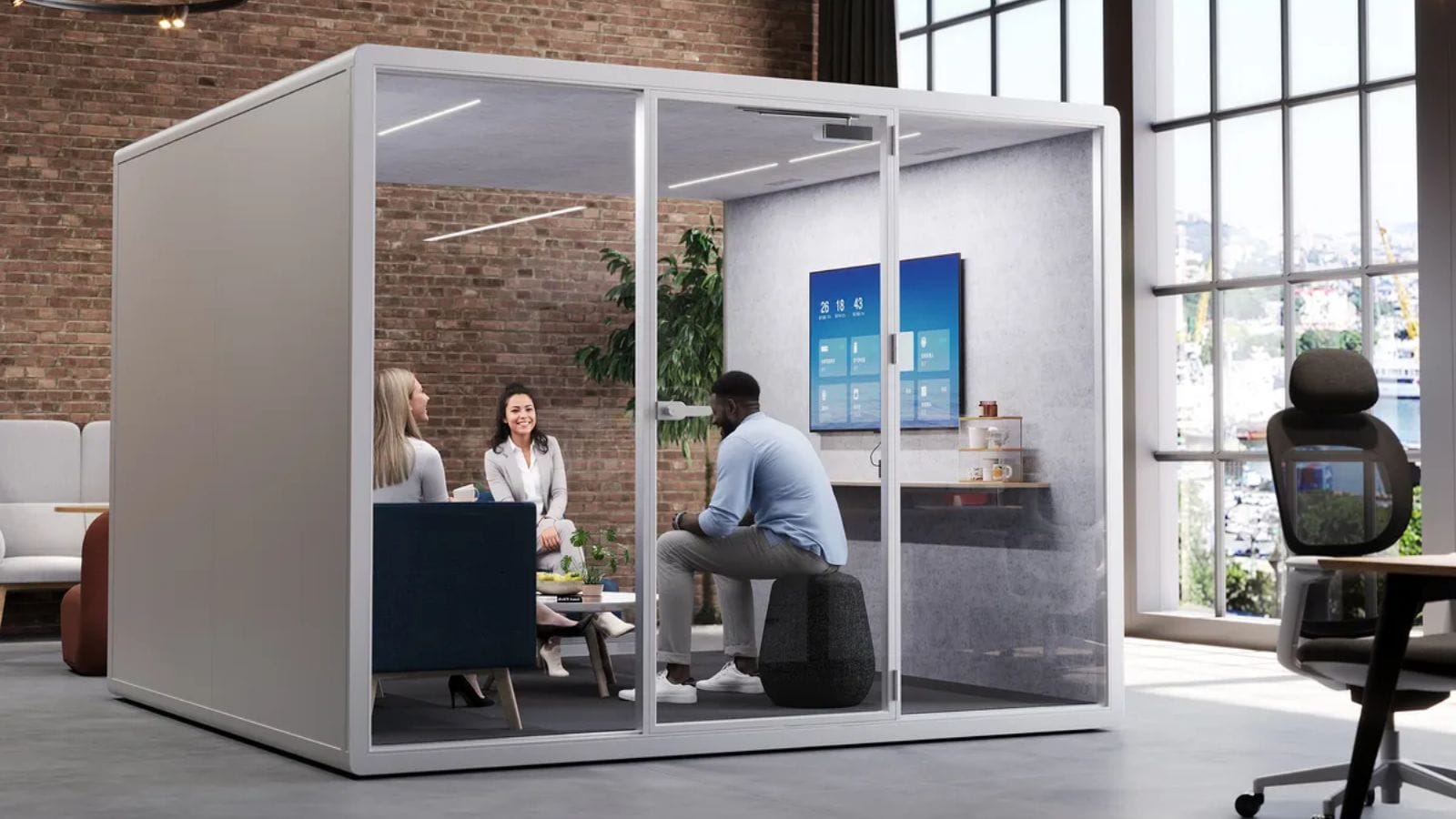
What They Are
Team pods accommodate 4–6 people, with footprints ranging from 7’x7′ to 8’x10′ (49–80 square feet). They function as small, portable meeting rooms—complete with a larger table, 4–6 chairs, integrated power, and often AV equipment. Premium models include mounted displays, camera mounts, and enhanced acoustic treatment.
What They’re Best For
| Use Case | Why It Works |
| Small team meetings | Project stand-ups, design reviews |
| Hybrid collaboration | Teams with remote members joining via video |
| Client presentations | Small group presentations without full conference room |
| Brainstorming sessions | Enclosed space for open discussion |
| Training or onboarding | Small group instruction |
What to Look For
- AV integration: Built-in display, camera, and microphone ports are essential for hybrid meetings.
- Ventilation: Team pods require active HVAC—passive ventilation isn’t enough for 4+ people.
- Acoustic performance: Critical for meetings where sensitive information is discussed. Look for DS,A 35+.
- Fire safety: Some jurisdictions require sprinklers or fire suppression for enclosed spaces of this size.
- Door accessibility: Ensure the door is wide enough (32+ inches) for ADA compliance.
How Many Do You Need?
Most offices need 1 team pod per 40–60 employees. If your organization has many small teams or uses hybrid collaboration extensively, consider increasing to 1 per 30 employees.
Who Should Consider Team Pods
- Organizations with hybrid work models requiring video-enabled meeting spaces
- Teams that need small-group collaboration space but lack dedicated meeting rooms
- Offices where traditional meeting rooms are constantly booked
Comparison: Single, Double, and Team Pods at a Glance
| Factor | Single Pod | Double Pod | Team Pod |
| Typical capacity | 1 person | 2 people | 4–6 people |
| Footprint | 4’x4′ to 4.5’x4.5′ | 5’x5′ to 6’x6′ | 7’x7′ to 8’x10′ |
| Square footage | 16–20 sq ft | 25–36 sq ft | 49–80 sq ft |
| Typical uses | Private calls, focus work | One-on-ones, pair work | Team meetings, hybrid calls |
| Ventilation | Active fan | Active fan | Active HVAC recommended |
| AV capability | Basic (power, USB) | Power + optional display | Integrated display, camera |
| Acoustic target | DS,A 30–35 | DS,A 35+ | DS,A 35+ |
| Price range | $7,000–12,000 | $12,000–18,000 | $18,000–30,000+ |
| Best for | Focus, call privacy | Collaboration, quick meetings | Hybrid meetings, small teams |
Decision Framework: Which Sizes Does Your Office Need?
Step 1: Audit Your Current Space
Start by understanding how your team currently uses private space:
- Where do people currently take calls? (Desks? Hallways? Empty conference rooms?)
- What meetings are hardest to book?
- Do employees complain about noise or lack of privacy?
- How often do one-on-one meetings happen?
Step 2: Match Pod Types to Use Cases
| Usage Pattern | Recommended Pod Type |
| Frequent phone/video calls | Single pods |
| Many manager-employee check-ins | Double pods |
| Pair programming or design collaboration | Double pods |
| Small team meetings (4–6 people) | Team pods |
| Hybrid meetings with remote participants | Team pods (with AV) |
| Quick confidential conversations (HR, etc.) | Single or double |
Step 3: Calculate Quantities
A common rule of thumb for open offices:
- Single pods: 1 per 20–30 employees
- Double pods: 1 per 30–40 employees
- Team pods: 1 per 40–60 employees
For call-heavy teams (sales, customer support, recruiting), increase single pod ratio to 1 per 10–15 employees.
Step 4: Consider a Mix
Most offices benefit from a mix rather than a single size. A typical 200-person office might deploy:
- 8 single pods (for private calls and focus)
- 5 double pods (for one-on-ones and quick collaboration)
- 4 team pods (for small meetings and hybrid calls)
This mix addresses the full range of privacy needs while using floor space efficiently.
Real-World Example: A 2026 Hybrid Office
A marketing agency with 150 employees in an open-plan space faced constant complaints about noise and lack of meeting space. After an audit, they found:
- 40% of employees took at least one private call daily
- 15 manager-direct report pairs needed regular one-on-one space
- The two existing conference rooms were always booked
Their solution:
- 6 single pods placed near high-traffic areas for quick access
- 4 double pods clustered near team neighborhoods
- 2 team pods with full AV for hybrid client meetings
Six months later, utilization data showed all pods were used at least 70% of the workday, and employee satisfaction with private space increased by 45%.
FAQ
1. Can a single pod be used for two people in a pinch?
Technically yes, but it’s not comfortable. Single pods are designed for one person; adding a second creates a cramped, awkward experience. If you anticipate frequent two-person use, buy double pods.
2. How many people can realistically fit in a team pod?
Four to six adults comfortably, depending on furniture layout. Six is possible with bench-style seating; six with individual chairs is tight. For hybrid meetings with remote participants, aim for four to avoid overcrowding on camera.
3. Do team pods require different electrical or HVAC?
Yes. Team pods with AV equipment often need dedicated circuits. Ventilation requirements are higher—some models require tie-in to building HVAC rather than self-contained fans.
4. Can I use a double pod for solo work?
Absolutely. Many employees prefer double pods for longer focus sessions because they offer more space and better ventilation. Just be aware that booking systems may prioritize two-person use.
5. What’s the most common pod size mistake?
Buying all one size. Offices that buy only singles find they lack collaboration space. Offices that buy only teams waste space on one-on-one meetings. A mix covers all needs.
6. How much floor space should I allocate per pod?
Allow for circulation around pods: at least 36 inches on one side for entry, 24 inches on others. For a single pod (4’x4′), allocate roughly 7’x7′ of floor space including circulation.
7. Can I combine pods into larger configurations?
Some manufacturers offer modular pods that connect to create larger spaces. This allows you to start with single or double units and expand as needs grow.
Conclusion
Choosing the right office pod size comes down to matching the pod to the activity. Single pods excel for private calls and focused work. Double pods are the sweet spot for one-on-one meetings and quick collaboration. Team pods replace small conference rooms for hybrid meetings and group work.
Most offices need a mix—not one size fits all. Start by auditing how your team uses private space today. Count how many people take calls, how many one-on-one meetings happen weekly, and how often conference rooms are fully booked. Then apply the ratios that match your usage patterns.
The right pod sizes, deployed thoughtfully, transform an open office from noisy and distracting to productive and comfortable. And unlike traditional construction, pods let you adjust that mix as your team’s needs evolve.
Meta Description
Single, double, or team pod? Learn how to choose the right office pod size for calls, collaboration, and meetings. Match capacity to your workplace needs.


_17.webp)