





 Meet&Co
Choosing between Conference Tables vs. Dining Room Tables depends on your need for integrated technology, professional durability, and ergonomic support for long-duration corporate meetings and collaborative work.
While they may look similar, the technical engineering behind each serves vastly different purposes in a modern productivity environment.
In the evolving landscape of modern workspaces, the line between commercial furniture and residential pieces often blurs.
However, for a high-performance office environment managed by Meet&Co, understanding the technical disparities is crucial for long-term productivity and brand image.
While a dining table facilitates social intimacy, a conference table is an engineered tool designed for operational efficiency.
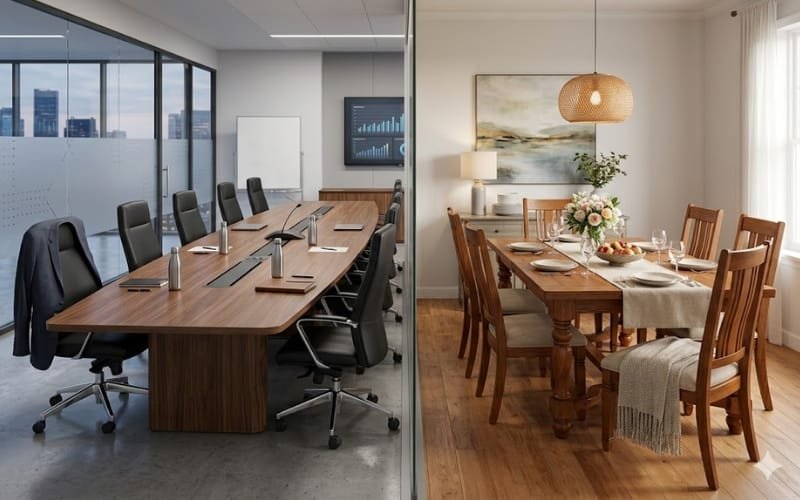
Quick Overview
At first glance, a table is simply a flat surface supported by legs. Yet, the architectural intent differs fundamentally.
A dining table is the heart of a home, designed for shared meals and casual conversation.
In contrast, conference room tables are specialized assets designed to host power dynamics, facilitate technological connectivity, and withstand the rigors of 24/7 commercial use.
The confusion often arises in the “work-from-home” era or within boutique startups where aesthetic “hominess” is prioritized.
But mixing these roles leads to “functional friction”—the realization that your dining table lacks the height, cable routing, or surface resilience required for an 8-hour strategy session.
Data shows that commercial furniture must meet ANSI/BIFMA standards, which 95% of dining furniture fails to consider.
Design Differences Explained (Not Just Shape)
Size & Proportions
Dining tables are usually 29 to 30 inches high, optimized for standard dining chairs.
Professional office conference tables adhere to stricter ergonomic ratios.
The depth of a conference table (often 48 inches or more) is specifically calculated to allow for laptops, notebooks, and central presentation materials without encroaching on the “personal bubble” of the attendee opposite you.
Research indicates that a minimum of 30 inches of linear workspace per person is required for professional comfort.
Material Differences
While residential tables favor aesthetic softwoods or high-maintenance oils, commercial tables use high-pressure laminates (HPL) or thermally fused laminates (TFL).
These materials are rated for high “Taber cycles” (abrasion tests), ensuring they don’t scratch when heavy equipment or metal-cased laptops are dragged across them.
Structural Engineering
A dining table is designed for static loads—plates and glassware. A conference table must support “impact loads” (people leaning on edges) and heavy hardware.
Most premium conference tables feature steel-to-steel connections and internal sub-frames to prevent sagging over long spans, whereas residential tables often rely on wood joinery that can loosen over time under commercial stress.
Cable Management & Tech Integration
This is the “deal-breaker.” Modern conference meeting tables feature grommets, “troughs,” and “power flip-tops.”
Without these, a boardroom becomes a mess of tangled HDMI and power cables.
According to 2023 workplace surveys, teams lose an average of 10 minutes per meeting due to technical setup issues.
Integrated cable management in office furniture reduces this latency by 60%.
Cost Comparison
The upfront cost of a professional table is higher, but the ROI (Return on Investment) tells a different story.
A high-end dining table may cost $800–$2,000. A commercial conference table ranges from $1,500 to $10,000+ depending on tech integration.
| Feature | Dining Table (Avg $1,200) | Conference Table (Avg $3,500) |
|---|---|---|
| Warranty | 1-2 Years (Residential Use Only) | 10 Years to Lifetime (Commercial) |
| Power Integration | Non-existent (requires DIY drilling) | Built-in (UL Listed) |
| Durability | Low (Scratches easily) | High (HPL/TFL surfaces) |
| Tax Benefits | Varies | Fully Deductible Section 179 Asset |
When analyzing conference tables vs. dining room tables cost, businesses must account for depreciation.
Commercial furniture is built to be an asset that retains structural integrity for 15+ years of daily use, whereas residential furniture in an office environment often needs replacement within 3-5 years.
Real Use Cases (Office vs Home vs Hybrid)
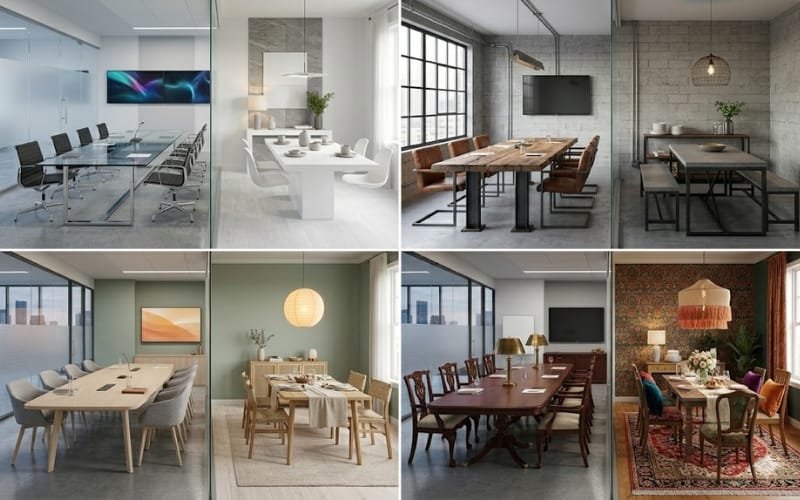
Corporate Boardrooms
In a boardroom, the table is a symbol of authority. Using a dining table here undermines brand perception.
Clients expect a sleek, tech-ready surface that signals professional readiness.
Studies show that 70% of high-value clients perceive a business as “more established” when the furniture is purpose-built.
Startup Coworking Spaces
For fast-growing startups, modular conference tables are the gold standard.
They allow a 10-person table to be split into five 2-person workstations or reconfigured into a U-shape for training sessions.
Dining tables are static; they cannot adapt to the pivot-heavy nature of startup life.
Reddit Opinions & Real User Experience
Scanning discussions on conference tables vs. dining room tables reddit reveals a common theme: the “Utility Regret.”
Users often report that using a large IKEA or West Elm dining table for their startup felt like a “budget hack” that saved $500 initially, but resulted in back pain and ruined floor finishes within six months.
One popular thread highlights that dining tables lack “leg clearance” for swivel office chairs.
The aprons (the wood frame under the tabletop) on dining tables are often too low, causing chair armrests to collide with the table.
This real-world feedback confirms that “cheaper” residential options carry hidden health and productivity costs.
Space Planning & Size Guide
A common mistake is underestimating the “walk-around” space. In a dining room, 36 inches of clearance is standard.
In a conference room, you need 48 to 60 inches of clearance to allow people to pass behind seated colleagues and to accommodate peripheral equipment like whiteboards or credenzas.
Proper planning ensures that the flow of the room supports, rather than hinders, the meeting’s pace.
Material & Durability Comparison
Maintenance is another divergent factor. A solid wood dining table requires humidity control and periodic waxing.
An office table with a high-pressure laminate surface can be cleaned with industrial disinfectants—a necessity in the post-pandemic workplace—without damaging the finish.
Commercial laminates are tested to withstand 100+ hours of continuous UV exposure without fading, while domestic finishes show significant discoloration after just 20 hours.
Decision Guide (Choosing Your Framework)
How do you choose? Follow this framework based on your primary operational goal:
If you need collaboration → Conference table. The psychological “work mode” is triggered by a professional environment. We recommend the Linora B Oval Conference Table for its sleek lines, integrated connectivity, and ergonomic oval shape that facilitates eye contact between all participants.
If you need multi-use home space → Dining table. If the room must transition from a breakfast nook to a workspace, a high-quality hardwood dining table suffices, provided you invest in a portable power hub.
If hybrid → Modular table solution. Choose tables on casters that can be ganged together or separated depending on the day’s tasks.
Common Mistakes Buyers Make
Ignoring Power: Thinking a power strip on the floor is “fine.” It’s a tripping hazard and looks unprofessional.
Wrong Height: Buying a “counter-height” dining table for 8-hour meetings. It leads to poor circulation in the legs and shoulder fatigue.
Finish Selection: Choosing a high-gloss dining finish that reflects the glare of overhead office lights, causing eye strain for staff.
Weight Limits: Overloading a residential table with heavy monitors, causing the center to “bow” or sag over time.
Final Verdict
In the debate of Conference Tables vs. Dining Room Tables, the winner is determined by your environment.
For any space where revenue is generated or clients are hosted, the specialized features of a conference table offer a superior ROI.
Investing in the right tools from Meet&Co Office Furniture ensures your team remains comfortable, connected, and productive.
Don’t let a “homey” shortcut undermine your professional potential.