





 Meet&Co
The conference table is definitely the centerpiece of a meeting room, influencing both office aesthetics and team interaction. With a wide range of conference table shapes available—including rectangular, round, oval, and boat-shaped—each shape brings a different atmosphere and impacts meeting dynamics.
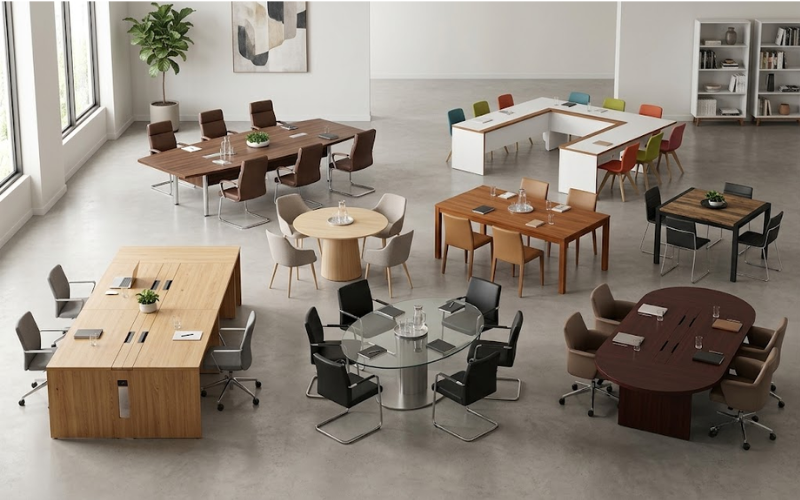
Selecting the right conference table shape is far beyond personal preference; it’s about balancing design, room dimensions, and spatial functionality. In this comprehensive guide, we compare the pros and cons of major conference table shapes to help you narrow down your options and choose the perfect table before ordering.
Key Takeaways
- Rectangular tables work well for formal presentations, structured meetings and maximum seating efficiency.
- A racetrack conference table has the same shape of a rectangular conference table with an interesting twist. Seating is the same as with a rectangular conference table.
- A boat-shaped or oval table is better for sightlines in presentation-focused rooms and soften large rooms.
- Round tables encourage equal participation, for collaborative discussions in smaller groups.
- Modular tables adapt to changing needs when the room need to support multiple layouts.
The Importance of Choosing the Right Shape
Choosing the right conference table shape is critical for several reasons:
- Space Utilization: Efficient use of space ensures comfort and accessibility, crucial for productive meetings.
- Functionality: The table must cater to the room’s primary function, whether for brainstorming sessions, formal meetings or presentations.
- Aesthetic: The shape contributes significantly to the room’s aesthetic, enhancing your brand’s image.
Common Conference Table Shape
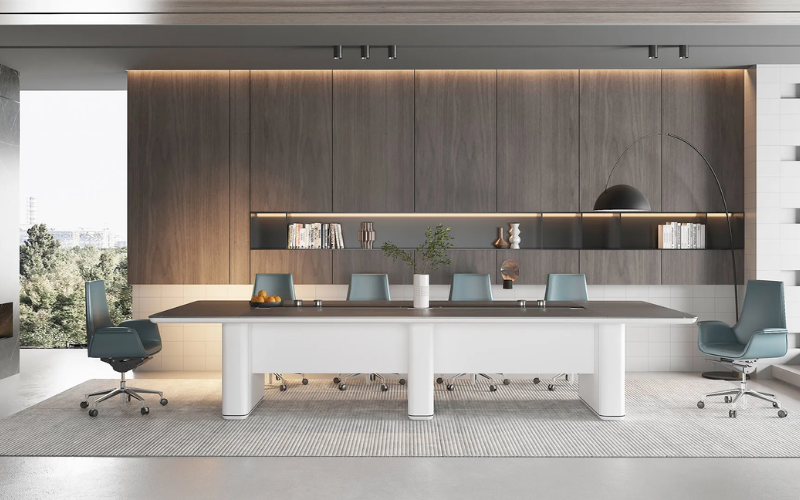
Rectangular tables are the most popular choice as they offer the most seating per square inch and use space efficiently. They also provide clear sightlines toward displays at the front of the room.
Source: https://www.meetcofurniture.com/
| Pros: | Cons: |
| Ideal for larger groups | Might not encourage interactive discussions |
| Structured and formal, gives a sense of power and organization | Can dominate smaller rooms |
| Maximizes seating capacity along the length | Puts stress on people’s backs and necks owing to focusing on one direction for a long time |
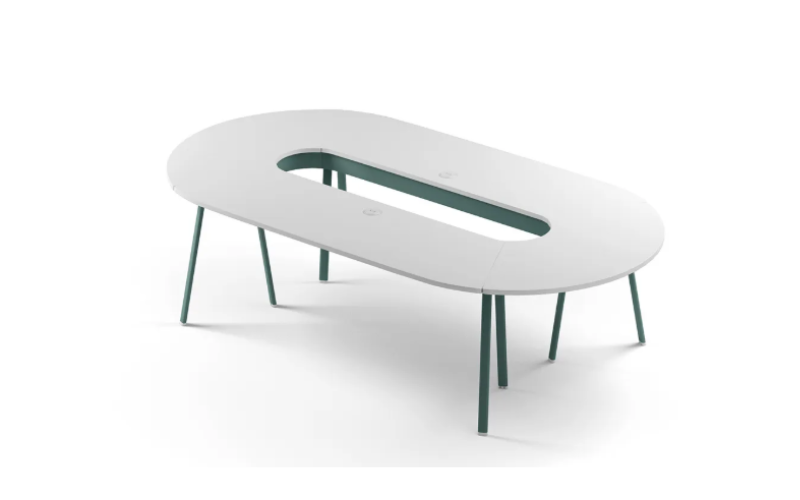
Racetrack tables, just as the name suggests, combine the efficiency of a rectangular table with the softer appearance of rounded ends. They’re popular in modern conference rooms because they improve circulation around the table while maintaining good seating capacity.
Source: https://www.meetcofurniture.com/
| Pros: | Cons: |
| Softens formality while maintaining efficient seating | Offers less seating than rectangle options |
| Prevents “dead corners” (common in rectangles) | Reduced surface depth at the curved ends for laptops and paperwork |
| Ideal for collaborative discussions (8–16 people) |
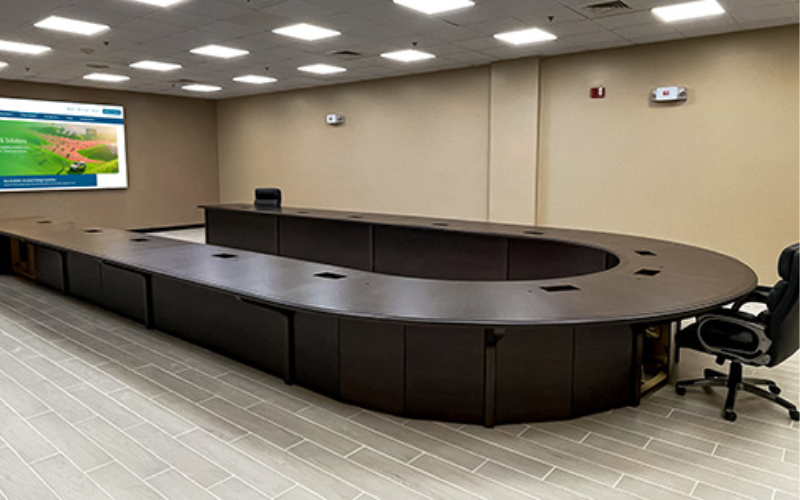
U-shaped tables are completely open on one side, so they’re often used for presentations and evaluations. Similar to rectangular tables, they give you the opportunity to address one person as the leader, however, that leader can more easily access the others around the table so the u-shape can bring everyone together. They also give the perception that your organization is information-driven and eager to collaborate.
Source: https://www.custom-conference-tables.com/
| Pros: | Cons: |
| Ideal for presenter’s interaction | Large distance between seated participants |
| Structured and formal | High spatial footprint |
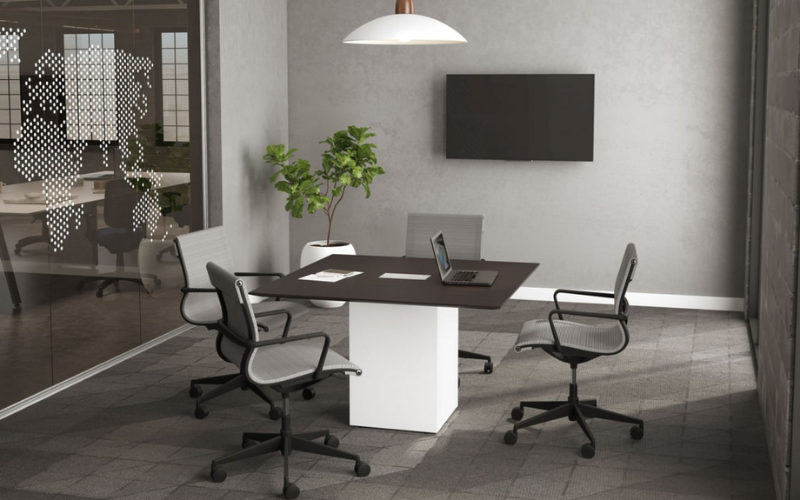
Square tables are modern and stylish, suitable for smaller conferences and more intimate gatherings.
Source: https://madisonliquidators.com/
| Pros: | Cons: |
| Suitable for more intimate gatherings | Limited to smaller gatherings |
| Promotes equality | Rarely used beyond compact 4-person meetings |
| Perfect for small groups | Sightlines feel confrontational |
Combining the benefits of both rectangular and round tables, oval tables are becoming increasingly popular. They offer a formal yet approachable setting.
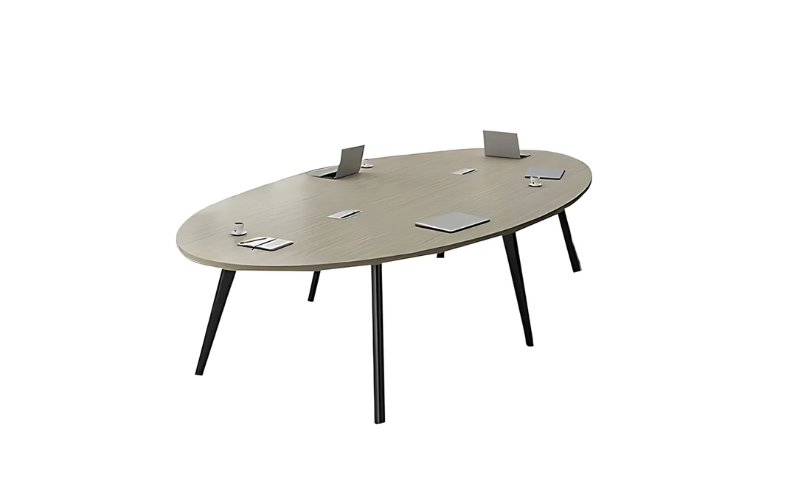
Source: https://anzhap.com/
| Pros: | Cons: |
| Enhances flow in high‑traffic areas for better circulation (no sharp corners) | Space for chairs on ends is limited |
| Creates egalitarian sightlines; no dominant “head” | Less common, which may affect availability |
| Smooth edges are safer and add a soft visual appeal |
Boat-shaped tables are similar to rectangular tables, except the longest sides have a curve. So they are wider in the middle and narrower at each end, creating a more open feel than a traditional rectangular table.
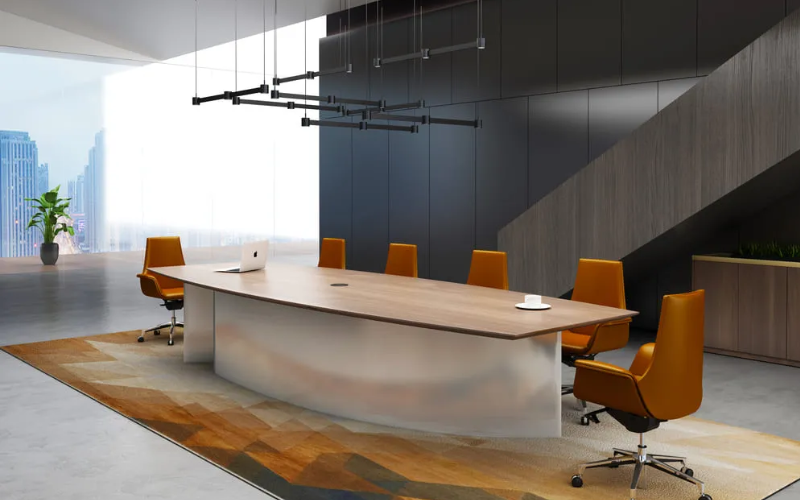
Source: https://www.meetcofurniture.com/
| Pros: | Cons: |
| Improves sightlines and visibility | Requires more space |
| Gives the center of the tabletop more room | Custom installations may be needed |
| Supports larger groups without compromising interaction, association and teamwork |
Round conference tables are often a good choice for smaller businesses, provide Equal sightlines (ideal for <10 people).
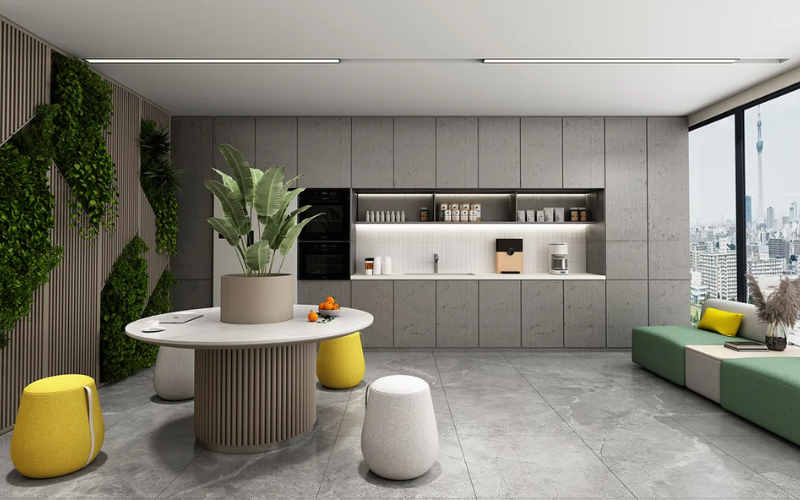
Source: https://www.meetcofurniture.com/
| Pros: | Cons: |
| No “head” position, gives a sense of equality and intimacy. | Limited seating capacity.
|
| Encourages discussion, dialogue and brainstorming; promotes collaboration. | May not fit well in all room dimensions and waste space in corners. |
| Reduces neck and back strain by eliminating constant side-to-side turning. | Requires larger room footprints (diameter = seating space + chairs). |
Keystone-shaped tables are similar to rectangular tables, however, one end is wider than the other. They give guests the impression that your business is technological and forward thinking.
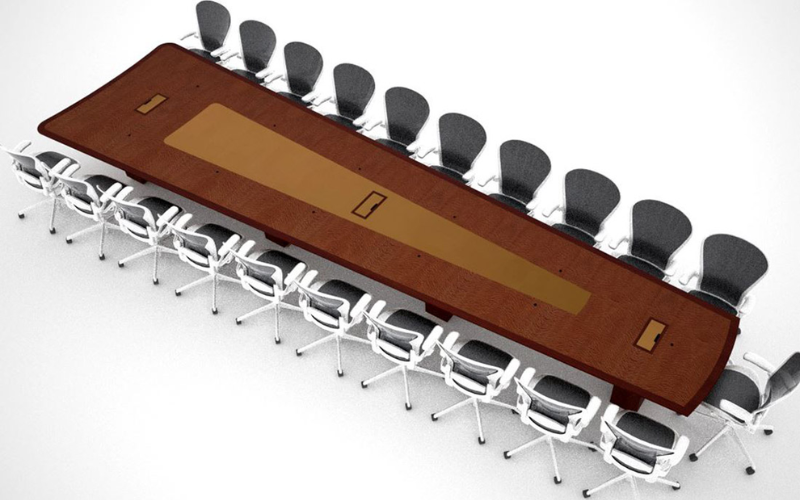
Source: https://www.custom-conference-tables.com/
| Pros: | Cons: |
| Improves sightlines and visibility | Can dominate smaller rooms |
| Structured and formal, gives a sense of power and organization | Inconvenient for intimate group discussions |
| Convenient for videoconferencing and taking photos |
If versatility is your main concern, modular conference room tables can’t be beat. Size, shape, and function can flex to accommodate your needs.
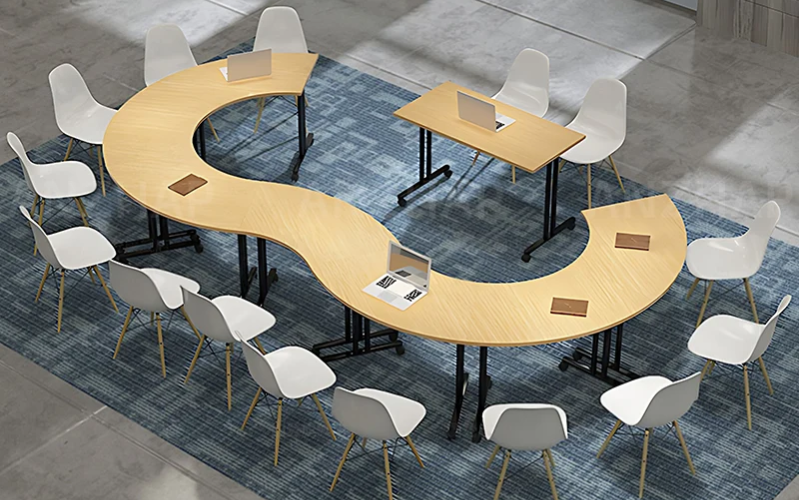
Source: https://anzhap.com/
| Pros: | Cons: |
| Provides different shapes | Visible seams reduce executive elegance |
| The strongest option for multipurpose rooms | Requires time and labor to frequently reconfigure |
| Easier to move through doorways than one oversized tabletop |
What should a conference table be equipped with?
When planning your meeting room, don’t forget equip practical accessories and furniture. In addition to basic tables and chairs, you can also consider equipping it with whiteboards, TVs, filing cabinets, audio-visual carts, podiums, and even some houseplants to boost productivity and ambiance.
If you need to use electronic devices, it is recommended to integrate power, network data ports, and USB interfaces into the conference table. Built-in power outlets and cable management are especially valuable in boardrooms used for video calls and presentations. The reserved cable holes on the desktop can also ensure that the cables are neat and tidy.
How Conference Table Size Is Actually Calculated
The professional rule, used by commercial architects and corporate space planners, is straightforward: each seated guest needs 24 to 30 inches of horizontal table edge. That’s the minimum personal space for a laptop, a notebook, a coffee cup, and breathing room between elbows.
Twenty-four inches is the absolute floor — fine for short stand-ups where people aren’t spreading out materials. Twenty-eight to thirty inches is the standard for boardrooms, conference rooms, and any meeting where people will sit for an hour or more with documents, laptops, or shared materials.
Multiply by the number of seats along each long edge, add 24 inches per end seat (if you’re seating the ends), and that’s your minimum table length.
Here’s the working formula in practice. Take a meeting where eight people need to sit comfortably with laptops:
- 4 seats per long side × 28 inches per seat = 112 inches per side
- Add 12 inches of buffer at each end of the table (not seated) for visual proportion = 24 inches
- Minimum table length: 136 inches, or 11 ft 4 in
The nearest standard size is 12 feet (144 inches). That’s why eight-person executive boardrooms almost always end up at 12 feet, not 10. The 10-foot table looks right on paper, but the math says it can only honestly seat six along the long edges with the kind of breathing room executive use demands.
There’s a second variable that is seldom mentioned: the visual buffer at each end. Industrial designers refer to this as “negative space” — the empty table surface that separates the last seat from the table edge. Without it, the end seats feel like they’re falling off the table. Twelve inches per end is the working minimum; eighteen inches is preferred for executive use. That buffer comes out of your usable seating length, which is why mathematical capacity and real-world capacity diverge.
Leave approximately 42 to 48 inches between the tabletop and surrounding walls or furniture, then confirm the manufacturer’s stated seating capacity instead of relying on length alone.
The most common pitfall
The most common mistake in conference table shape and sizing isn’t the table — it’s the room around the table. the table is only part of the measurement. There are some professional clearance standards:
Behind seated guests (no walk-through): 36 inches minimum, 42 inches preferred. This is the space for chairs to push back without hitting a wall.
Behind seated guests (walk-through path): 48 inches minimum. This is the path for someone to walk behind seated colleagues without the seated person tucking in.
Between table and presentation whiteboards or TV: 60 inches minimum if anyone presents from the head of the room. Less than 60 inches and the presenter is standing on top of the end chairs.
Three room scenarios where clearance math kills the obvious choice:
- The pillar problem. Modern open-plan offices put structural columns in the strangest places. A column 36 inches inside the room wall reduces your effective room depth by that distance and forces the table to shift toward one side, which creates uneven clearance on the long edges. The fix is either notching the table to clear the column or stepping down a size.
- The door swing problem. If your conference room door swings inward, the door’s swing radius (typically 36 inches) becomes a clearance constraint. Cracking a door against the back of an executive chair is a guaranteed annoyance for the next forty years of the room’s life. Plan around it during table sizing, not after.
- The AV cart problem. Mobile AV carts, side credenzas, and rolling whiteboards all need parking space along one wall. Subtract their footprint from your usable room dimensions before calculating maximum table size.
A practical method we use during commission conversations: ask the client to measure the room, then subtract 96 inches from one dimension and 84 inches from the other. The remainder is the maximum table footprint that leaves proper clearance on all sides. This rule has been right within an inch when we’ve used it.
Conclusion
The right conference table should fit the room, seat everyone comfortably, support technology, and match the way your team meets.
Choosing a conference table begins with the room and the people who will use it. Whether a classic rectangular table fits your formal boardroom or modular options offer maximum flexibility for dynamic workspaces, the key is balancing form and function.
Measure circulation space, verify seating capacity, coordinate chairs, and plan power before selecting a style. With those decisions made, you can compare Meet&Co’s conference table collections and choose a table that supports your team’s daily collaboration.
FAQ
1.What is the standard conference table height?
Standard height is 30 inches, matching most executive chair geometry. Sit‑stand and crank‑adjustable conference tables typically range 29 to 42 inches, allowing the entire table to raise and lower for mixed seated and standing meetings. For pure standing meeting tables, plan on 40 to 42 inches.
2.Why is comfort important in a conference room?
Comfortable chairs and tables help everyone focus better during long meetings. Make sure they fit different people’s needs.
3.How can I stay within my budget when buying a conference table?
Understand what features are most important to you and look for financing options if needed. Remember, quality can save money in the long run.
4.How much room clearance does a conference table need?
Allow a minimum of 36 inches behind every chair (42 inches preferred) for chair pull‑out without hitting walls. If anyone walks behind seated guests, that clearance jumps to 48 inches. Between the table end and a presentation wall, plan for 60 inches minimum so the presenter doesn’t stand on top of the end chairs.