






 Meet&Co
Living in an urban environment often demands creative spatial solutions.
Whether you are transitioning into a studio apartment or hosting long-term guests, the question inevitably arises: Can I sleep on a sofa bed every night?
While the immediate answer is a cautious “yes,” the long-term reality is far more nuanced.
As a furniture specialist with five years of hands-on testing, I’ve seen how the wrong setup can lead to chronic fatigue, while the right one offers a seamless lifestyle.
However, before you commit to this sleeping arrangement, you must understand the “Health Truth” behind what happens to your spine when a temporary solution becomes a permanent fixture.
At Meet&Co, we believe that space-saving should never come at the cost of your physical well-being.
This guide breaks down the medical implications and hardware requirements for nightly sofa bed use.
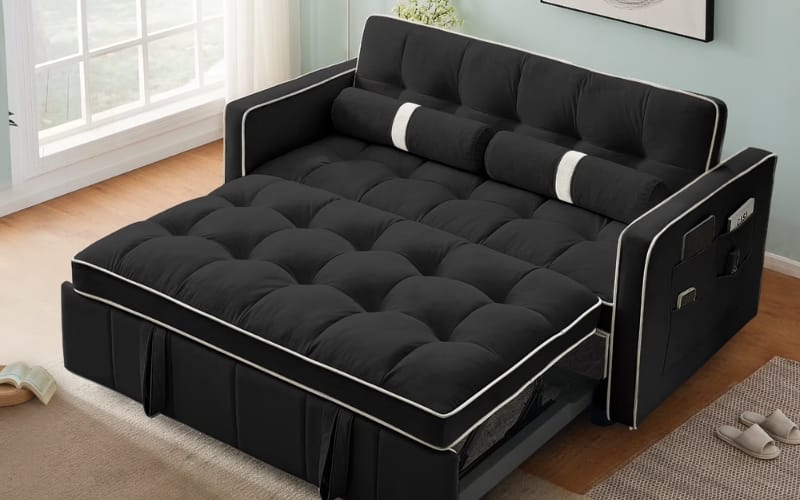
Source: https://www.walmart.com/
The Medical Verdict: What Happens to Your Body?
The primary concern with nightly use of a sofa bed isn’t just the hardness of the cushion; it’s the structural integrity.
Standard mattresses are designed with zones to support different body weights—heavier at the hips, lighter at the shoulders. Sofa beds, by contrast, are often uniform in density.
Spinal Alignment and Pressure Points
When you sleep, your spine should maintain its natural “S” curve.
Most sofa beds feature a folding mechanism that creates a “gap” or a “dip” right where your lower back rests.
Over months of use, this lack of lumbar support leads to micro-strains in the spinal ligaments.
You might not feel it after one night, but after sixty nights, that morning stiffness is your body’s way of signaling spinal misalignment.
The “Bar in the Back” Syndrome
Older pull-out models are notorious for the metal support bar that runs across the frame.
Continuous pressure on this bar can impede circulation and cause localized inflammation.
If your goal is nightly rest, you must ensure your chosen model uses a webbing system or a high-resiliency foam base that masks these mechanical components entirely.
The 3 Non-Negotiable Factors for Nightly Use
If you are determined to make a sofa bed your primary sleeping surface, you cannot compromise on these three pillars of furniture engineering.
1. The Mechanism Type
Not all frames are created equal.
Pull-Out Frames: Generally offer the best support if they use a thick mattress.
Click-Clack Models: Usually the worst for nightly sleep as the “seam” where the back and seat meet is often right under the sleeper’s hips.
Power-Motion: New for 2026, these offer adjustable firmness but require more maintenance.
2. Mattress Thickness and Density
A “healthy” sofa bed mattress needs to be at least 10cm to 12cm thick.
Look for high-density polyurethane foam or independent pocket springs.
Cheap, open-coil springs will lose their tension within six months of nightly use, leading to the dreaded “taco effect” where you roll into the center of the bed.
3. Breathability and Hygiene
Sofas are upholstered in fabrics designed for durability, not necessarily for skin contact.
A comfortable fabric sofa should ideally use breathable materials like linen blends or treated cotton.
Synthetic polyesters trap heat, leading to night sweats and, eventually, the accumulation of allergens within the foam.
5 Expert Tips to Protect Your Back

Drawing from five years of evaluating sleep surfaces, I’ve developed a “survival strategy” for those who don’t have the luxury of a traditional guest room.
Invest in a 3-Inch Topper: A high-quality memory foam or latex topper is the single most effective way to bridge the gaps in a sofa bed. It redistributes your weight and adds a much-needed transition layer between you and the mechanical frame.
Rotate, Don’t Just Flip: Most sofa bed mattresses cannot be flipped because they are one-sided. Instead, rotate the mattress 180 degrees every two weeks to prevent localized sagging.
Upgrade Your Pillows: Because sofa beds often have a slight incline or decline due to the frame, using an orthopedic pillow can help re-align your neck and shoulders.
The Morning Reset: Mentally and physically, you should fold the bed away every morning. This prevents the “couch potato” effect where the foam never gets a chance to decompress from your body weight.
Check the Bolts: Nightly use puts 7x more stress on the joints of the bed than occasional use. Tighten the hardware every three months to prevent the squeaks that ruin REM sleep.
Beyond the Fold: Healthier Alternatives
Sometimes, the “Health Truth” is that a traditional folding mechanism simply won’t cut it for your specific back needs.
In these cases, we look toward modular designs that prioritize posture over mechanics.
The Rise of Modular Solutions
If you want the versatility of a sofa but the support of a real bed, modular sofas are a superior alternative.
Unlike pull-outs, these units consist of independent blocks that can be rearranged into a flat, gap-free sleeping surface.
Because they lack the heavy metal folding frame, the foam can be much thicker and more supportive.
For a true upgrade in comfort, consider the modular sectional sofa.
These pieces provide a sprawling surface area that rivals a King-sized bed.
Because each section is a solid block of high-resiliency foam, you get consistent support from head to toe without the structural weaknesses of a hinge.
Featured Recommendation: The Caterpillar Modular Sectional Sofa

If you are looking for a permanent solution that doubles as a design statement, the Caterpillar Modular Sectional Sofa is the pinnacle of ergonomic lounging.
Unlike traditional sofa beds that force your body to adapt to a stiff frame, this model features a low-profile, “segmented” design that mimics the natural contours of the human form.
It acts as an ergonomic sofa during the day, providing multiple points of contact to relieve pressure on the coccyx and lumbar spine.
At night, its high-density foam construction provides a firm yet yielding surface that is far healthier for nightly rest than a thin, folding mattress.
It effectively removes the “mechanical” risk from the sleep equation.
Maintenance: How to Extend Your Sofa Bed’s Life
When you use a sofa bed every night, you are effectively condensing ten years of wear into two.
To protect your investment and your health, follow this maintenance schedule:
Vacuum Weekly: Skin cells and dust mites settle deep into the crevices of a sofa bed. Use a HEPA-filter vacuum to keep the sleep surface hypoallergenic.
Steam Clean: Once a year, professional steam cleaning removes the salts from sweat that break down the cellular structure of the foam.
Lubrication: Use a silicone-based lubricant on the folding hinges. This prevents friction that can lead to the frame warping over time.
Final Verdict: Is It Right for You?
So, Can I sleep on a sofa bed every night? Yes—provided you stop treating it like a couch and start treating it like a high-performance sleep system.
If you choose a model with a robust frame, add a premium topper, and maintain a strict hygiene routine, you can enjoy a restorative night’s sleep even in the smallest of spaces.
However, if you prioritize long-term spinal health and want a piece of furniture that evolves with your lifestyle, moving toward modular or ergonomic designs is the smarter “Health Truth.”
For those seeking professional-grade setups that balance office functionality with home comfort, exploring the catalog at Meet&Co Office Furniture can provide the structural quality needed for such a demanding task.
Your back is the foundation of your daily productivity. Don’t let a sub-par mattress be the reason you wake up exhausted.
Choose quality, prioritize support, and remember that where you sleep dictates how you live.
Also see:
FAQ
Q: Can a teenager sleep on a sofa bed every night?
A: During growth spurts, spinal alignment is critical. A teenager should only use a sofa bed nightly if it is equipped with a high-quality orthopedic topper and a supportive frame.
Q: How often should I replace a sofa bed used nightly?
A: Expect a lifespan of 3 to 5 years. Once you notice a permanent indentation of more than 1 inch, the “Health Truth” is that it’s time for a replacement to avoid back injury.
Q: Is it better to sleep on the floor than a bad sofa bed?
A: Generally, yes. A firm, flat floor with a thin mat provides better spinal alignment than a sagging, spring-filled sofa bed that forces the spine into a curved position.
_20.webp)