





 Meet&Co
You are trying to focus. A call comes in. You look around and realise — every person in the room can see you. Every person can hear you. And there is nowhere to go.
That is the reality of a small open office. You want the energy of an open layout, but you also need moments of quiet. You want your team to collaborate easily, but you also want them to be able to focus when the work demands it.
Enter office partitions — the friend of anyone who has ever wished for a little visual and acoustic breathing room.
For small offices, the challenge is finding a partition that does not eat up valuable floor space. This guide walks you through four smart options that actually work in tighter layouts — from glass partitions that keep light flowing to fabric dividers that absorb noise. Plus, a few pointers on what to measure before you buy.
Our designer’s tip: The biggest mistake people make in small offices is putting up partitions that are too tall and too solid, which makes the space feel like a maze. In a compact layout, lower partitions (desk height or slightly above) give you privacy where you need it most — while keeping the room feeling open.
What to Look for When Space Is Tight
Not every partition works well in a small office. Here is what to prioritise.
Light flow matters more than you think. In a small room, solid partitions can quickly make the space feel closed in. Glass partitions or lower screens let light travel across the room, which helps the office feel larger than it actually is.
Moveability is a lifesaver. In a small office, layouts change. A partition that can be wheeled into a different position — or folded and stored — gives you the flexibility to adapt as your team grows or your needs shift.
Acoustic doesn’t have to mean massive. You probably do not need a soundproof wall. For a small office, a fabric-covered partition can cut down distracting ambient noise without taking up a lot of floor space.
Measure your walkways. Before buying any partition, measure the clearance around it. Leave at least 24–30 inches for people to walk past comfortably — otherwise, you are trading privacy for a traffic jam.
Also see: Office Partitions Guide: Top Design Ideas, Products & More
Quick Overview: Types of Partitions for Small Offices
| Type | Best For | Key Feature | Space Impact |
|---|---|---|---|
| Glass partition | Keeping light flowing while adding separation | Transparent, visual privacy without blocking light | Low — visually lightweight |
| Fabric panel partition | Noise reduction and softening office lines | Absorbs sound, blocks view, adds warmth | Medium — solid but not bulky |
| Mobile room divider | Frequent layout changes | Wheels for easy repositioning | Medium — movable |
| Modular partition system | Creating larger divided zones | Interlocking panels for custom layouts | Medium to high |
4 Office Partitions Worth a Look
Here are four solid options for small office layouts. Each one approaches space differently.
1. Meet&Co Glass Partition Walls — Best for Keeping Light and Flow
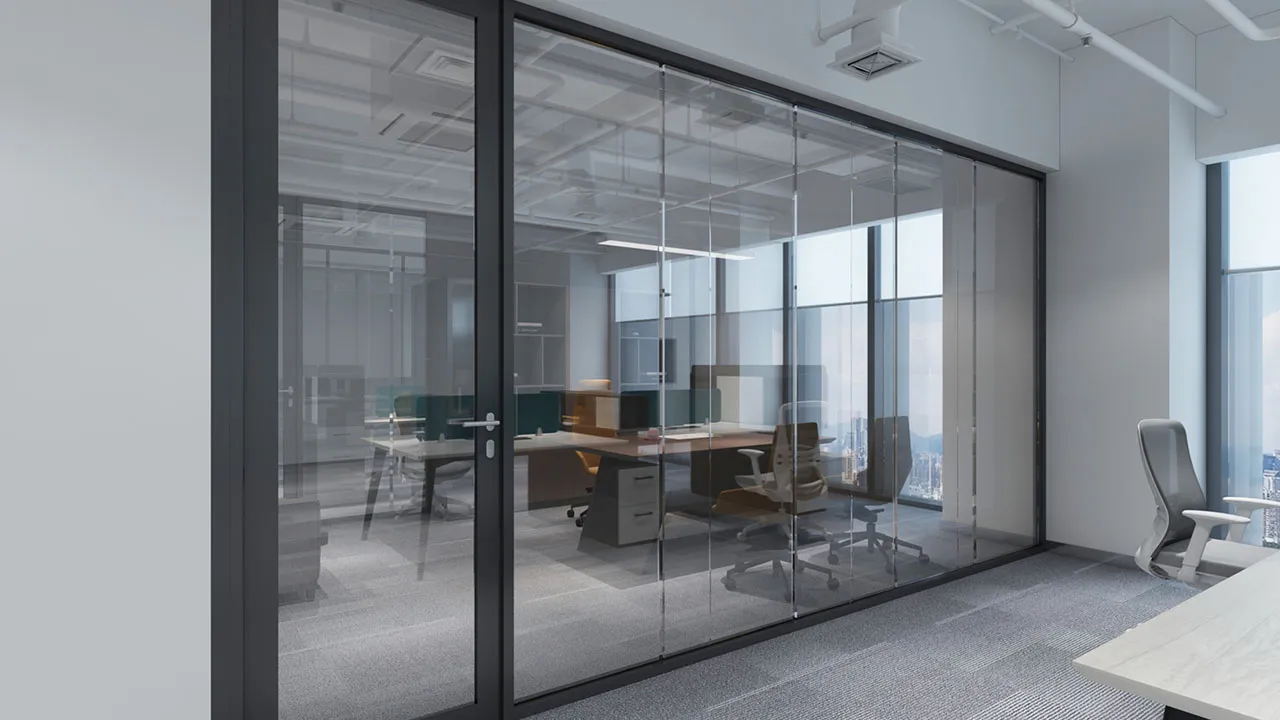
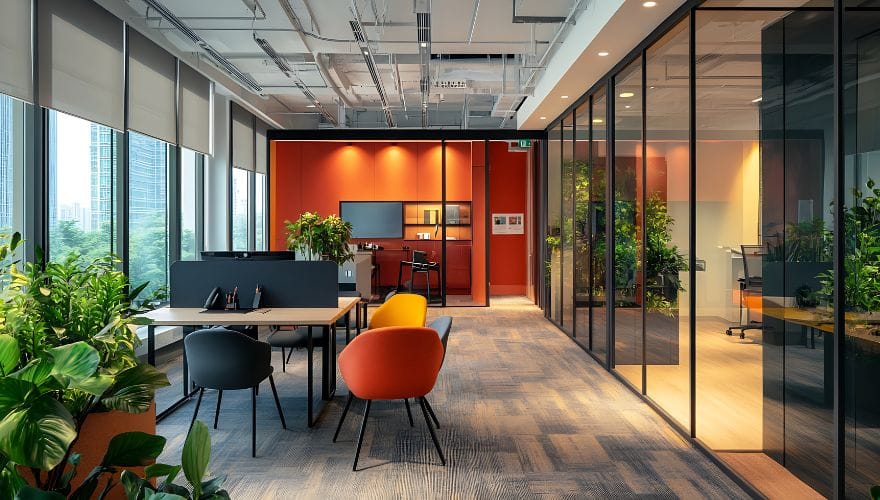
Glass partitions are the smartest choice for a small office that still needs to feel open. They give you separation — visual privacy, reduced foot traffic — but they let light pour through the entire space.
The Meet&Co Glass Partition Wall is built with a premium aluminium alloy frame and sturdy glass that stands up to daily use. The transparent design means your office does not feel chopped up into dark little boxes. Instead, light flows from one zone to the next, which makes the whole space feel larger.
The panels are fully customisable — you can configure them endlessly, move them, slide them open, or adjust them as your needs change. This makes them great for spaces that serve multiple purposes throughout the day: standing desks, video call zones, quiet corners, you name it.
A custom fixed glass option is also available for areas that need a more permanent separation.
Best for: Offices that need visual separation but cannot afford to lose natural light. Also great for shared workspaces where different teams need their own zones without feeling closed off.
Key strengths: Transparent design keeps light flowing, aluminium frame is durable, highly customisable panel configurations, suitable for multiple settings.
2. Meet&Co Enjoy Office Partition Room Divider — Best for Softening a Space
Sometimes you do not need to block the view completely. You just need to soften it.
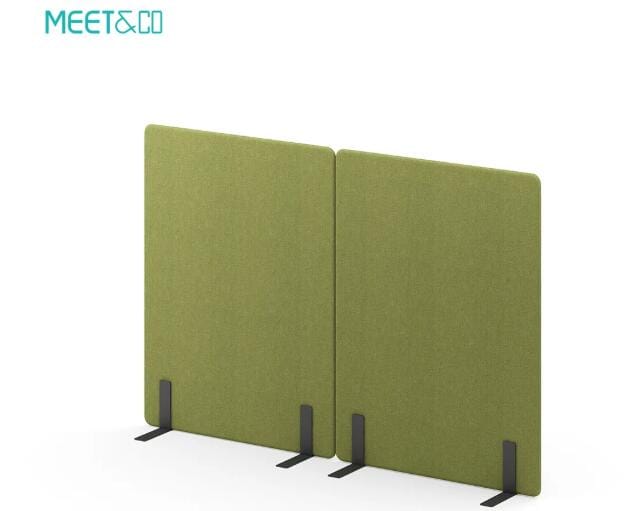
The Enjoy Office Partition is designed for open-plan offices and home workspaces that need a bit of calm. It has a soft green fabric finish that does a few helpful things at once. It softens harsh office lines. It adds a warm, natural feel to the room. And the textile surface helps reduce noise reflection, so the space feels quieter and more focused.
The design is clean and simple — it complements both modern and traditional interiors without shouting for attention.
The Enjoy Partition comes in multiple height and width configurations, so you can match it to your specific layout. It is lightweight enough to move when needed, but stable enough to stand firm. The modular design lets you connect multiple panels to create larger dividers when you need to section off a meeting corner or screen a messy desk area.
If the green fabric is not your colour, you can also get a dark grey version.
Best for: Offices that want subtle separation with a touch of warmth — think reception corners, semi-private lounge zones, or screening off a cluttered area.
Key strengths: Fabric finish reduces noise reflection, lightweight construction, modular panels can be connected for larger dividers, adds warmth without adding bulk.
3. At Work Mobile Room Divider — Best for Max Flexibility on Wheels
https://www.nationalbusinessfurniture.com/at-work-mobile-room-divider-52h-x-73w-21427?option=21427_2
Some small offices change their layout constantly. Meetings in the morning, individual work in the afternoon, team workshops after lunch. For those spaces, a partition on wheels is a game-changer.
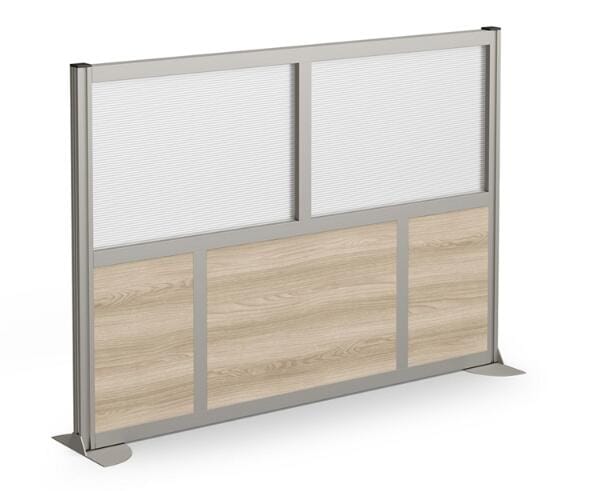
The At Work Mobile Room Divider is 73 inches wide and 52 inches high — large enough to create a meaningful visual separation, but not so tall that it overwhelms a small room. The standout feature: wheels. You can roll it into position when you need privacy, and roll it away when you don‘t.
The unit is sturdy and stylish, with a clean design that fits well in professional office settings. Users consistently report that the assembly is straightforward and the divider is easy to move. It is built to handle daily use in shared office spaces.
At 52 inches high, it gives you a solid visual barrier without making the room feel chopped up. You still see people‘s upper bodies and faces, which keeps the space feeling connected — but the desk-level visual clutter is blocked.
Best for: Offices that reconfigure regularly — shared meeting rooms, hot-desking zones, coworking spaces, or any layout where needs change by the day.
Key strengths: Sturdy build, easy to move (wheels), straightforward assembly, user‑approved, 11+ customer reviews with positive ratings.
Also see: Types of Partition Walls: Complete Guide for Homes & Offices
4. Modular Office Divider / Cube Screen — Best for Permanent Desk Separation

Sometimes you need actual desk separation, not just a room divider. For open‑plan offices where employees sit in rows, low-height modular screens are the answer.
Cube screens fit directly onto desks, typically standing about 12–18 inches tall. At that height, you can still see across the room, so the space feels open and collaborative. What you do not see are the messy coffee cups, scattered papers, or the person aggressively typing three feet away.
These modular systems are also highly configurable. You can add whiteboards, storage shelves, fabric panels, or glass sections depending on your needs. For small offices where every square foot counts, this is a surprisingly effective solution — it uses vertical space above the desk rather than eating up floor area.
Best for: Open-plan offices, shared workstations, and any space where you want to give employees a bit of their own turf without building actual walls.
Key strengths: Saves floor space, keeps the office feeling open, can be combined with other desk accessories.
Frequently Asked Questions (FAQ)
1. What is the best office partition for a very small space?
For tight spaces, glass partitions or low-profile modular screens are the best choices. Glass keeps light flowing — which is essential in a small room — while low screens above desks give you separation without using floor space. Avoid bulky, floor‑standing partitions that take up precious square footage.
2. Can an office partition reduce noise?
Yes, but it depends on the material. Fabric-covered acoustic panels absorb ambient noise and reduce echo. They are great for cutting down distracting chatter. However, most freestanding office partitions reduce ambient noise but do not block speech entirely, and 68% of complaints about acoustic performance come from buyers who expected near-soundproof separation. For full speech privacy, you need a sealed wall system, not a freestanding screen.
3. How do I measure for a partition in a small office?
Measure three things. First, the width of the space where the partition will go. Second, the height — ensure it is not too tall for the room‘s proportions. Third, the walkway clearance around it. Leave at least 24–30 inches of space for people to walk past comfortably (a standard corridor width is often 48 inches for two-way passage).
4. Are glass partitions less private than solid ones?
They offer visual privacy without blocking visibility. A frosted or tinted glass partition blurs what is on the other side — you see shapes and movement, but not detailed activity. You still feel separate, but the room does not feel closed in. For full visual privacy, go with frosted glass or fabric panels.
Final Thoughts
A small office does not have to mean zero privacy. The right partition — glass, fabric, mobile, or desk-mounted — can give your team the separation they need without making the space feel closed in.
Start by looking at how your team actually uses the office. Do people mostly work solo, with occasional collaboration? Glass or low screens work well. Does the room switch layouts constantly? A mobile partition is worth the investment. Is noise the main problem? Fabric panels will help more than glass.
The best part? You do not have to get it perfect on the first try. Start with one partition, see how your team responds, and then add more as you learn what works.
A little separation goes a long way — especially when your desk has been in everyone‘s line of sight for way too long.
-加USB_25.webp)