





 Meet&Co
You’re searching for acoustic partitions, and every product claims to reduce noise. Some promise “superior sound absorption.” Others boast “speech privacy guaranteed.” But when you look at the specifications, you see numbers like NRC 0.85, STC 35, or DS,A 30—and you have no idea what they mean for your actual office.
The truth is that acoustic partitions vary widely in performance. A fabric screen that works beautifully for reducing echo in a quiet library will do almost nothing to stop conversation from carrying across a busy call center. Buying the wrong level of acoustic performance means either wasting money on more than you need or—worse—being disappointed when your new partitions don’t solve the problem you bought them to fix.
This guide demystifies acoustic ratings, helps you understand how much noise reduction different situations require, and shows you how to match partition performance to your actual needs.
Understanding the Problem: What Kind of Noise Are You Trying to Solve?

Before you can determine how much noise reduction you need, you must identify what kind of noise problem you’re facing. Different acoustic issues require different solutions.
| Noise Problem | What It Sounds Like | Acoustic Solution |
| Echo and reverberation | “Lively” room; sounds linger; voices blend together | Absorption (high NRC) |
| Ambient noise | Constant low-level hum; general office buzz | Absorption + strategic placement |
| Speech intelligibility | You can understand conversations across the room | Blocking transmission (higher STC) |
| Confidential conversations | Sensitive discussions need to stay private | Sealed enclosures (STC 40+) |
| Mechanical noise | HVAC hum, printer noise | Absorption near noise sources |
The Two Main Functions
Acoustic partitions serve two different functions, often confused:
| Function | What It Does | Measured By | Best Application |
| Sound absorption | Reduces echo and reverberation within a space | NRC (Noise Reduction Coefficient) | Open offices, cafeterias, rooms with hard surfaces |
| Sound blocking (transmission loss) | Prevents sound from traveling from one side to the other | STC (Sound Transmission Class) | Enclosed offices, conference rooms, spaces requiring privacy |
Many people assume any “acoustic” product does both. In reality, most freestanding partitions are absorptive, not blocking. Understanding this distinction is the first step to choosing the right product.
The Key Metrics: What the Numbers Actually Mean
1. NRC (Noise Reduction Coefficient)
NRC measures how much sound a material absorbs. It’s expressed as a number between 0 and 1, where 0 means no absorption (hard concrete) and 1 means 100% absorption (theoretical perfect absorber).
| NRC Rating | What It Means | Example Materials |
| 0.00–0.20 | Highly reflective | Glass, concrete, drywall, wood |
| 0.20–0.40 | Minimal absorption | Carpet on concrete, thin fabric panels |
| 0.40–0.60 | Moderate absorption | Standard acoustic ceiling tiles |
| 0.60–0.80 | Good absorption | Fabric-wrapped panels, acoustic foam |
| 0.80–1.00 | Excellent absorption | Thick acoustic panels, high-performance felt |
What NRC tells you: How much the partition will reduce echo and reverberation. Higher NRC means a “deader” acoustic environment.
What NRC doesn’t tell you: How much sound the partition blocks from one side to the other.
2. STC (Sound Transmission Class)
STC measures how much sound a barrier blocks. Higher numbers mean better blocking. STC ratings apply to full enclosures (walls, partitions with seals), not open freestanding screens.
| STC Rating | What It Means | Typical Use |
| STC 25–30 | Normal speech clearly audible | Minimal privacy, cubicle walls |
| STC 30–35 | Loud speech audible but not intelligible | Standard office walls, some partitions |
| STC 35–40 | Loud speech faint, not intelligible | Meeting rooms, basic confidentiality |
| STC 40–45 | Loud speech barely audible | Confidential discussions, HR offices |
| STC 45–50 | Very loud speech inaudible | Executive offices, legal settings |
| STC 50+ | Near-soundproof | Recording studios, specialized spaces |
3. DS,A (Speech Level Reduction for Pods and Enclosures)
For freestanding acoustic pods and phone booths, ISO 23351-1 provides a standardized measurement called DS,A. This measures how much the enclosure reduces intelligible speech.
| DS,A Rating | What It Means | Suitable For |
| DS,A 25–30 | Moderate speech privacy | Quick calls, general use |
| DS,A 30–35 | Good speech privacy | Confidential conversations |
| DS,A 35+ | Excellent speech privacy | Highly sensitive discussions |
How Much Noise Reduction Do Different Situations Need?
Office Partition
Now that you understand the metrics, let’s apply them to real-world office scenarios.
Scenario 1: Open Office with Echo Problem
What you hear: Voices bounce off hard surfaces; the room sounds “lively” or “echoey.” You can’t pinpoint where sounds are coming from.
What you need: Absorption (NRC). You don’t need to block sound completely—you need to reduce reverberation so sounds don’t linger and blend.
Recommended solution:
- Acoustic panels with NRC 0.70–0.90
- Ceiling baffles or clouds
- Fabric-covered partitions placed at sound reflection points
How much: NRC 0.70+ for noticeable improvement. Don’t expect to eliminate speech—you’re taming echo, not creating silence.
Scenario 2: Distracting Conversations in Open Plan
What you hear: You can understand conversations from across the room. Each word is clear enough to pull your attention.
What you need: A combination of absorption (to reduce overall noise) and some blocking (to reduce sound travel distance).
Recommended solution:
- Acoustic screens between desks (absorptive, not blocking)
- Ceiling baffles to reduce sound travel
- Increased distance between workstations
- White noise system for masking
How much: Freestanding screens alone won’t achieve this. You need a layered approach. NRC 0.70+ panels plus sound masking yields best results.
Also see: How to Choose Partitions for Open-Plan Offices Without Sacrificing Light
Scenario 3: Confidential Conversations in Meeting Rooms
What you need: Conversations inside should not be intelligible outside.
What you need: Blocking (STC), not just absorption. Freestanding screens will not work—you need enclosed spaces.
Recommended solution:
- Fully enclosed meeting rooms or pods
- Sealed doors with gaskets
- STC 35–40 minimum; STC 45+ for highly sensitive discussions
- For pods, look for DS,A 35+
How much: STC 35 makes loud speech faint; STC 40 makes it unintelligible. For HR or legal conversations, aim for STC 45+.
Scenario 4: Phone Calls in Open Office
What you need: Callers should be able to speak without disturbing neighbors; listeners shouldn’t be distracted by the call.
What you need: A phone booth or enclosed pod with good speech reduction.
Recommended solution:
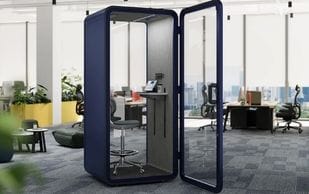
- Single-person phone booth
- DS,A 30+ rating
- Ventilation that doesn’t compromise acoustics
How much: DS,A 30–35 provides good speech privacy for most business calls.
Scenario 5: Quiet Focus Zone
What you need: A low-noise environment where employees can concentrate without distraction.
What you need: Combination of absorption, distance, and visual separation.
Recommended solution:
- Area designated as quiet zone
- Soft surfaces (carpet, acoustic panels)
- Visual barriers that don’t need to block sound
- Clear signage and etiquette
How much: NRC 0.70+ for surfaces. The goal is ambient noise reduction, not complete isolation.
Comparison: Acoustic Needs by Space Type
| Space Type | Primary Need | Recommended NRC | Recommended STC/DS,A | Notes |
| Open office general | Reduced echo, lower ambient | 0.60–0.80 | N/A | Treat 25–40% of ceiling/wall area |
| Open office workstations | Speech privacy between desks | 0.70–0.90 | N/A | Combine with sound masking |
| Phone booth | Confidential calls | 0.70–0.90 | DS,A 30+ | Sealed enclosure required |
| 2–4 person meeting pod | Small group discussions | 0.70–0.90 | DS,A 30–35 | Ventilation critical |
| Conference room | Prevent sound bleed | 0.60–0.80 | STC 35–45 | Sealed doors with gaskets |
| Quiet zone | Low ambient noise | 0.70–0.90 | N/A | Signage and etiquette matter |
| Break area | Reduce noise from activity | 0.60–0.80 | N/A | Focus on absorption near sources |
| Executive office | Confidential conversations | 0.50–0.70 | STC 40+ | Full wall construction |
How to Choose the Right Acoustic Partition
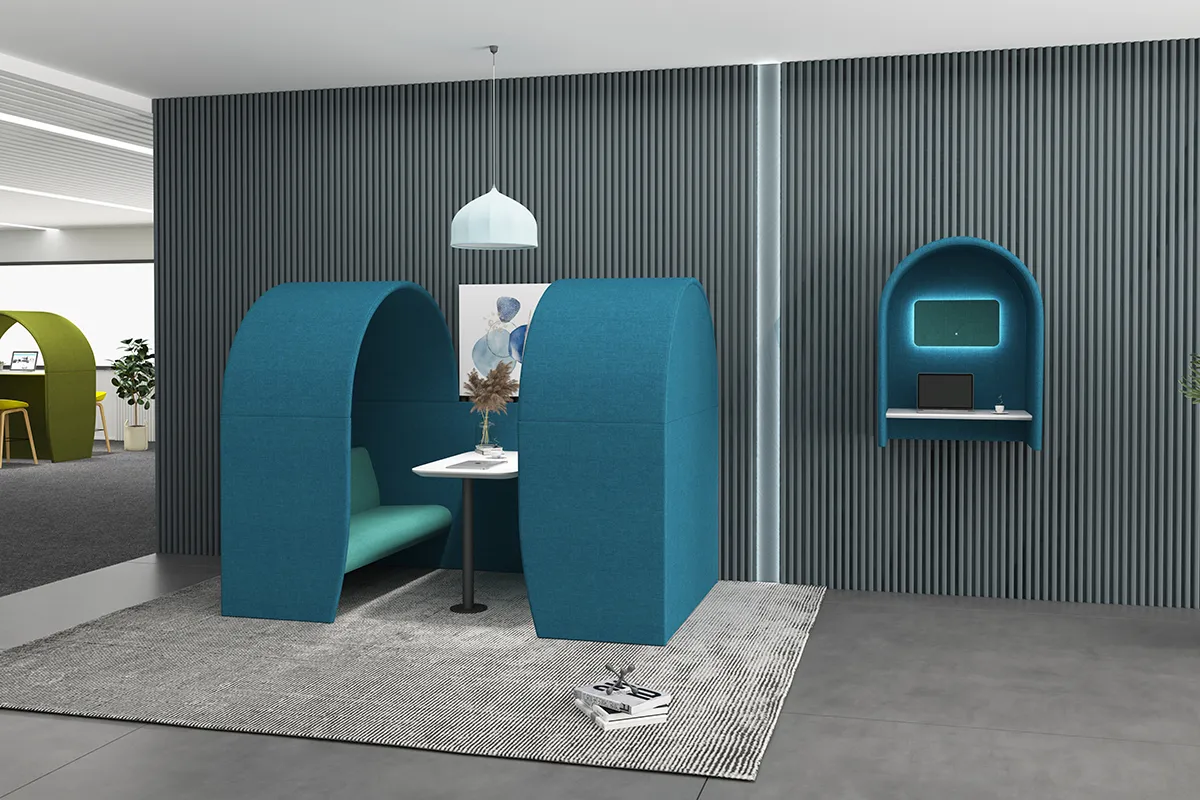
Step 1: Define Your Primary Problem
- Echo/echo/reverberation → Prioritize NRC (absorption)
- Sound traveling between areas → Need blocking (STC) or enclosures
- Speech intelligibility in open plan → Layered approach: absorption + masking + distance
Step 2: Understand What Different Products Deliver
| Product Type | NRC Range | STC/Blocking | Best For |
| Freestanding fabric screen | 0.60–0.85 | Minimal | Reducing echo, visual privacy |
| Desk-mounted privacy screen | 0.40–0.60 | None | Seated visual privacy only |
| Acoustic wall panel | 0.70–0.95 | None | Wall-mounted absorption |
| Ceiling baffle | 0.80–1.00 | None | Overall room absorption |
| Felt partition on stand | 0.60–0.80 | Low | Flexible absorption, some visual privacy |
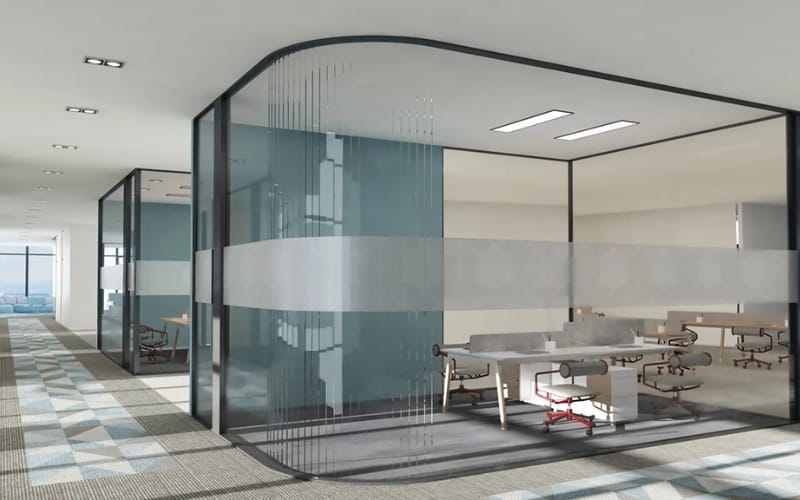
| Glass partition with seals | 0.20–0.40 | STC 35–45 | Blocking with light preservation |
| Folding wall with seals | 0.30–0.50 | STC 40–50 | Room division with blocking |
| Acoustic phone booth | 0.70–0.90 | DS,A 30–35 | Full enclosure for calls |
Step 3: Match Product to Problem
| If Your Problem Is… | Choose… |
| Echo in a large room | Ceiling baffles or clouds |
| Noise from adjacent workstations | Freestanding screens + ceiling treatment |
| Conversations traveling across open plan | Layered: screens, ceiling baffles, sound masking |
| Confidential meetings | Enclosed pod or meeting room with STC 40+ |
| Quick phone calls without disturbing others | Single-person phone booth |
| Visual privacy for seated work | Desk-mounted screens (acoustic benefit minimal) |
Real-World Examples
Example 1: Law Firm Open Office
Problem: Associates need to discuss client matters without being overheard. Current open plan offers no privacy.
Solution:
- Enclosed phone booths (DS,A 35) for calls
- Meeting rooms with STC 45 walls and sealed doors
- Acoustic ceiling baffles in open areas to reduce overall noise
Why this works: Confidential conversations require full enclosures—screens alone won’t provide legal-grade privacy.
Example 2: Tech Startup Open Office
Problem: Developers distracted by conversations; office feels loud and echoey.
Solution:
- Ceiling baffles (NRC 0.85) throughout open area
- Freestanding felt screens (NRC 0.75) between desk clusters
- Sound masking system
Why this works: The goal is ambient noise reduction, not total silence. Absorption reduces echo; masking makes conversations less intelligible.
Example 3: Shared Coworking Space
Problem: Members take calls at desks; noise complaints from focus workers.
Solution:
- Three single-person phone booths (DS,A 30)
- Designated “quiet zone” with acoustic panels and signage
- Freestanding screens between desks for visual privacy
Why this works: Providing alternative spaces for calls redirects noise. Quiet zone with absorption creates contrast.
Acoustic Partitions: Common Mistakes
| Mistake | Why It’s Problematic | Better Approach |
| Buying freestanding screens expecting sound blocking | Screens absorb, don’t block | For blocking, need full enclosures or sealed walls |
| Overlooking ceiling treatment | Sound travels over screens | Treat ceilings for overall noise reduction |
| Ignoring sound masking | Absorption alone may not achieve speech privacy | Combine with masking system |
| Choosing screens based on looks alone | Different materials have different acoustic properties | Check NRC ratings, not just appearance |
| Under-treating the space | One panel won’t fix a large room | Calculate coverage: aim for 25–40% of wall/ceiling area |
FAQ
1. What NRC rating do I need for an open office?
For noticeable reduction in echo and ambient noise, aim for NRC 0.70 or higher on panels covering 25–40% of ceiling or wall area. Lower ratings may not provide meaningful improvement.
2. Will a freestanding acoustic screen stop my coworker from hearing my conversation?
No. Freestanding screens absorb some sound but do not block transmission. Conversations remain audible on the other side. For speech privacy, you need a full enclosure (pod) or sealed walls.
3. What’s the difference between NRC and STC?
NRC measures absorption (how much sound a material soaks up). STC measures blocking (how much sound a barrier stops). A product can have high NRC and low STC—they’re independent properties.
4. Do I need acoustic treatment if I already have carpet?
Carpet helps with footstep noise but has limited effect on voice frequencies. For speech-related noise, you need additional absorption (panels, baffles) with NRC 0.70+.
5. How much of my ceiling should I treat with acoustic baffles?
As a rule of thumb, cover 25–40% of the ceiling area for noticeable improvement. In spaces with high noise levels or many hard surfaces, aim for 40% or more.
6. What’s the best acoustic solution for a home office?
For a home office, start with a thick rug, acoustic wall panel behind your desk, and heavy curtains. If noise from other rooms is a problem, weatherstripping around doors makes a significant difference.
7. Can I combine different acoustic products?
Yes—in fact, this is recommended. A layered approach (ceiling baffles + freestanding screens + sound masking) delivers better results than relying on any single solution.
Conclusion
How much noise reduction you need depends entirely on what you’re trying to achieve. Reducing echo in a large open office requires different solutions—and different acoustic ratings—than ensuring confidential conversations stay private.
Remember the fundamentals:
- For echo and reverberation: Look for NRC 0.70+. Treat ceilings and walls. Freestanding screens help but don’t solve alone.
- For speech privacy: Absorption alone isn’t enough. You need blocking (STC) or full enclosures. Freestanding screens won’t deliver this.
- For confidential conversations: Enclosed pods or rooms with STC 40+ or DS,A 35+. No shortcuts.
- For general office comfort: A layered approach—absorption, masking, and distance—creates a balanced acoustic environment.
Before buying, define your primary problem. Understand what different products actually deliver. And when in doubt, work with an acoustic specialist—the cost of buying the wrong solution far exceeds the cost of professional guidance.