





 Meet&Co
An effective office furniture procurement guide for businesses delivers a strategic framework to optimize asset management, balance upfront CAPEX with total cost of ownership (TCO), and align workspace functionality with corporate scaling.
Key Takeaways
Strategic Asset Shift: Workplace sourcing must transition from a reactive transaction (purchasing) to a lifecycle-driven business investment (procurement) that directly impacts workforce retention.
Total Cost Mastery: Successful procurement focuses on the “cost per seat” metrics and hidden lifecycle expenses rather than just initial retail price tags.
Supplier Optimization: Balancing manufacturers, dealers, and FF&E agencies based on volume and customization needs ensures reliable lead times and high ROI.
Future-Proofing Design: Incorporating modularity and ergonomics safeguards your capital investment against organizational scaling and shifting hybrid work models.
Office Furniture Procurement vs Purchasing (Why It Matters)

Strategic procurement focuses on lifecycle value, whereas purchasing is merely a transactional acquisition of goods.
In corporate real estate, understanding this distinction is vital because simple purchasing often leads to fragmented supply chains, high maintenance costs, and premature replacement cycles.
For enterprises aiming to build sustainable workspaces, partnering directly with leading office furniture manufacturers in china allows teams to move beyond transactional buying and enter the realm of strategic sourcing.
Integrating FF&E procurement (Furniture, Fixtures, and Equipment) into early-stage project planning ensures that commercial furniture sourcing aligns perfectly with a company’s financial goals and workplace design.
Strategic procurement treats office furniture not as an immediate expense, but as a depreciating corporate asset that requires proactive management, volume negotiation, and long-term warranty enforcement to maximize corporate capital efficiency.
Procurement Decision Framework
Needs & Workspace Planning
Workspace planning must prioritize explicit headcount forecasting and precise space mapping over aesthetic preferences.
As businesses adapt to hybrid work models, workspaces require data-driven layouts that balance hot-desking, collaborative zones, and quiet focus areas.
Procurement teams should map historical utilization rates to prevent over-purchasing, ensuring that every square foot of real estate is optimized for maximum daily productivity and spatial flexibility.
Budget Logic (CAPEX vs Lifecycle Thinking)
Evaluating office furniture through long-term lifecycle thinking yields far greater ROI than focusing solely on upfront CAPEX.
While initial expenditure is a critical balance-sheet metric, the primary KPI for procurement officers should be the total cost per seat over a five-to-seven-year period.
This comprehensive budgetary metric includes the initial purchase price, routine maintenance, administrative overhead, and the eventual disposal or recycling costs of the assets.
Vendor Selection Model
Selecting the right partner requires a rigorous analysis of your project’s scale, design complexity, and customization needs.
Buyers must choose between working directly with a factory, utilizing a local dealer, or hiring a dedicated FF&E procurement agency.
Evaluating vendors requires a balanced assessment across five critical dimensions: manufacturing capacity, price transparency, strict quality control certifications, historical lead-time reliability, and the robustness of their after-sales warranty frameworks.
Office Furniture Cost Breakdown
Understanding the complete cost allocation per employee prevents unexpected budget overruns during final project execution.
While a standard ergonomic chair and workstation desk form the financial baseline of your procurement budget, bulk office furniture pricing models vary wildly based on material quality, adjustment mechanisms, and order volumes.
To maintain strict cost control, procurement teams must look past the list price and calculate the often-overlooked hidden expenses.
Freight shipping, local customs duties, last-mile delivery logistics, professional on-site installation, and early replacement cycles can collectively inflate your initial furniture acquisition budget by 20% to 35% if they are not explicitly factored into your initial financial models.
Total Cost of Ownership
Total Cost of Ownership (TCO) calculation is the only reliable method to measure the true long-term value of workplace furniture.
A low upfront purchase price often masks high recurring maintenance costs and a dangerously short furniture replacement cycle of just 2 to 3 years.
Investing in premium commercial-grade assets extends this replacement timeline to a sustainable 7+ years, greatly lowering the annualized cost of the asset.
Furthermore, ergonomic furniture plays a massive, measurable role in driving daily corporate productivity.
Selecting high-performance ergonomic seating and sit-to-stand desks directly mitigates workplace fatigue, reduces musculoskeletal absenteeism, and boosts overall employee engagement, turning your furniture procurement into a high-yield tool for talent retention.
Vendor Selection Framework
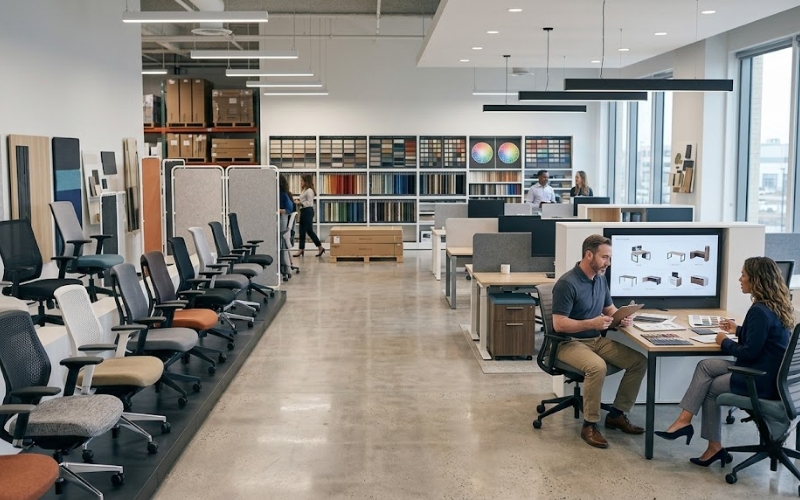
Vendor Types Comparison
Choosing your supply chain partner depends entirely on balancing design flexibility against volume cost savings.
A tabular analysis highlights the fundamental tradeoffs:
| Vendor Type | Best For | Price Advantage | Lead Time | Customization |
|---|---|---|---|---|
| Manufacturer | Bulk orders, Custom designs | High (Direct) | Medium-Long | Very High |
| Dealer | Fast turnaround, Small mix | Medium | Short | Low-Medium |
| FF&E Agency | Turnkey multi-category | Medium-Low | Managed | High |
| Design & Build | All-in-one office fit-out | Low (Bundled) | Integrated | Medium |
Evaluation Criteria
Supplier evaluation must balance commercial viability with operational execution.
Procurement teams must score potential partners using four strict pillars: uncompromised price transparency with no hidden fees, verified lead-time reliability backed by contractual penalties, agile customization capabilities to match corporate branding, and a dedicated, responsive after-sales support team capable of resolving field issues within 48 hours.
Industry-Based Procurement Strategies
Startups
Startups must focus heavily on operational flexibility and immediate cost efficiency to preserve precious runway.
Procurement strategies should favor modular, multi-functional furniture items that can be easily reconfigured as team structures shift.
Utilizing predictable, scalable furniture systems allows rapidly evolving companies to expand their headcount seamlessly without incurring redundant capital expenditures or facing complex logistics challenges during office moves.
Tech Companies
Technology firms require highly adaptable, modular workstation systems that fully support advanced data routing and power management.
Given the fast expansion readiness inherent in the tech sector, procurement frameworks must prioritize hot-desking configurations, collaborative standing desks, and built-in acoustic privacy solutions.
These flexible assets easily adapt to changing team sizes and support iterative, agile sprint cycles without requiring expensive infrastructure changes.
Enterprises
Global enterprises demand highly standardized procurement systems to maintain absolute brand consistency across multi-office rollouts.
Procurement directors should establish comprehensive global furniture catalogs with pre-negotiated volume pricing and fixed service level agreements (SLAs).
This standardized framework streamlines international supply chains, shortens local implementation timelines, and simplifies long-term facility management across diverse geographic corporate locations.
Procurement Checklist
An exhaustive, multi-stage procurement checklist serves as a vital tool to eliminate operational friction and mitigate financial risks.
Requirements Checklist: Document exact headcount metrics, spatial boundaries, IT power requirements, ergonomic certifications, and localized building compliance codes.
Vendor Shortlist Checklist: Verify manufacturing licenses, review audited financial statements, cross-reference client case studies, and test physical product samples.
Cost Evaluation Checklist: Calculate itemized unit costs, volume discounts, freight charges, customs duties, installation labor fees, and long-term warranty values.
Delivery & Lead Time Checklist: Confirm production milestones, shipping transit buffers, local off-loading access, on-site elevator dimensions, and disaster recovery timelines.
Common Procurement Mistakes
Choosing office furniture based solely on the lowest initial price tag invariably results in rapid product failure and higher long-term costs.
Low-cost alternatives routinely compromise on structural integrity and lack proper ergonomic certifications, directly leading to employee discomfort and increased workers’ compensation claims.
Additionally, underestimating international manufacturing and logistics lead times can severely disrupt your entire office opening schedule, resulting in expensive project delays.
Failing to plan for future scalability can leave your business stuck with discontinued furniture lines, forcing you to buy completely mismatched assets when your team expands.
Conclusion
Treating corporate procurement as a long-term strategic investment decision rather than a short-term expense safeguards capital and improves employee output.
By maintaining absolute cost clarity, optimizing your vendor selection matrix, and prioritizing a lifecycle ROI mindset, procurement professionals can design high-performance workspaces that adapt seamlessly to organizational growth.
For expert guidance in streamlining your corporate workspace sourcing, consulting with established industry pioneers like Meet&Co provides your business with the global manufacturing scale and custom design expertise needed to optimize every corporate seat.