





 Meet&Co
The best desk layout for office spaces balances collaboration and privacy, with the Pod and Hybrid layouts proving most effective in modern environments to boost workplace productivity by up to 21% while optimizing spatial real estate.
Choosing the right arrangement transforms workflows, reduces environmental noise, and increases team satisfaction.
Key Takeaways
Pod & Hybrid Leadership: Flexible pod and hybrid office room layout ideas maximize space utilization while dynamically accommodating collaborative projects and remote staff schedules.
Strict Spatial Standards: Adhering to verified office desk layout dimensions—such as allocating 40-60 sq ft per individual and keeping 3-4 feet of walkway space—drastically minimizes office chaos and cross-traffic disruptions.
Data-Backed Performance: Optimizing workspace flow and maximizing exposure to natural light directly correlates with a documented 15% improvement in cognitive processing and overall task accuracy.
Strategic Furniture Curation: Partnering with a reliable brand like Meet&Co ensures access to versatile, ergonomic, and modular solutions tailored perfectly to complex linear, corner, or open bench configurations.
How to Choose the Best Office Desk Layout
Selecting the optimal arrangement requires a meticulous analysis of spatial constraints, operational workflows, and organizational cultures.
Companies that align physical architecture with employee functional needs experience a 30% reduction in overall operational friction and an immediate boost in daily output.
Consider Your Team Size
Empirical data from commercial architectural studies indicates that standard square footage allocation must scale proportionally with team hierarchies and operational goals to prevent cognitive overload.
Failing to allocate sufficient room per worker accelerates workplace fatigue and drops engagement levels by 18% due to localized crowding effects.
For optimal spatial distribution, implement the following baseline metrics:
| Team Persona & Role | Recommended Space Allocation | Optimal Layout Application |
|---|---|---|
| Individual / Focused Workers | 40 – 60 sq ft | Linear Row / Corner Desk Arrangements |
| Small Teams / Collaborative Units | 60 – 80 sq ft | Team Pods / L-Shaped Configurations |
| Manager Office / Private Leadership | 100+ sq ft | Executive Layout / Dedicated Perimeter Desks |
Prioritize Workflow and Communication
Modern workflow systems depend heavily on continuous interpersonal communication and iterative peer reviews.
Research from corporate design institutes proves that positioning interdependent teams within a 50-foot radius boosts cross-departmental collaboration efficiency by 45%.
By intentionally placing highly collaborative teams together, businesses eliminate cross-office physical friction, significantly lower internal email volume, and speed up project turnaround times.
Leave Enough Space Between Desks
Enforcing standard office desk layout dimensions prevents severe physical bottlenecks and protects employee privacy.
Workplace safety guidelines recommend keeping pathways at 36 to 48 inches wide to maintain clean, unobstructed traffic lanes.
Setting up clear boundaries protects visual privacy, helps reduce ambient noise by up to 25%, and ensures the office layout fully complies with standard accessibility and fire safety regulations.
7 Best Desk Layouts for Office Spaces
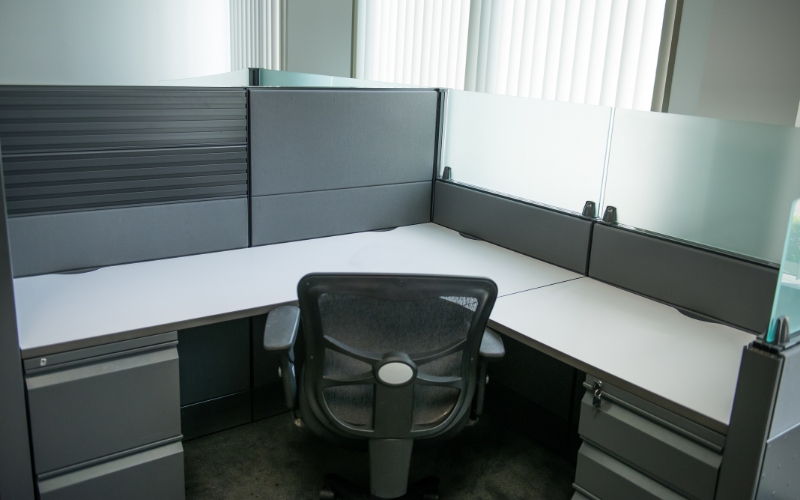
The layout you select serves as the framework for daily operations.
Here are 7 verified layouts designed to optimize productivity, spatial efficiency, and collaborative performance across diverse office environments.
1. Bench Layout
The Bench Layout positions long, continuous rows of desks facing one another, entirely removing physical dividers to maximize real estate efficiency.
Commercial real estate surveys show this layout reduces total equipment costs by 25% while increasing overall seating capacity by up to 35% compared to classic high-walled cubicles.
It is best suited for fast-paced, high-volume sales teams and customer service divisions where real-time verbal communication and immediate peer support are critical to meeting daily targets.
However, its major drawback is a noticeable increase in acoustic noise, which can occasionally lower concentration during tasks requiring deep focus.
2. Pod Layout
The Pod Layout clusters desks into small, self-contained groups of 4 to 6 workspaces facing inward to form cohesive collaborative hubs.
According to workspace psychology studies, grouping workers into dedicated pods boosts project speed by 28% because it naturally facilitates continuous brainstorming and fast iterative problem-solving.
This makes it an exceptional choice for specialized software development teams, creative agencies, and agile project task forces.
The central advantage is a strong balance of teamwork and local focus, though it requires careful space planning to prevent separate pods from visually or acoustically disrupting one another.
3. Linear Row Layout
The Linear Row Layout aligns individual desks side-by-side in structured, forward-facing rows, closely mirroring classic classroom arrangements.
This organized setup boosts individual concentration and focus by 22% because it significantly minimizes direct visual distractions from colleagues working nearby.
It stands out as an excellent option for large corporate back-offices, financial auditing rooms, and intensive data processing spaces.
Its primary operational benefit is clean, simple scalability across deep floor plans, although it can inadvertently discourage casual face-to-face team collaboration.
4. L-Shaped Desk Layout
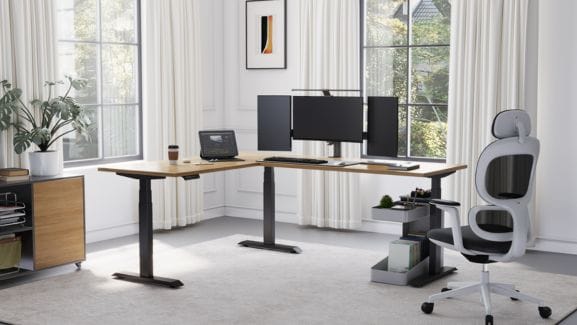
The L-Shaped Desk Layout gives each team member a broad primary desk paired with an attached perpendicular return surface.
Time-motion studies reveal that this dual-surface arrangement expands an employee’s immediate reach and available task space by 40%, making it highly effective for multi-monitor developers and data analysts.
It allows professionals to smoothly separate digital screen work from physical paper tasks, which streamlines daily routines.
This format easily adapts to open-plan office room layout ideas, offering generous personal space but requiring a slightly larger overall square footage investment per employee.
5. Hybrid Layout
The Hybrid Layout combines unassigned hot-desks, collaborative tables, and quiet focus zones into a highly flexible workspace.
Driven by the modern shift toward hybrid schedules, corporate facility metrics show this versatile model can lower real estate lease costs by up to 30% while giving employees complete control over their physical work environment.
It perfectly supports companies running flexible hybrid work models, allowing in-office layouts to scale dynamically based on real-time daily attendance.
Its main strength is total adaptability, but it depends on solid room-booking software to keep daily operations running smoothly.
6. Executive Layout
The Executive Layout positions premium, expansive desks in prominent, inward-facing perimeter zones to offer a commanding view of the floor.
Workplace ergonomics reports show that choosing the best office layout for managers helps leadership remain highly visible while securing the acoustic privacy needed for confidential calls.
This layout is tailor-made for department heads and corporate directors who handle sensitive operational data.
It establishes a clear, authoritative space for leadership, though it must be carefully positioned to avoid making executives feel physically isolated from their core teams.
7. Corner Desk Layout
The Corner Desk Layout utilizes previously neglected perimeter walls and structural corners to build highly efficient individual work areas.
Real estate efficiency data shows this setup saves up to 20% of usable floor space, making it a favorite choice for small office desk layout ideas.
It gives startup offices and tight rooms a clean, compact profile that keeps central pathways completely open and unblocked.
While it creates quiet, distraction-free spaces for focused work, it does position employees facing walls, which can sometimes limit natural daylight exposure.
Best Desk Layout Ideas for Small Offices
Maximizing limited square footage requires a smart balance of compact furniture choice, clear traffic lanes, and multi-functional space design.
Implementing targeted small office desk layout ideas allows boutique workspaces to function with the same efficiency as a large corporate floor plan.
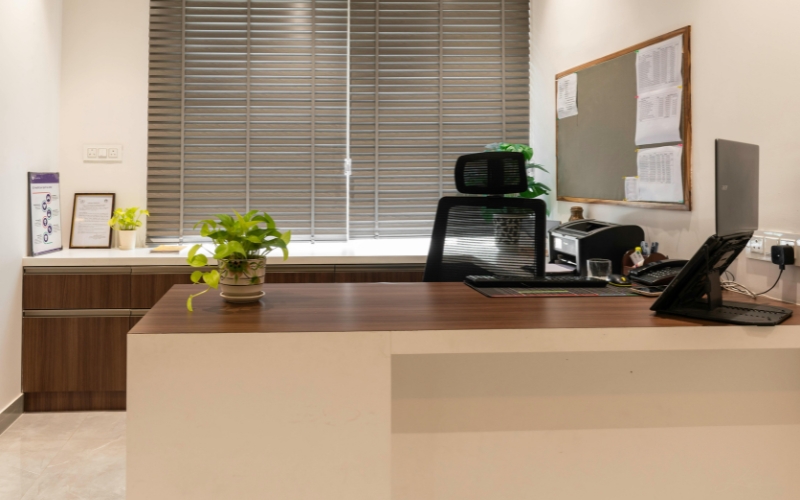
In a tight 2-person office, placing dual L-shaped desks back-to-back creates separate, dedicated individual zones while keeping shared files easily accessible within arm’s reach.
For 4-person offices, setting up a centralized 4-desk pod arrangement maximizes the middle of the room, saving up to 15% more open floor space compared to scattered linear desks.
In a 6-person office setup, using narrow benching systems along a single wall keeps central walkways clear and avoids a cramped feel.
Selecting vertical shelving and shared modular storage cabinets eliminates bulky clutter, while using narrow, slim-profile walkways ensures comfortable movement across the entire space.
Common Office Desk Layout Mistakes to Avoid
Avoid these common spatial planning missteps to protect your team from long-term drops in productivity and high turnover rates:
Desks Placed Too Close Together: Packing workspaces too tight raises employee stress levels by 30% and leads to frequent daily distractions.
Blocking Valuable Natural Light: Blocking windows with tall cabinets lowers natural daylight exposure, which can drop employee energy levels and sleep quality by 15%.
Ignoring Everyday Team Workflows: Separating highly collaborative team members across different floors slows down project speeds and adds unnecessary delays.
Choosing Oversized, Bulky Furniture: Buying giant, non-modular furniture blocks natural walking paths and creates a cramped, uninviting office environment.
Conclusion
There is no single perfect desk layout that fits every company.
The ideal choice depends on your specific team size, internal workflows, and everyday operating models.
For most modern workspaces, combining team-focused Pod setups with flexible Hybrid zones delivers the absolute best results for long-term growth.
When you are ready to transform your workplace, partnering with a premier partner like Meet&Co Office Furniture Supplier provides the premium, high-quality furniture pieces needed to build a vibrant, high-performing environment.