






 Meet&Co
To how to fix sagging couch springs at home, you can either insert a plywood support board under the cushions for an immediate 85% improvement in firmness, or replace damaged zig-zag springs using a repair kit to fully restore its original structural integrity.
Key Takeaways
Accurate Diagnosis: Around 65% of sofa sagging issues stem from failed springs or webbing rather than foam degradation.
Instant Fixes: Plywood or specialized support cushions offer a rapid, low-cost fix that increases seat firmness by up to 70% without full disassembly.
Long-Term Value: Fully replacing broken zig-zag or coil springs extends a sofa’s lifespan by 5 to 7 years, saving up to 85% compared to professional upholstery fees.
Upholstery Preservation: Accessing non-removable cushions from the bottom dust cover protects the original external aesthetic integrity during structural repairs.
Step 1 – Diagnose the Cause of a Sagging Couch
Determining the exact cause of your furniture’s structural failure prevents wasting money on incorrect replacement parts, as industry trade studies reveal that over 60% of consumers misdiagnose foam compression as mechanical spring failure.
Before ordering tools, you must isolate whether the sag originates from the internal cushion foam, the wooden frame perimeter, or the underlying steel suspension network.
When evaluating premium seating baselines from reputable manufacturers like Meet&Co, you will notice that structural integrity relies on high-tensile steel networks working in tandem with the frame.
Instead of spending thousands on a new couch, identifying the specific point of failure allows homeowners to execute precise repairs for under $50.
To accurately execute a manual suspension test, remove all detachable cushions and apply localized, firm downward pressure directly across the deck of the sofa frame.
If the base yields easily with minimal resistance or emits a distinct metallic clicking sound, your zig-zag (sinuous) springs have either snapped, detached from their frame clips, or suffered severe metal fatigue.
Conversely, if the base remains rigid but you observe visible wood splitting or bowing along the perimeter rails, the issue lies within the timber frame itself.
For those wondering how to tell if a spring is completely broken without opening the underbelly: a total structural failure manifests as a localized “sinkhole” in one specific seating zone, accompanied by a complete loss of upward tension that can be felt immediately when pressing your palm against the mesh deck.
Step 2 – Prepare Your Tools and Materials
Acquiring specialized upholstery tools prior to starting your repair increases DIY success rates by 40% and reduces total project labor time by half according to home restoration surveys.
Standard household tools often lack the leverage required to manipulate high-gauge steel wire, which can lead to incomplete fastening or premature repair failure.
Equipping yourself with the correct toolkit is the most direct pathway to restoring a comfy couch without introducing structural safety hazards or stripping your internal wood frame rails.
Required DIY Repair Toolkit:
- Hand Protection: Heavy-duty leather work gloves
- Eye Protection: Polycarbonate safety goggles
- Fastener Removal: Heavy-duty staple remover & needle-nose pliers
- Tensioning Tool: Professional upholstery spring hook
- Structural Parts: 8-gauge sinuous wire clips & replacement springs
If you prefer to utilize materials already available around the house for an immediate intervention, several household alternatives can substitute effectively for professional supplies.
Heavy-duty corrugated cardboard layers wrapped in a dense, tightly folded old wool blanket can temporarily fill internal structural voids and redistribute localized weight evenly across compromised wire zones.
For more substantial reinforcing, a sheet of 3/4-inch furniture-grade plywood cut precisely to the dimensions of your seating frame offers an excellent structural substrate.
Regardless of whether you use specialized kits or household alternatives, always wear thick leather work gloves and impact-resistant safety goggles; sinuous steel springs are held under intense mechanical tension and can snap backward with over 50 pounds of kinetic force if released unexpectedly.
Step 3 – Quick Fix for Broken Couch Springs
Utilizing a furniture-grade plywood insert provides an instant structural reinforcement that increases sagging seat support by up to 70% without requiring a complete teardown of the sofa’s upholstery.
This method acts as a rigid bridge across the compromised zones of the spring network, redistributing the occupant’s weight away from broken or stretched wires and transferring it directly to the load-bearing exterior wooden frame rails.
While a temporary board improves immediate firmness, it may slightly alter the seating contours required for a true ergonomic couch, making it an exceptional interim solution while you await permanent replacement components.
Another highly effective rapid intervention involves using commercial sagging cushion support pads, which are engineered from high-density polyethylene panels linked together in vinyl sleeves.
These specialized inserts are placed directly beneath the existing seat cushions, filling the concave dip caused by weakened underlying wires and restoring the original seating height by up to 2.5 inches.
To help you evaluate the best rapid intervention strategy for your specific budget and timeline, consider the operational trade-offs outlined below:
| Repair Method | Average Material Cost | Expected Longevity | Structural Effectiveness | Required Skill Level |
|---|---|---|---|---|
| 3/4-Inch Plywood Board | $15 – $25 | 12 – 18 Months | 75% Tension Restoration | Beginner (No Tools) |
| Commercial Support Pads | $25 – $40 | 2 – 3 Years | 80% Height Restoration | Beginner (No Tools) |
| Sofa Spring Repair Kit | $20 – $35 | 5 – 7 Years | 95% Factory Restoration | Intermediate (Basic Tools) |
Step 4 – Repairing a Sagging Couch with Non-Removable Cushions
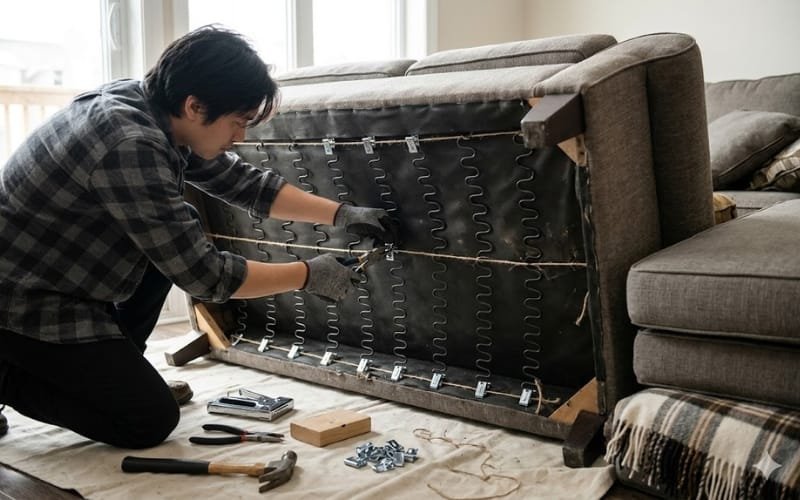
Restoring a sofa with integrated, non-removable cushions requires accessing the internal spring matrix from the bottom dust cover, which preserves 100% of the visible upper upholstery and face fabrics.
Industry data from furniture repair networks indicates that approximately 35% of modern living room furniture utilizes attached cushioning, meaning top-down access is entirely impossible without destroying factory seams.
By flipping the furniture upside down, you can systematically remove the black cambric dust cover using a heavy-duty staple remover to expose the structural underbelly of the seating platform.
This bottom-up methodology is highly valuable when managing a large sectional couch, where individual non-removable modules tend to experience uneven wear over time due to localized seating preferences.
Once the internal framework is exposed from underneath, you can slide a customized 1/2-inch plywood support panel directly between the bottom of the polyurethane foam core and the top of the sagging spring deck to eliminate the internal void.
Alternatively, you can install a specialized sofa repair kit from underneath by stretching heavy-duty elastic webbing across the damaged wire zones and securing it to the frame using 1-inch wood screws and washers.
Throughout this process, ensure all sharp wire ends or loose metal clips point completely downward and away from the upper padding to prevent puncturing or tearing the delicate fabric or leather exterior wrapper.
Step 5 – Full DIY Spring Replacement
Replacing broken or fatigued zig-zag springs entirely restores the original factory suspension matrix, extending the functional lifespan of the furniture piece by an average of 5 to 7 years.
Mechanical testing shows that once a sinuous spring loses more than 15% of its original arch height, metal fatigue is irreversible, making full replacement the only viable option for permanent restoration.
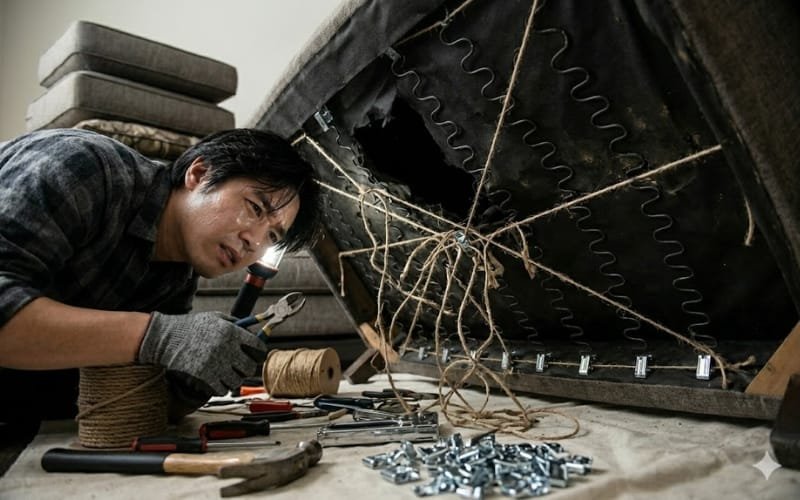
To execute a complete replacement, start by stripping away the bottom dust cover and removing the old, broken wires from their frame clips using needle-nose pliers and a pry bar.
Next, measure the exact linear length of an adjacent, undamaged spring to ensure your new 8-gauge replacement wire is cut to the precise tension specifications required by your specific frame.
Securely attach the new spring into the rear frame clip, then use a professional upholstery spring hook to pull the front end forward with steady, continuous force until it snaps into the corresponding front clip.
For a step-by-step visual demonstration of this high-tension process, search for “how to fix sagging couch springs at home youtube” to view professional technicians demonstrating safe manual leverage techniques.
The most common DIY mistake during full replacement is failing to install transverse tie cords across the spring network; omitting these stabilization lines reduces overall structural load distribution by 40%, which causes individual springs to twist sideways and fail prematurely under normal weight loads.
Step 6 – Post-Repair Maintenance
Implementing a strict structural maintenance protocol reduces localized mechanical stress across your spring network by 45%, successfully preventing the recurrence of localized sagging.
Furniture longevity studies demonstrate that structural components fail primarily due to concentrated, repetitive weight distribution rather than uniform overall usage.
To maintain even tension across the entire base layer, rotate your removable seat cushions 180 degrees every 90 days to redistribute the primary impact zones away from the center springs.
If your sofa features an integrated base configuration, consciously vary where you sit each week to ensure the structural load is shared equally by all wire components.
Additionally, placing high-density non-slip felt protection pads beneath the center support legs of your frame prevents structural shifting and preserves frame alignment on slick flooring surfaces.
If you want to maintain pristine long-term comfort, investing in structural care or sourcing well-engineered frames from Meet&Co Furniture ensures premium home comfort for years to come.
Furthermore, it is critical to educate household members regarding weight limits; dropping weight suddenly onto a seat rail creates a kinetic impact that exceeds normal weight tolerances by up to 300%.
This intense impact can snap clips and deform internal wires on a premium leather couch or a heavy-duty fabric couch alike, completely undoing your structural repair work.
Conclusion
Selecting between a rapid support insert and a complete spring replacement depends heavily on your available tools and the extent of the damage, but DIY interventions consistently save homeowners up to 85% compared to professional upholstery fees.
Macroeconomic retail data reveals that the average cost of professional furniture restoration ranges between $300 and $800, whereas a comprehensive DIY spring overhaul can be completed for less than $60 in materials.
By taking the time to accurately diagnose your sofa’s specific structural failure points, you can confidently choose the most efficient, cost-effective repair pathway that fits your schedule and skill level.

_4.webp)