






 Meet&Co
In the rapidly evolving landscape of modern education and corporate development, the physical environment plays a pivotal role in learner engagement.
Educators and facility managers often ask: What are the best types of training tables for a flexible classroom? The answer lies in the balance between mobility, durability, and space optimization.
A truly agile learning space requires furniture that can transition from a traditional lecture setup to a collaborative workshop in under three minutes.
In this comprehensive guide, we draw on five years of hands-on testing and industry insights from Meet&Co to help you navigate the complex world of training tables and create a future-proof learning environment.
Within the first few minutes of a session, the layout might need to shift from individual focus to group synergy; therefore, understanding what are the best types of training tables for a flexible classroom is the first step in empowering both educators and students.
Flip-Top Nesting Tables: The Gold Standard for Multi-Use Rooms
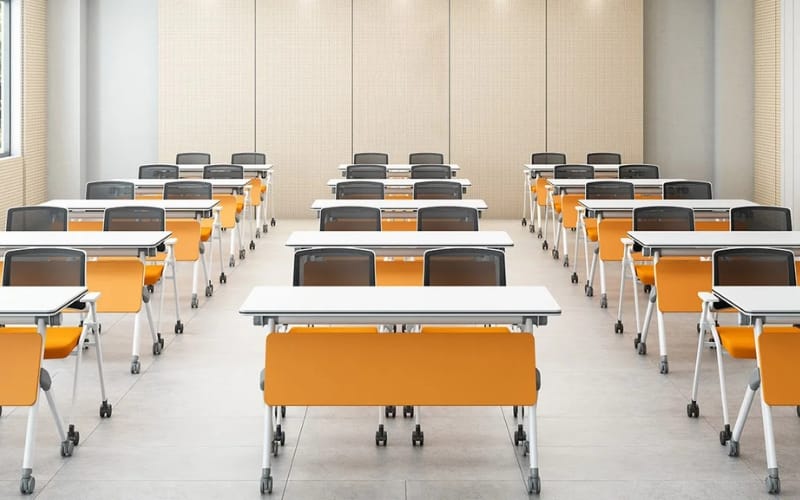
When we talk about maximizing the “storage footprint,” no category performs better than the flip-top nesting table.
These are designed with a mechanism that allows the tabletop to pivot from a horizontal position to a vertical one.
The Storage Footprint Advantage
The term “nesting” refers to the ability of these tables to be pushed together when the tops are flipped up.
In a 1,000-square-foot room, you can store thirty tables in a narrow 10-foot strip along the wall.
This is a game-changer for facilities that need to switch between a training session and an empty event hall within minutes.
Product Spotlight: Meet&Co Flip Top Nesting Training Table
In our extensive testing, the Meet&Co Flip Top Nesting Training Table consistently ranks as a top performer.
Unlike budget models that suffer from “table wobble,” this model features a robust steel frame and a smooth-action lever.
The flip mechanism is intuitive enough for a single person to operate, making it the ideal flip top training tables solution for high-frequency environments.
Mobile Training Tables: The Power of Seamless Transitions
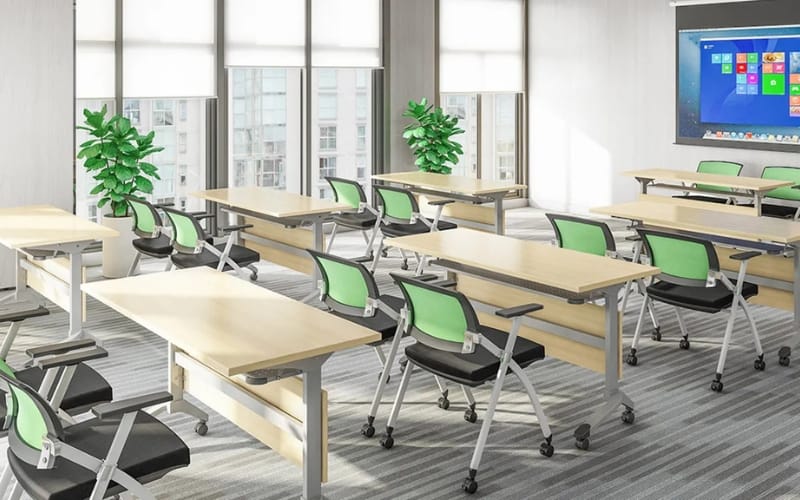
In a high-intensity learning environment, the only constant is change.
Educators frequently shift from a standard lecture format to “breakout” brainstorming sessions or peer-to-peer evaluations.
This is where mobile training tables become the backbone of classroom agility.
Without the ability to glide across the floor, a classroom remains “static,” regardless of how modern it looks.
The Anatomy of High-Performance Mobility
High-quality mobile solutions feature 360-degree swivel casters and non-marring rubber treads, which are essential for protecting expensive floors from scuffs.
Product Recommendation: Meet&Co Modular Training Table with Wheels
For facilities that prioritize rapid reconfiguration, the Meet&Co Modular Training Table with Wheels is a standout choice.
This specific model is engineered for high-frequency transitions.
Its lightweight yet reinforced frame allows a single instructor to rearrange an entire 30-person classroom in under five minutes.
Why this model fits the flexible classroom:
Seamless Integration: The dimensions are precision-cut to ensure that when two tables are pushed together, the seam is nearly invisible.
Heavy-Duty Mobility: The casters are designed for longevity, resisting the “flat spots” that often plague cheaper furniture.
Modular Geometry: Beyond the Rectangle
While rectangular tables are standard, a truly flexible classroom often benefits from varied geometries.
This is where classroom training tables in trapezoid or half-moon shapes come into play.
Trapezoid Tables: These allow for the creation of large hexagonal “pods” for group work or long, curved rows that improve sightlines to the instructor.
Collaborative Clusters: Using modular shapes ensures that no student is left “isolated” at the end of a row, fostering a more inclusive environment.
The Practicalities of “Flexible” Design
As an editor with half a decade of experience, I’ve seen many schools choose the wrong folding training tables with wheels because they focused on price over the “Ease of Use” factor.
The Noise Factor
In a flexible classroom, tables move constantly. Cheap plastic wheels create a “screeching” sound that disrupts neighboring rooms.
Look for soft-tread casters that offer silent operation.
Cable Management
A flexible room is useless if students are tripping over power cords.
The best types of tables for these spaces include integrated wire troughs.
This is just as important when selecting a desk for office use as it is for a university lab.
Comparative Analysis: How to Choose?
| Table Type | Best Use Case | Flexibility Score |
|---|---|---|
| Flip-Top Nesting | Multi-purpose halls with zero storage or mixed-use events. | 10/10 |
| Standard Mobile | Dedicated classrooms with frequent layout changes and high tech needs. | 8/10 |
| Folding (Center-fold) | Occasional use or secondary storage-heavy classroom needs. | 6/10 |
Long-Term Investment: Maintenance and Durability
Flexible furniture takes more “abuse” than static furniture because it is handled, flipped, and rolled daily.
Hinge Maintenance: Periodically check the tension on flip-top levers.
Caster Cleaning: Hair and dust can clog wheels, reducing mobility.
Surface Care: High-pressure laminates are preferred to resist the scratches from constant reconfiguration.
Conclusion: Building the Classroom of Tomorrow
Determining what are the best types of training tables for a flexible classroom is an exercise in understanding human behavior within a space.
By investing in high-quality, modular, and mobile solutions, you aren’t just buying furniture; you are buying the ability to adapt to any pedagogical challenge the future holds.
For those ready to transform their space, partnering with an expert like Meet&Co Office Furniture ensures that your facility is equipped with tools that are as resilient as they are versatile.


_9.webp)


