







 Meet&Co
If you’re seriously researching how to choose a modern sofa for a family with kids?
You’ve probably noticed something frustrating—most advice online sounds helpful, but doesn’t hold up in real life.
That’s because most sofas are designed for appearance, not daily stress.
In a home with kids, your sofa will be exposed to:
- Liquid spills that penetrate fabric within seconds
- Constant friction from movement, climbing, and jumping
- Oils, dirt, and repeated pressure that break down materials over time
👉 The result? Many sofas look worn out within a year.
After 5 years of hands-on testing, one thing is clear:
The right sofa isn’t the one that looks best—it’s the one that performs best under pressure.
This guide will walk you through exactly how to choose one that lasts.
Step 1: Define Your Sofa’s “Stress Level”
Before choosing materials or styles, you need to understand:
👉 How much real-world stress will your sofa face?
Low Stress (Older kids, controlled use)
- Minimal spills
- Light daily use
✔ More flexibility in materials
Medium Stress (Typical family use)
- Daily sitting + occasional mess
- Food and drink exposure
✔ Requires balance of durability and comfort
High Stress (Toddlers or pets involved)
- Frequent spills
- Jumping and rough use
- Scratching and staining
✔ Requires maximum durability + easy cleaning
👉 Key insight:
A sofa that performs well in a low-stress home can fail very quickly in a high-stress one.
Step 2: Material Selection (What Actually Works Long-Term)
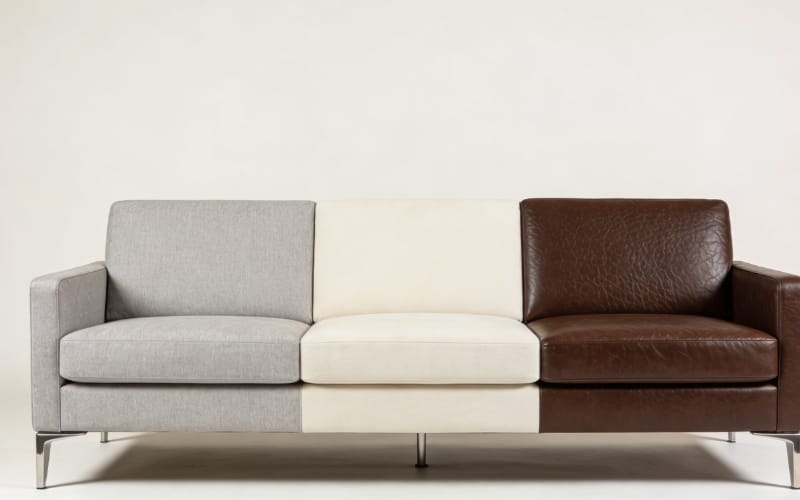
Material choice is the single biggest factor affecting lifespan.
But instead of just listing options, let’s look at how they behave under real conditions.
🥇 Performance Fabric (Most Reliable Choice)
High-quality performance fabric is engineered to resist:
- Liquid absorption
- Staining
- Fiber breakdown
The critical distinction most buyers miss:
Not all “performance fabrics” are equal.
Low-quality version:
- Surface coating only
- Protection wears off
High-quality version:
- Protection built into fibers
- Long-term resistance
Real-world behavior:
- Spill sits on surface instead of soaking in
- Dirt can be wiped away before bonding
- Fabric resists fading and thinning
👉 Conclusion:
For families with kids, performance fabric is not a luxury—it’s a baseline requirement.
🥈 Microfiber (Best Budget Option)
Microfiber works because of its extremely tight fiber structure.
Advantages:
- Slows liquid penetration
- Naturally stain-resistant
- Affordable
Limitations:
- Can absorb oils over time
- May develop uneven coloration
👉 Best for:
- Budget-conscious households
- Moderate daily use
🥉 Leather (Situational Use Only)
Leather performs very differently from fabric.
Strengths:
- Easy to wipe clean
- Doesn’t absorb liquids
Weaknesses:
- Scratches permanently
- Sensitive to temperature
- Requires maintenance
👉 Best used when:
- Kids are older
- No pets are present
- Aesthetic is a priority
❌ Materials That Fail in Family Use
Certain materials consistently underperform:
- Linen → absorbs instantly
- Velvet → traps oils and dust
- Loose weave fabrics → difficult to clean deeply
👉 Rule:
If a material requires careful maintenance, it will not survive daily family use.
Step 3: Durability Metrics (The Specs That Actually Matter)
Most buyers rely on feel—but durability is measurable.
Fabric Durability (Rub Count)
This indicates how much friction fabric can handle.
- 15,000 → light residential use
- 25,000 → standard use
- 30,000+ → recommended for families with kids
👉 Why it matters:
Low ratings lead to visible wear, pilling, and thinning.
Martindale Rating
A widely used durability test.
- 20,000 → acceptable
- 30,000 → durable
- 40,000+ → heavy-duty
👉 For long-term use: aim for 30K+ minimum
Cushion Density (The Hidden Lifespan Factor)
This determines whether your sofa keeps its shape.
- Low density → cushions flatten quickly
- High density → maintains structure
👉 Recommended:
- 2.5 lb/ft³ or higher
Real impact:
Low-density cushions:
- Lose support within months
- Affect posture and comfort
Frame Construction (Structural Integrity)
The frame determines whether the modern style sofa lasts years—or fails entirely.
Durable construction:
- Kiln-dried hardwood
- Reinforced corner joints
Weak construction:
- Stapled frames
- Particle board
👉 Frame failure usually means full replacement.
Step 4: Cleaning Strategy (The Most Overlooked Decision)
Most people underestimate how often cleaning will be needed.
Must-Have Features
- Removable covers
- Machine-washable fabric
- Zippered cushions
- Stain-resistant fibers
Real-Life Scenario
Without removable covers:
- Spill = permanent damage
With removable covers:
- Wash = restored appearance
👉 Key rule:
If cleaning is inconvenient, it won’t happen consistently.
Step 5: Why Modular Sofas Make More Sense for Families
Traditional sofas assume a fixed lifestyle. Families are constantly changing.
Advantages of Modular Sofas
- Individual sections can be replaced
- Layout can be adjusted
- Easier to move and maintain
👉 This flexibility is why many families choose modular designs from Meet&Co.
Step 6: Color Strategy Based on Real Use
Color isn’t just aesthetic—it affects maintenance.
Best-performing colors:
- Medium gray
- Taupe
- Textured neutrals
Why they work:
- Hide stains
- Mask wear patterns
- Reduce visible dirt buildup
Colors to avoid:
- White → shows stains immediately
- Black → highlights dust and pet hair
Step 7: Common Mistakes That Shorten Sofa Lifespan
1. Choosing Style Over Function
→ Leads to faster wear and replacement
2. Ignoring Cleaning Requirements
→ Results in permanent staining
3. Trusting Marketing Claims
→ “Stain-resistant” doesn’t always mean washable
4. Skipping Physical Testing
Always check:
- Fabric resistance
- Cushion rebound
- Frame stability
FAQ
Q1: What is the best sofa material for kids?
Performance fabric is the most reliable due to its durability and stain resistance.
Q2: How durable should a family sofa be?
Look for at least 30,000 rub count and high-density foam.
Q3: Is a modular sofa better for families?
Yes, because modular sofa offers flexibility, easier maintenance, and replaceable sections.
Q4: What color sofa is best for kids?
Medium-tone colors like gray or taupe are the most practical.
Conclusion
Choosing the right modern design sofa is not about trends—it’s about real-life performance.
To make the right decision:
- Choose durable, engineered materials
- Ensure high durability ratings (30,000+ rub count)
- Prioritize cleanability and adaptability
Now you fully understand How to choose a modern sofa for a family with kids—and more importantly, how to choose one that will last for years.

_17.webp)
_2.webp)