





 Meet&Co
The school library isn’t what it used to be. Gone are the days of silent rows of study carrels, stern librarians shushing students, and shelves upon shelves of dusty encyclopedias. Today’s school library is a vibrant, multi-functional hub—part classroom, part makerspace, part media studio, and part living room.
This transformation demands a new approach to furniture. Bookshelves still matter, but they’re no longer the centerpiece. Modern school libraries need furniture that supports collaboration, accommodates technology, welcomes diverse learners, and adapts to activities that shift from hour to hour. A space that works for independent reading at 9 AM might need to host a robotics workshop at 1 PM and a student council meeting at 3 PM.
Meet&Co’s school furniture guide explores the essential furniture types for modern school libraries, how to select pieces that serve multiple functions, and how to create zones that balance activity levels. Whether you’re planning a new library or refreshing an existing one, you’ll find practical guidance for moving beyond bookshelves.
The Evolving Role of School Libraries
Before diving into furniture types, it’s important to understand what today’s school libraries actually do. The furniture you choose must support these diverse functions.
| Library Function | What It Involves | Furniture Needs |
| Reading and research | Independent reading, quiet study | Comfortable seating, task lighting, individual work surfaces |
| Collaborative learning | Group projects, peer tutoring, discussion | Mobile tables, shared work surfaces, whiteboard access |
| Digital media creation | Video recording, podcasting, editing | Sound-dampening surfaces, power access, flexible layouts |
| Makerspace activities | Robotics, 3D printing, hands-on projects | Durable work surfaces, tool storage, easy-clean materials |
| Instruction | Class visits, library lessons, presentations | Flexible seating, clear sightlines, teaching station |
| Community gathering | Events, clubs, after-school programs | Configurable layouts, soft seating, welcoming atmosphere |
The most successful libraries don’t try to do everything in one zone. They use furniture to create distinct areas that support different activities—often simultaneously.
7 Essential Furniture Types for Modern School Libraries
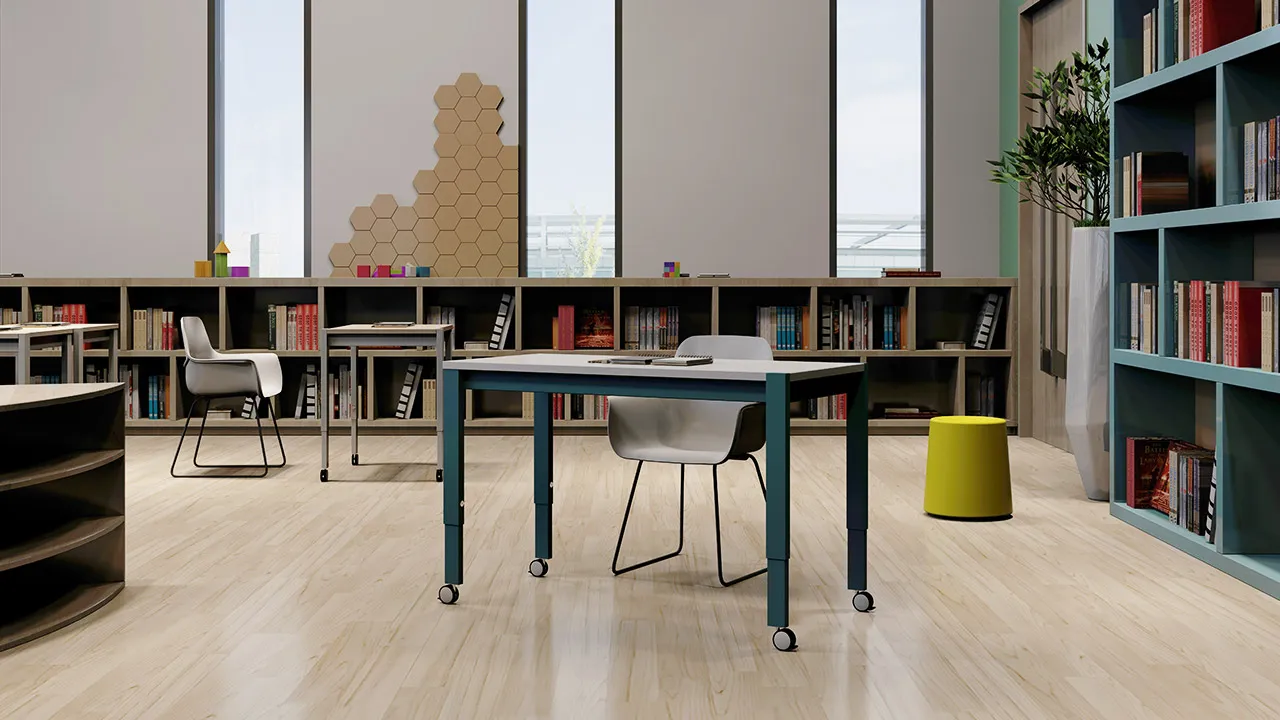
Daman Training Table with Wheels
1. Mobile Bookshelves and Display Units
Books aren’t going away, but how they’re displayed and accessed has changed. Fixed floor-to-ceiling shelving is being supplemented—and sometimes replaced—by mobile units that can be repositioned as needs change.
| Type | Best For | Key Features |
| Low-height shelving (42–48″) | Maintaining sightlines, creating open feel | Casters, rounded corners, forward-facing display options |
| Mobile book trucks | Curated collections, rotating displays | Locking casters, multiple shelves, easy maneuverability |
| Modular shelving systems | Flexible configurations, future reconfiguration | Interchangeable components, adjustable heights, wall or floor mount options |
| Face-out display units | High-interest titles, new arrivals, featured books | Angled shelves, eye-catching design, mobility |
What to look for:
- Casters on lower units for easy reconfiguration
- Adjustable shelves to accommodate different book sizes
- Durable finishes that withstand frequent use
- Rounded corners for student safety
2. Flexible Seating for Reading and Relaxation
Soft, comfortable seating signals that the library is a welcoming space, not just a place for research. But flexibility matters—students need options that suit different comfort preferences and postures.
| Seating Type | Best For | Considerations |
| Lounge chairs | Extended reading, relaxation | Upholstery durability; removable, washable covers |
| Floor cushions and poufs | Informal reading, younger students | Easy to store; durable, cleanable fabric |
| Modular soft seating | Configurable reading nooks | Pieces that connect; various shapes (curve, straight, corner) |
| Rocking chairs | Sensory regulation, focused reading | Stability; quiet movement; appropriate size for age group |
| Bean bags | Casual reading, lounging | Durability; filled with foam rather than beads for longevity |
What to look for:
- Stain-resistant, easy-clean fabrics
- Weighted or stable bases for safety
- Variety of seat heights to accommodate different ages
- Stackable or nestable designs for storage
3. Collaborative Workstations
Group work requires surfaces that accommodate multiple students, technology, and materials. Collaborative workstations should be mobile enough to reconfigure and durable enough to withstand daily use.
| Station Type | Best For | Key Features |
| Modular tables | Group projects, team work | Trapezoid or kidney shapes that connect in multiple configurations |
| Whiteboard tables | Brainstorming, planning | Dry-erase surfaces; markers and erasers nearby |
| High-top tables | Standing collaboration, quick meetings | Counter-height; stools or perching seats |
| Mobile tables with casters | Reconfigurable group spaces | Locking casters; durable edges; power access |
What to look for:
- Casters on at least one leg for mobility
- Scratch-resistant, easy-clean surfaces
- Power outlets and USB ports integrated into table surfaces
- Lightweight enough for students to move safely
4. Technology-Integrated Furniture
Laptops, tablets, and charging devices are everywhere in modern libraries. Furniture needs to accommodate them without creating cable clutter or restricting access.
| Furniture Type | Best For | Key Features |
| Power-integrated tables | Device charging, laptop work | Built-in outlets, USB ports, cable management channels |
| Charging carts | Device storage and charging | Secure locking, ventilation, mobility |
| Tech-enabled carrels | Individual digital work | Integrated power, task lighting, privacy panels |
| Media production stations | Video/audio creation | Sturdy surfaces, monitor mounts, sound-dampening elements |
What to look for:
- Tamper-resistant outlets for safety
- Cable management that keeps cords off floors
- Surfaces that don’t overheat devices
- Flexible configurations that accommodate future technology
5. Makerspace and Hands-On Learning Furniture
Makerspaces require durable, adaptable furniture that can handle tools, materials, and projects of all kinds.
| Furniture Type | Best For | Key Features |
| Sturdy work tables | Building, creating, experimenting | Heavy-duty surfaces, easy-clean finishes, adjustable heights |
| Mobile storage units | Materials, tools, supplies | Locking casters, labeled bins, accessible organization |
| Project display shelves | Showcasing student work | Open shelving, visible from multiple angles |
| Standing-height tables | Detailed work, tool use | Counter height, stable bases |
What to look for:
- Surfaces that resist scratches, stains, and heat
- Storage that keeps materials accessible and organized
- Durable construction that withstands tools and equipment
- Easy-to-clean materials for messy projects
6. Acoustic Solutions for Sound Management
Libraries are no longer silent, but they also can’t be chaotic. Acoustic furniture helps manage sound levels across different zones.
| Acoustic Solution | Best For | Key Features |
| Felt privacy screens | Quiet zones, individual focus | Sound-absorbing material, partial visual privacy |
| Acoustic panels | Reducing echo, dampening noise | Wall-mounted or freestanding; various colors and shapes |
| Soft seating with acoustic backing | Reading areas with sound control | Upholstered pieces with sound-absorbing materials |
| Ceiling baffles | Overall noise reduction | Suspended elements that don’t take floor space |
What to look for:
- NRC (Noise Reduction Coefficient) ratings of 0.7 or higher
- Fire-rated materials for commercial spaces
- Aesthetic integration with library design
- Placement that doesn’t block sightlines for supervision
7. Mobile Whiteboards and Display Surfaces
Writable surfaces are essential for brainstorming, instruction, and student collaboration. Mobile options add flexibility.
| Type | Best For | Key Features |
| Mobile whiteboards | Group work, instruction, brainstorming | Double-sided, locking casters, marker trays |
| Glass boards | Modern aesthetic, easy cleaning | Non-ghosting surfaces, magnetic options |
| Pin-up panels | Displaying student work, announcements | Fabric or cork surfaces, mobile or wall-mounted |
| Interactive displays | Digital instruction, presentations | Height-adjustable, touch-enabled, integrated technology |
What to look for:
- Sturdy frames that don’t wobble
- Locking casters for stability during use
- Easy-to-clean surfaces
- Compatibility with markers, magnets, or pins
Zoning Your Library with Furniture
Effective library design uses furniture to define zones for different activities. Here’s how to create distinct areas without building walls.
| Zone | Furniture Types | Characteristics |
| Quiet reading zone | Lounge chairs, floor cushions, low shelving | Soft surfaces, task lighting, acoustic treatment |
| Collaborative zone | Modular tables, mobile whiteboards, soft seating clusters | Flexible layouts, writable surfaces, power access |
| Makerspace zone | Sturdy work tables, tool storage, standing-height surfaces | Durable materials, easy-clean surfaces, tool accessibility |
| Media production zone | Tech-integrated tables, acoustic panels, monitor arms | Sound control, power access, flexible configurations |
| Instruction zone | Flexible seating, teaching station, clear sightlines | Configurable layouts, screen visibility, student-facing whiteboard |
| Display and circulation zone | Face-out shelving, display units, service desk | High visibility, clear pathways, welcoming entry |
Zoning Tips
- Place active zones near entrances, quieter zones deeper in the space
- Use furniture height strategically: lower pieces near windows to preserve light, taller pieces to define zone boundaries
- Create clear pathways between zones—at least 36 inches for main circulation
- Use area rugs to visually define zones without adding walls
- Ensure staff sightlines from the circulation desk to all areas, especially quieter zones
How to Choose Library Furniture
1. Durability and Maintenance
School furniture faces more abuse than almost any other category. Quality matters.
| Consideration | What to Look For |
| Surface durability | Scratch-resistant laminates, powder-coated metal, high-pressure laminate tops |
| Upholstery | Stain-resistant, bleach-cleanable fabrics; removable, washable covers |
| Frame construction | Welded steel frames, reinforced joints, commercial-grade casters |
| Edge finishing | Rounded corners, bumper edges, tamper-resistant hardware |
| Warranty | 5–10 years minimum for case goods; lifetime for frames |
2. Flexibility and Adaptability
The library of today may not be the library of tomorrow. Choose furniture that can adapt.
- Casters on tables, shelving, and storage units allow reconfiguration without heavy lifting
- Modular systems can be expanded or reconfigured as needs change
- Adjustable heights accommodate different ages and activities
- Nesting and stacking designs free floor space when not in use
3. Age Appropriateness
Different age groups need different furniture scales and features.
| Age Group | Considerations |
| Pre-K and early elementary | Low heights, rounded edges, durable and easy-clean surfaces, bright colors |
| Upper elementary and middle school | Varied seating options, collaborative spaces, technology integration |
| High school | More formal study options, lounge seating, professional-grade technology furniture |
4. Safety and Compliance
- ASTM and CPSIA compliance for children’s furniture
- Flame-retardant materials that meet commercial fire codes
- Tip-resistant design for tall shelving and heavy pieces
- Non-toxic finishes with low VOCs
5. Budgeting and Prioritization
Not every library can replace all furniture at once. Here’s a prioritization framework:
| Priority | Investment Area | Why |
| 1. High-use surfaces | Tables, desks, seating | These see daily use and directly affect user experience |
| 2. Flexible elements | Mobile shelving, casters on tables | Enables reconfiguration without new purchases |
| 3. Acoustic treatment | Soft seating, acoustic panels | Addresses noise complaints, improves focus |
| 4. Technology integration | Power access, charging | Meets student expectations, supports digital learning |
| 5. Specialized zones | Makerspace, media production | Adds value but can be phased in |
6. Cost-Saving Strategies
- Start with mobility: Adding casters to existing furniture is low-cost and high-impact
- Choose modular systems that can be expanded over time
- Consider phased implementation: outfit one zone fully, then expand
- Look for grants specifically for library modernization or STEM/makerspace development
Real-World Example: A Middle School Library Transformation
A 600-student middle school library was underutilized—students came for book checkout but didn’t stay. The space felt outdated and uninviting. The transformation focused on creating zones:
- Entry zone: Bright, face-out shelving with high-interest titles; mobile display units that change monthly
- Collaborative zone: Six trapezoidal tables on casters, 24 stackable stools, two mobile whiteboards
- Quiet zone: Four lounge chairs, six floor cushions, low shelving creating a defined area away from circulation
- Makerspace corner: Two sturdy work tables, mobile tool storage, standing-height surface for 3D printer
- Technology zone: Two tables with integrated power, eight laptop charging stations
The result: library visits increased 40% in the first year, and the space now hosts classes, club meetings, and after-school programs regularly.
Also see: Best School Furniture Manufacturers You Should Know in 2026
FAQ
1. How much should a school library furniture upgrade cost?
Costs vary widely based on size and scope. A basic refresh (new seating, mobile shelving, updated tables) for a medium-sized library might run $15,000–30,000. A comprehensive transformation (zoned layout, technology integration, specialized furniture) could be $50,000–100,000 or more.
2. What’s the most important furniture investment for a school library?
Mobility. Tables, shelving, and seating on casters allow the space to adapt to different activities without requiring additional purchases. Start with mobile pieces, then add specialized items over time.
3. How do I create quiet zones in an active library?
Use furniture placement and acoustics: position quiet zones away from entry and high-traffic areas, use soft seating and acoustic panels to absorb sound, and consider low shelving or screens to define boundaries without closing off the space.
4. What’s the best seating for elementary school libraries?
A mix. Include lounge chairs for extended reading, floor cushions for informal groups, and traditional chairs at tables for structured activities. Choose durable, stain-resistant fabrics with removable covers.
5. How do I integrate technology without creating cord clutter?
Choose furniture with built-in power and cable management. Tables with pop-up outlets, charging shelves, and wire channels keep cords organized and off floors. Plan power access during furniture layout, not as an afterthought.
6. Can I use outdoor furniture in a library?
Yes—some outdoor furniture lines are designed for indoor use and offer exceptional durability and easy cleaning. HDPE (high-density polyethylene) furniture is weather-resistant, easy to clean, and available in many colors suitable for library settings.
7. How do I involve students in furniture selection?
Create a student advisory group. Test seating options in a pilot area and gather feedback. Students are honest about what’s comfortable and what works—and their buy-in increases usage of new spaces.
Conclusion
The modern school library is no longer defined by its bookshelves. It’s defined by its ability to serve as a flexible, welcoming hub for reading, collaboration, creation, and community. Furniture is the tool that makes this possible.
As you plan your library space, remember these principles:
- Start with function: Define what activities your library needs to support, then choose furniture that enables them
- Prioritize flexibility: Mobile, modular pieces adapt to changing needs and extend the life of your investment
- Create zones: Use furniture to define distinct areas for different activities without building walls
- Consider all learners: Varied seating, acoustic comfort, and technology access support diverse student needs
- Plan for durability: Quality furniture costs more upfront but lasts far longer and requires less replacement
The library is often called the heart of the school. With thoughtful furniture choices, it can truly earn that title—a place where students want to be, where learning happens everywhere, and where the space itself invites exploration and discovery.