





 Meet&Co
You’re looking to add privacy to your office. You search online and see screens labeled “acoustic partition,” “privacy screen,” “room divider,” and “sound-absorbing panel.” They all look similar—fabric-covered panels on stands or hanging from ceilings. So you pick one that matches your decor and call it done.
Three months later, your team is still complaining about noise. Conversations from the next workstation are perfectly audible. The screen you bought blocks the view of your coworker, but it doesn’t block their voice. You’ve confused visual privacy with acoustic privacy—and you’re not alone.
This confusion is one of the most common mistakes in office planning. Visual privacy screens and acoustic partitions serve completely different purposes, use different materials, and deliver different results. Understanding the distinction is the first step to solving the right problem.
What Are Visual Privacy Screens?
Visual privacy screens are designed to do exactly what their name suggests: block sightlines. They create physical barriers that prevent people from seeing across a space, into a workstation, or through a meeting area.
Common characteristics:
- Often made from opaque materials (fabric, wood, metal, acrylic)
- May be solid or have small gaps
- Height is typically 48–72 inches (blocks seated or standing views)
- Minimal or no sound-absorbing properties
- Primary function: visual separation
Examples:
- Desk-mounted monitor screens
- Freestanding room dividers
- Frosted glass panels
- Cubicle walls
- Plants or plant walls
What Are Acoustic Partitions?
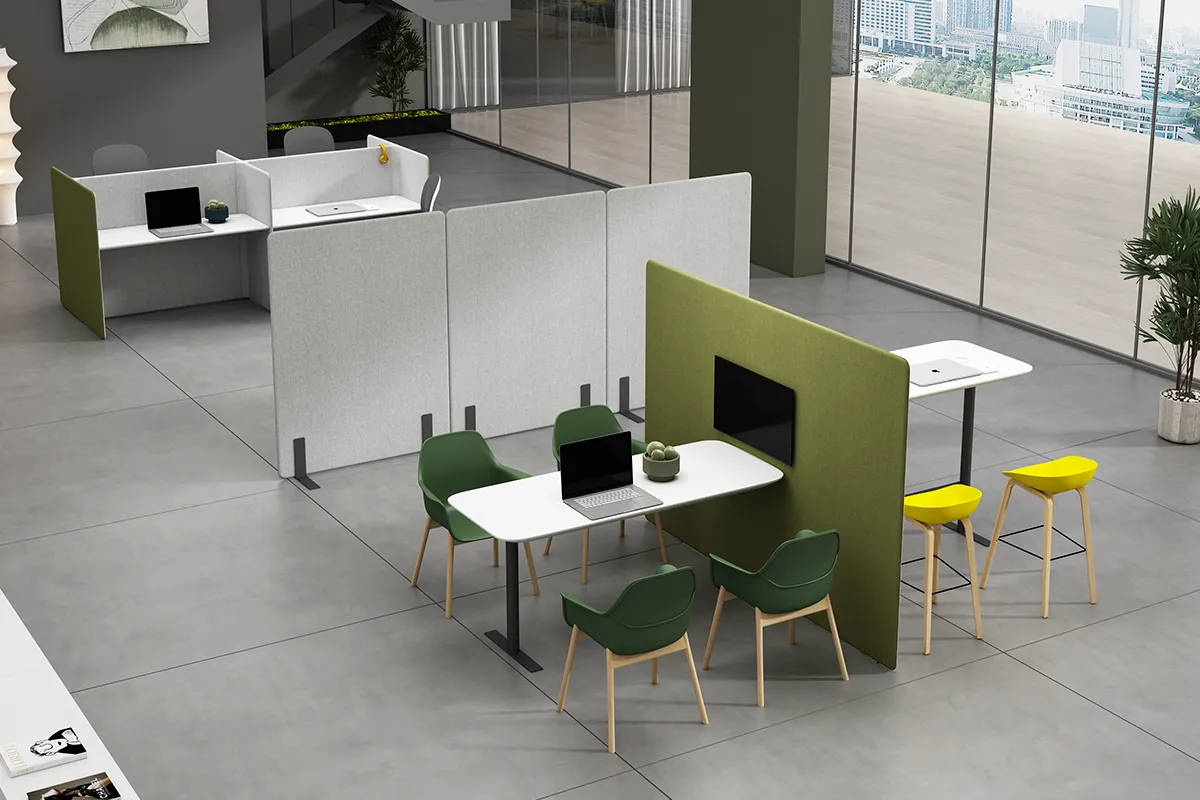
Acoustic partitions are designed to manage sound. They absorb sound waves, reducing echo and reverberation in a space, and can help reduce the transmission of noise between areas. Unlike visual screens, their primary purpose is auditory, not visual.
Common characteristics:
- Made from sound-absorbing materials (felt, acoustic foam, fabric-wrapped fiberglass)
- Often have a porous surface that traps sound waves
- Thickness matters—typically 1–4 inches
- May be mounted on walls, hung from ceilings, or freestanding
- Primary function: noise reduction
Examples:
- Fabric-wrapped acoustic panels
- Felt screens on stands
- Ceiling-mounted acoustic baffles
- Acoustic room dividers
- Sound-absorbing wall panels
Acoustic Partitions vs. Visual Privacy Screens: Core Differences at a Glance
| Factor | Visual Privacy Screen | Acoustic Partition |
| Primary purpose | Block sightlines | Manage sound |
| Material | Opaque (wood, metal, acrylic, fabric) | Porous (felt, acoustic foam, fiberglass) |
| Sound performance | Minimal (STC 15–20) | Moderate to high (NRC 0.7–1.0) |
| Visual privacy | High (opaque) | Variable (often semi-transparent) |
| Thickness | Thin (0.5–2 inches) | Thicker (1–4 inches) |
| Key metric | Opacity, height | NRC (Noise Reduction Coefficient) |
| Best for | Creating defined spaces, blocking views | Reducing echo, softening ambient noise |
Understanding the Science
How Sound Works
To understand why these two types aren’t interchangeable, it helps to know a little about how sound behaves in an office.
| Sound Behavior | Description | How Partitions Affect It |
| Direct sound | Sound traveling straight from source to listener | Visual screens don’t block; acoustic partitions absorb some |
| Reflected sound | Sound bouncing off hard surfaces (walls, ceilings, desks) | Acoustic partitions absorb reflections; visual screens reflect |
| Flanking paths | Sound traveling around obstacles (over, under, around) | Neither type fully blocks; full enclosures needed for true isolation |
The key insight: Visual privacy screens are typically made of hard, non-porous materials (wood, metal, acrylic). When sound hits them, it bounces off—potentially creating more echo, not less. Acoustic partitions are made of soft, porous materials that trap sound waves, converting acoustic energy into small amounts of heat.
Metrics That Matter
| Metric | What It Measures | Relevant For |
| NRC (Noise Reduction Coefficient) | How much sound a material absorbs (0 = no absorption, 1 = 100% absorption) | Acoustic partitions |
| STC (Sound Transmission Class) | How much sound a barrier blocks | Full walls, sealed enclosures |
| Opacity | How much light/vision passes through | Visual privacy screens |
A visual privacy screen might have an NRC of 0.2–0.3 (minimal absorption) and no meaningful STC rating. An acoustic partition might have an NRC of 0.7–0.9 (excellent absorption) but still not block sound transmission—it reduces echo but doesn’t stop conversation from being audible on the other side.
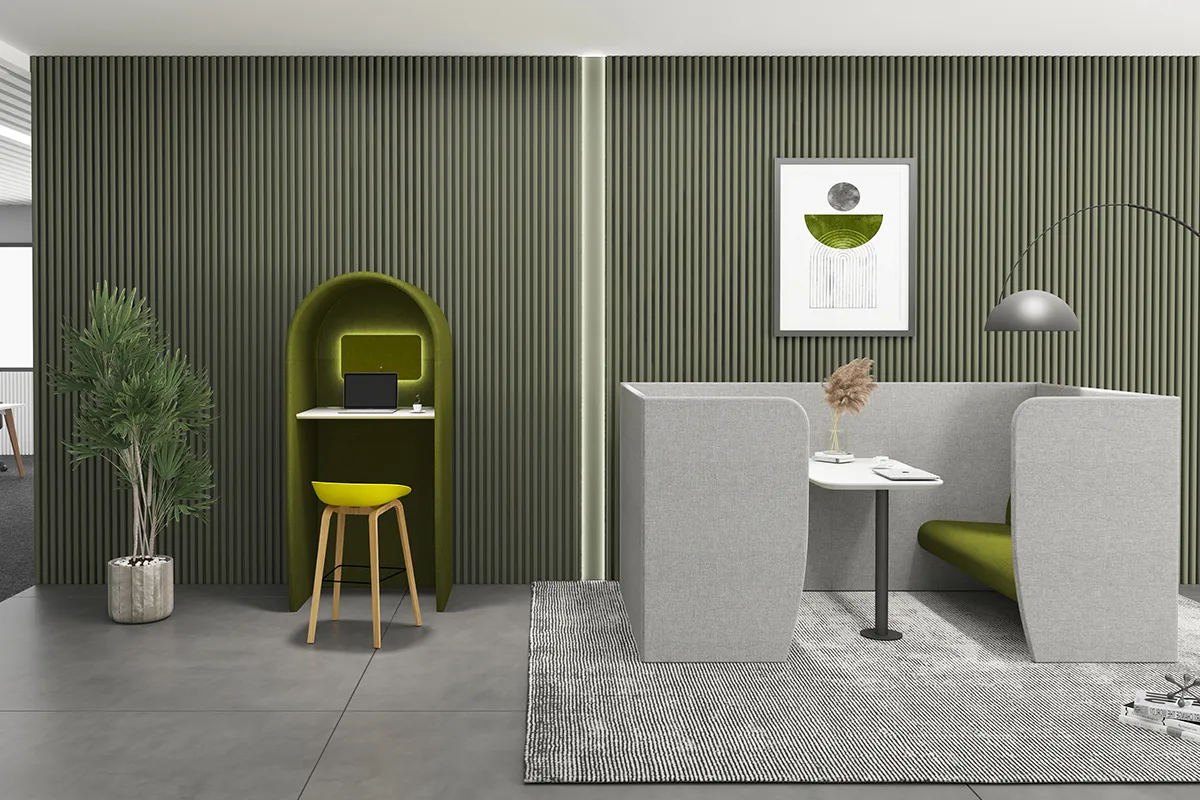
COVE 2-Seater Facing Partition Sofa With Negotiation Table Sceen Image 1
Visual Privacy Screens: Deep Dive
When to Use Them
Visual privacy screens are the right choice when:
- You need to block sightlines, not sound
- Employees are distracted by seeing others move or work
- You want to define zones without closing off the space
- You need temporary or reconfigurable barriers
- Aesthetics matter and you want to maintain an open feel
Common Applications
| Setting | Application | Why It Works |
| Open-plan office | Desk-mounted screens between workstations | Blocks view of coworker; maintains collaboration |
| Reception area | Freestanding screen at entry | Creates welcoming separation without full wall |
| Breakout zone | Low screens defining space | Visual cue that area is for specific use |
| Healthcare | Privacy screens in waiting areas | Blocks views of sensitive situations |
| Home office | Screen behind desk for Zoom calls | Professional background, blocks household activity |
What to Look For
- Height: 48–60 inches for seated privacy; 72+ inches for standing privacy
- Stability: Weighted bases or wide feet prevent tipping
- Portability: Casters if you need to move frequently
- Material: Fabric screens soften the space; solid materials (wood, metal) feel more permanent
- Opacity: Ensure material fully blocks vision—some fabric screens are semi-transparent when backlit
Limitations
- No sound blocking: Conversations remain audible
- Can increase echo: Hard surfaces reflect sound
- Limited privacy for standing: Low screens don’t block views of standing individuals
Acoustic Partitions: Deep Dive
When to Use Them
Acoustic partitions are the right choice when:
- Echo and reverberation are problems (hard surfaces, high ceilings)
- Ambient noise levels are distracting
- You want to improve speech privacy (make conversations less intelligible at a distance)
- Sound is reflecting off walls or ceilings
- You need to reduce noise from HVAC or other mechanical systems
Common Applications
| Setting | Application | Why It Works |
| Open-plan office | Acoustic panels suspended from ceiling | Absorbs sound before it travels across space |
| Conference room | Fabric-wrapped wall panels | Reduces echo during calls, improves audio quality |
| Cafeteria | Ceiling baffles | Lowers ambient noise during busy periods |
| Call center | Desk-mounted acoustic screens | Reduces noise spill between adjacent workstations |
| Home office | Acoustic panel on shared wall | Absorbs sound from neighboring rooms |
What to Look For
- NRC rating: Look for 0.7 or higher for meaningful absorption
- Thickness: 1–2 inches for wall panels; 2–4 inches for freestanding or ceiling baffles
- Fire rating: Class A fire-rated materials are essential for commercial spaces
- Installation type: Wall-mounted, ceiling-hung, or freestanding (on stands)
- Material: Felt, acoustic foam, or fabric-wrapped fiberglass
Limitations
- No visual privacy: Most acoustic partitions are semi-transparent or allow some vision
- Doesn’t block sound transmission: Reduces echo but doesn’t stop conversation from traveling
- Requires proper placement: Effectiveness depends on positioning and coverage area
Acoustic Partitions and Visual Privacy Screens Comparison: When to Choose Which
| Scenario | Best Solution | Why |
| Coworker across the aisle is distracting you visually | Visual privacy screen | Blocks sightline without affecting sound |
| Office feels loud and echoey | Acoustic partitions | Absorbs reverberation, lowers ambient noise |
| Need confidential conversation space | Neither—need full enclosure | Screens and partitions don’t block speech sufficiently |
| Zoom background looks cluttered | Visual privacy screen | Creates clean backdrop |
| Can hear conversations from across the room | Acoustic partitions + ceiling treatment | Reduces sound travel distance |
| Want to define zones without closing off | Visual privacy screen | Maintains open feel while creating boundaries |
| Conference room echo during calls | Acoustic wall panels | Improves audio quality for remote participants |
The Hybrid Approach: Combining Both
For many offices, the best solution isn’t one or the other—it’s both. Acoustic partitions and visual privacy screens serve complementary functions and work best together.
Layered Privacy Strategy
| Layer | Purpose | Product Examples |
| Layer 1: Absorption | Reduce echo, lower ambient noise | Ceiling baffles, wall panels, acoustic screens |
| Layer 2: Visual separation | Block sightlines, define zones | Desk screens, freestanding dividers |
| Layer 3: Full enclosure | Complete privacy for specific uses | Phone booths, meeting pods |
Product Examples That Combine Both
Some manufacturers now offer hybrid products that serve both purposes:
- Felt screens on stands: Absorb sound while blocking vision (felt is porous for acoustics, dense enough for visual privacy)
- Fabric-wrapped acoustic panels with printed graphics: Absorb sound while adding visual interest and subtle separation
- Glass panels with acoustic backing: Provide visual privacy (frosted) while adding sound absorption on one side
Room Zoning Strategy
In an open-plan office, a common approach is:
- Acoustic ceiling baffles throughout the space to control overall noise levels
- Visual privacy screens at individual workstations to block sightlines
- Acoustic screens between rows to reduce sound travel between teams
- Enclosed pods for confidential calls and focused work
This layered approach addresses both visual and acoustic privacy without building permanent walls.
Top 5 Common Mistakes to Avoid
| Mistake | Why It’s Problematic | Better Approach |
| Buying visual screens expecting sound reduction | Disappointment when conversations remain audible | Understand the difference; add acoustic treatment if noise is the issue |
| Placing acoustic partitions in wrong locations | Minimal impact if not positioned correctly | Place near sound sources or at ear level; ceiling baffles work well for overall absorption |
| Choosing solid wood screens for noise control | Hard surfaces reflect sound, potentially increasing echo | Use porous materials (felt, fabric) for acoustic needs |
| Using only desk screens for open office noise | Desk screens block sightlines but sound travels over them | Combine with ceiling treatment for meaningful noise reduction |
| Ignoring flanking paths | Sound travels over, under, and around screens | For true speech privacy, full enclosures are necessary |
FAQ
1. Can a visual privacy screen also reduce noise?
Minimally. Visual privacy screens are typically made from hard, non-porous materials that reflect sound rather than absorbing it. They may slightly reduce sound transmission if they create a physical barrier, but they won’t meaningfully reduce echo or ambient noise.
2. Do acoustic partitions provide visual privacy?
It depends. Felt or fabric-wrapped acoustic panels often allow some vision through—they’re semi-transparent. If visual privacy is the goal, look for opaque materials or layer an acoustic panel behind a visual screen.
3. What’s the most effective way to reduce office noise?
A combination approach: acoustic ceiling baffles or tiles to absorb sound before it travels, acoustic wall panels to reduce reflections, and soft surfaces (rugs, upholstery) throughout. For individual workstations, acoustic screens can help but won’t fully block conversation.
4. How high should a visual privacy screen be?
For seated privacy, 48–60 inches works. For standing privacy (where people walk behind desks), 72 inches or higher is needed. However, taller screens can make spaces feel closed off—balance privacy needs with openness.
5. What’s the difference between NRC and STC?
NRC measures absorption (how much sound a material soaks up). STC measures transmission loss (how much sound a barrier blocks). Acoustic partitions have high NRC; full walls have high STC. Freestanding screens typically have neither.
6. Can I use plants as visual privacy screens?
Yes. Tall plants or plant walls provide effective visual privacy while adding biophilic benefits. However, they don’t absorb sound significantly—plants have an NRC of roughly 0.1–0.2, far less than purpose-made acoustic products.
7. What’s the best solution for speech privacy in an open office?
True speech privacy requires full enclosures (pods, phone booths) or high STC-rated walls with seals. Acoustic partitions and visual screens alone cannot make speech unintelligible at a distance—they reduce ambient noise but don’t block conversation.
Decision Framework
Ask These Questions
- What’s the actual problem?
- People are distracted by seeing others? → Visual privacy screen
- The space feels loud or echoey? → Acoustic partitions
- Conversations are intelligible across the room? → Need full enclosures
- What’s the space like?
- Hard surfaces everywhere (glass, concrete, drywall)? → Acoustic treatment needed
- Already has carpet and soft surfaces? → Visual privacy may be sufficient
- What’s the budget and timeline?
- Quick, affordable solution? → Visual privacy screens
- Willing to invest in acoustics? → Ceiling baffles, acoustic panels
- Need complete privacy? → Phone booths or pods
- How permanent does it need to be?
- Temporary, reconfigurable? → Freestanding screens
- Permanent installation? → Wall-mounted acoustic panels, ceiling systems
Conclusion
Acoustic partitions and visual privacy screens serve fundamentally different purposes. One manages sound; the other blocks sightlines. Confusing them leads to solutions that don’t solve the actual problem.
| If your problem is… | Choose… |
| Seeing coworkers and getting distracted | Visual privacy screens |
| Echo and noise making it hard to focus | Acoustic partitions |
| Both visual distraction AND noise | Combine both types |
| Confidential conversations | Full enclosure (pod, booth, or walled room) |
Before buying, clearly define what you’re trying to solve. Walk through your space and identify whether the distraction is visual, auditory, or both. Then choose the right tool for the job.
When in doubt, remember: visual screens block eyes; acoustic panels calm ears. Most offices need both—but understanding the difference ensures you buy the right one for the right reason.