





 Meet&Co
Your office is too noisy. Or maybe it’s too open. Or perhaps you have the opposite problem: the space feels chopped up and disconnected. Whatever the challenge, partitions seem like the obvious solution. But when you start looking at options, the choices multiply fast.
Freestanding screens that you can move anywhere. Folding walls that disappear when you need open space. Glass partitions that define areas without blocking light. Each promises to solve your office layout problems—but each does it differently, with different costs, different installation requirements, and different long-term flexibility.
The Meet&Co team offers this guide to break down the three main partition types, comparing their strengths, limitations, and ideal applications. By the end, you’ll know exactly which one belongs in your office—or whether you need a combination of them.
Why Partition Choice Matters More in 2026
The way we work has changed. Hybrid schedules mean offices need to adapt daily—sometimes hourly. The same space that hosts a team meeting in the morning might need to become individual focus zones in the afternoon.
Partitions are no longer just about dividing space. They’re about creating flexibility. According to recent workplace research, 65% of employees prefer a work environment that offers both open and private spaces. The right partitions make that possible without permanent construction.
| Work Mode | What It Needs |
| Collaboration | Open areas, minimal barriers, whiteboard surfaces |
| Focused work | Visual privacy, acoustic separation |
| Hybrid meetings | Semi-enclosed spaces with AV integration |
| Quick transitions | Movable, reconfigurable solutions |
Freestanding Partitions: The Flexible Workhorse
What They Are
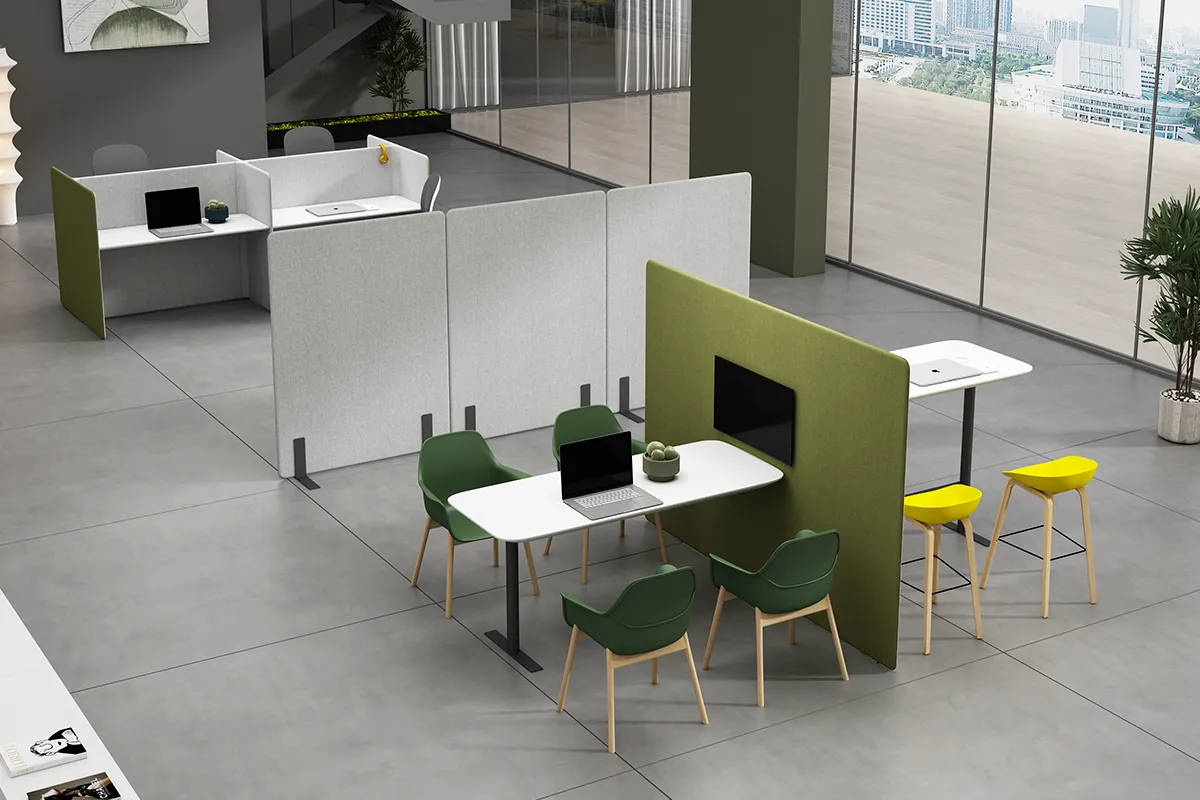
Freestanding partitions are self-supporting screens that sit on the floor without attaching to walls, ceilings, or floors. They come in various heights—from desk-height privacy screens to full room dividers—and materials including fabric, felt, wood, and metal.
What They’re Best For
| Use Case | Why It Works |
| Desk privacy | Low screens create visual boundaries between workstations |
| Zoning open spaces | Define areas without permanent installation |
| Temporary needs | Move as teams reorganize or projects change |
| Acoustic dampening | Fabric-covered screens absorb sound, reducing ambient noise |
| Event flexibility | Create breakout areas that can disappear afterward |
Pros
- No installation: Place them where needed—no tools, no contractors
- Highly mobile: Most include casters or are light enough to move by hand
- Immediate delivery: No lead time for construction
- Variety of materials: Fabric, wood, metal, glass, or combinations
- Cost-effective: Generally lower upfront cost than permanent options
Cons
- Limited acoustic isolation: Reduce noise but don’t block conversation
- Stability concerns: Tall screens can tip without proper base weight
- Aesthetic coherence: Mixing types can look disjointed
- Floor protection: Heavy bases may mark flooring over time
Best Applications
- Open-plan offices needing quick privacy at desks
- Co-working spaces requiring reconfigurable zones
- Training rooms that switch between lecture and group formats
- Temporary setups during office transitions
Also see: Types of Partition Walls: Complete Guide for Homes & Offices
Folding Partitions: The Space-Changing Solution
What They Are
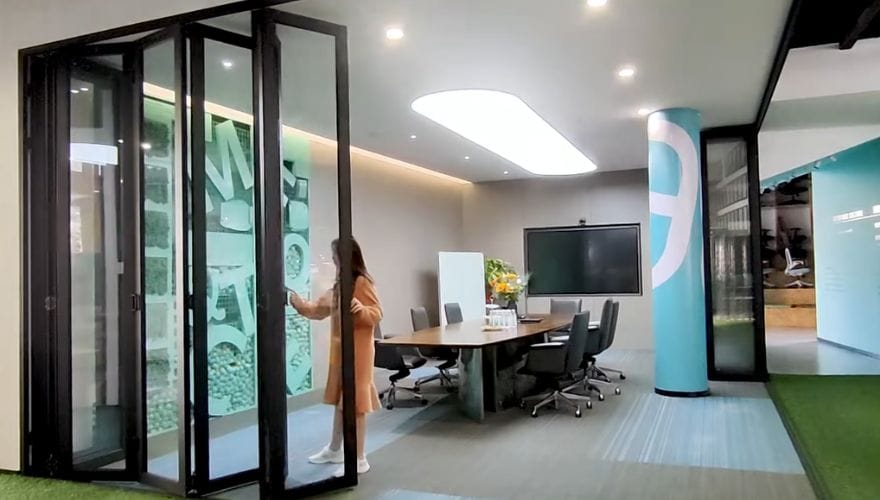
Folding partitions (also called accordion walls or operable walls) consist of hinged panels that fold together like an accordion. They typically mount to a ceiling track and can be deployed or stored in seconds. Some models offer acoustic ratings comparable to permanent walls.
What They’re Best For
| Use Case | Why It Works |
| Multipurpose rooms | Convert one large room into two smaller ones |
| Event spaces | Open fully for gatherings, close for breakouts |
| After-hours flexibility | Create secure zones when different groups use the space |
| Conference rooms | Divide into smaller meeting spaces as needed |
Pros
- True room transformation: Can completely change a space’s configuration
- Acoustic options: High-quality folding partitions offer STC 40–50 ratings
- Disappear when not needed: Panels stack into a compact storage pocket
- Professional appearance: Integrated into ceiling, looks like part of the building
- Durable: Commercial-grade models last 20+ years with maintenance
Cons
- Installation required: Needs ceiling reinforcement and professional install
- Higher upfront cost: $3,000–10,000 per linear foot depending on acoustic rating
- Lead time: 4–8 weeks for manufacturing and installation
- Permanent track: Ceiling track remains even when walls are open
- Floor track or seal: Some models require floor channels or drop seals
Best Applications
- Conference rooms that need to divide for multiple meetings
- Event spaces with variable capacity needs
- Training centers requiring different room sizes
- Schools and community centers with shared spaces
Glass Partitions: The Light-Filled Division

What They Are
Glass partitions are framed or frameless walls made from tempered or laminated glass. They mount to floors and ceilings, creating permanent or semi-permanent divisions while maintaining visual connectivity. Options range from fully transparent to frosted or tinted for privacy.
What They’re Best For
| Use Case | Why It Works |
| Executive offices | Private space without feeling closed off |
| Meeting rooms | Visible from outside, reduces hallway congestion |
| Open-plan zones | Define departments while maintaining light flow |
| Reception areas | Professional, modern aesthetic |
Pros
- Preserves light: Natural light flows through, keeping spaces bright
- Visual connectivity: Staff feel connected even when separated
- Privacy options: Frosted or switchable glass provides privacy on demand
- Professional aesthetic: Clean, modern look that increases property value
- Acoustic performance: Double-glazed options achieve STC 35–45
Cons
- Permanent installation: Requires construction, permits, and professional install
- Higher cost: $50–150 per square foot depending on glass type and framing
- Cleaning maintenance: Shows fingerprints, dust, and smudges
- Not movable: Once installed, repositioning requires new construction
- Privacy trade-off: Clear glass offers no visual privacy without blinds or film
Best Applications
- Private offices that need to stay connected to team areas
- Conference rooms where visibility reduces interruptions
- Department boundaries in open plans
- Spaces where natural light is limited
Comparison: Freestanding vs. Folding vs. Glass Partitions
| Factor | Freestanding | Folding | Glass |
| Installation | None (place on floor) | Professional (ceiling track) | Professional (floor-to-ceiling) |
| Lead time | Immediate | 4–8 weeks | 4–12 weeks |
| Mobility | High (move by hand) | Low (stored, not moved) | None (permanent) |
| Acoustic isolation | Low (STC 15–20) | Good (STC 40–50 with seals) | Good (STC 35–45 with double-glaze) |
| Visual privacy | Full (opaque) | Full (when closed) | Variable (clear to frosted) |
| Light transmission | None | None | Full |
| Cost per linear foot | $200–500 | $3,000–10,000 | $1,000–3,000 |
| Lifespan | 5–10 years | 20+ years | 20+ years |
| Best for | Flexibility, temporary needs | Room division, multipurpose spaces | Permanent zones, light preservation |
Decision Framework: Which Partition Is Right for Your Office?
Choose Freestanding Partitions If:
- You need flexibility now: No time for construction, needs may change soon
- You’re in a leased space: Can’t make permanent modifications
- Budget is limited: Lower upfront cost fits tighter budgets
- You need desk-level privacy: Quick solution for open-plan workstation privacy
- Acoustic needs are modest: You need visual separation, not sound isolation
Choose Folding Partitions If:
- You have a multipurpose room: The same space must serve different functions
- Acoustic separation matters: Need true sound isolation between spaces
- You want walls that disappear: Need open space when partitions aren’t in use
- Long-term investment: Will stay in the same space for 5+ years
- You own the building: Can invest in ceiling reinforcement and track installation
Choose Glass Partitions If:
- Natural light is precious: Can’t afford to block windows or interior light
- Visual connectivity matters: Want staff to see each other even when separated
- Aesthetic quality is priority: Clean, modern look that feels permanent
- You need privacy on demand: Frosted or switchable glass provides options
- You’re making a long-term commitment: Permanent installation that increases property value
The Hybrid Approach
Many offices don’t choose one type—they combine them strategically. For example:
- Permanent glass walls for private offices along the perimeter
- Folding partitions between conference rooms for flexible meeting capacity
- Freestanding screens for quick desk privacy and temporary zones
This approach balances permanence with flexibility, investing in fixed infrastructure where needs are stable while keeping options open for areas that change frequently.
Also see: What is the Best Office Design Layout in 2026?
Cost-Benefit Quick Reference
| Partition Type | Upfront Cost | Installation Time | Flexibility | Acoustic Performance | Aesthetic Impact |
| Freestanding | $ | None | High | Low | Moderate |
| Folding | $$$$ | Weeks | Medium | High | High (when closed) |
| Glass | $$$ | Weeks | Low | Medium-High | Very High |
FAQ
1. Can freestanding partitions provide soundproofing?
No. Fabric-covered freestanding screens absorb some ambient noise but do not block conversation. For true sound isolation, you need sealed folding partitions or glass walls with acoustic seals.
2. How much do folding partitions cost?
Costs vary widely based on size, acoustic rating, and finish. Expect $3,000–10,000 per linear foot for commercial-grade operable walls. Motorized or high-STC models cost more.
3. Do glass partitions require building permits?
Yes. Because they attach to floors and ceilings, glass partitions typically require permits. Your contractor should handle this, but confirm before installation.
4. Can I move freestanding partitions to a new office?
Absolutely. Their portability is a key advantage. They can be packed up and reinstalled in a new space with no loss of function.
5. What’s the best partition for an open-plan office?
A combination works best: freestanding screens at desks for visual privacy, plus a few folding partitions to create enclosed meeting spaces when needed.
6. How do I maintain folding partition tracks?
Quarterly cleaning of the track to remove debris. Annual professional inspection of the trolley system and seals. Most manufacturers offer maintenance contracts.
7. Can I get glass partitions that become opaque on demand?
Yes—switchable privacy glass uses electrochromic technology to change from clear to frosted with a switch. It costs more but offers the ultimate in flexibility.
Conclusion
The right office partition depends entirely on your goals. Freestanding screens win on flexibility and speed. Folding partitions excel at transforming rooms. Glass partitions balance openness with definition.
Ask yourself three questions:
- How permanent does this need to be? (If your layout changes monthly, freestanding wins. If it’s fixed for years, glass or folding makes sense.)
- What kind of privacy do you need? (Visual privacy only? Freestanding works. Acoustic isolation? You need folding or glass with seals.)
- What’s your timeline and budget? (Need privacy tomorrow? Freestanding. Planning a renovation? Invest in folding or glass.)
Most offices benefit from a mix—not one solution. Use glass for permanent boundaries that preserve light. Add folding walls where rooms need to divide. Deploy freestanding screens where flexibility matters most.
The partitions you choose shape how your team works. Choose thoughtfully, and your space will support collaboration when needed and focus when required—all without sacrificing light, connection, or flexibility.