





 Meet&Co
HIGH POINT — Customization and modular design have swept through nearly every corner of the home furnishings industry, yet freestanding storage has mostly remained unchanged. Outside the bedroom in particular, built-ins tend to dominate, leaving limited options for flexible, furniture-style storage that can move with the homeowner.
This gap has long pushed modular storage into commercial settings — schools, healthcare facilities, and other nonresidential spaces where durability matters more than aesthetics. Sherrill Furniture believes it’s time to shift that perception.
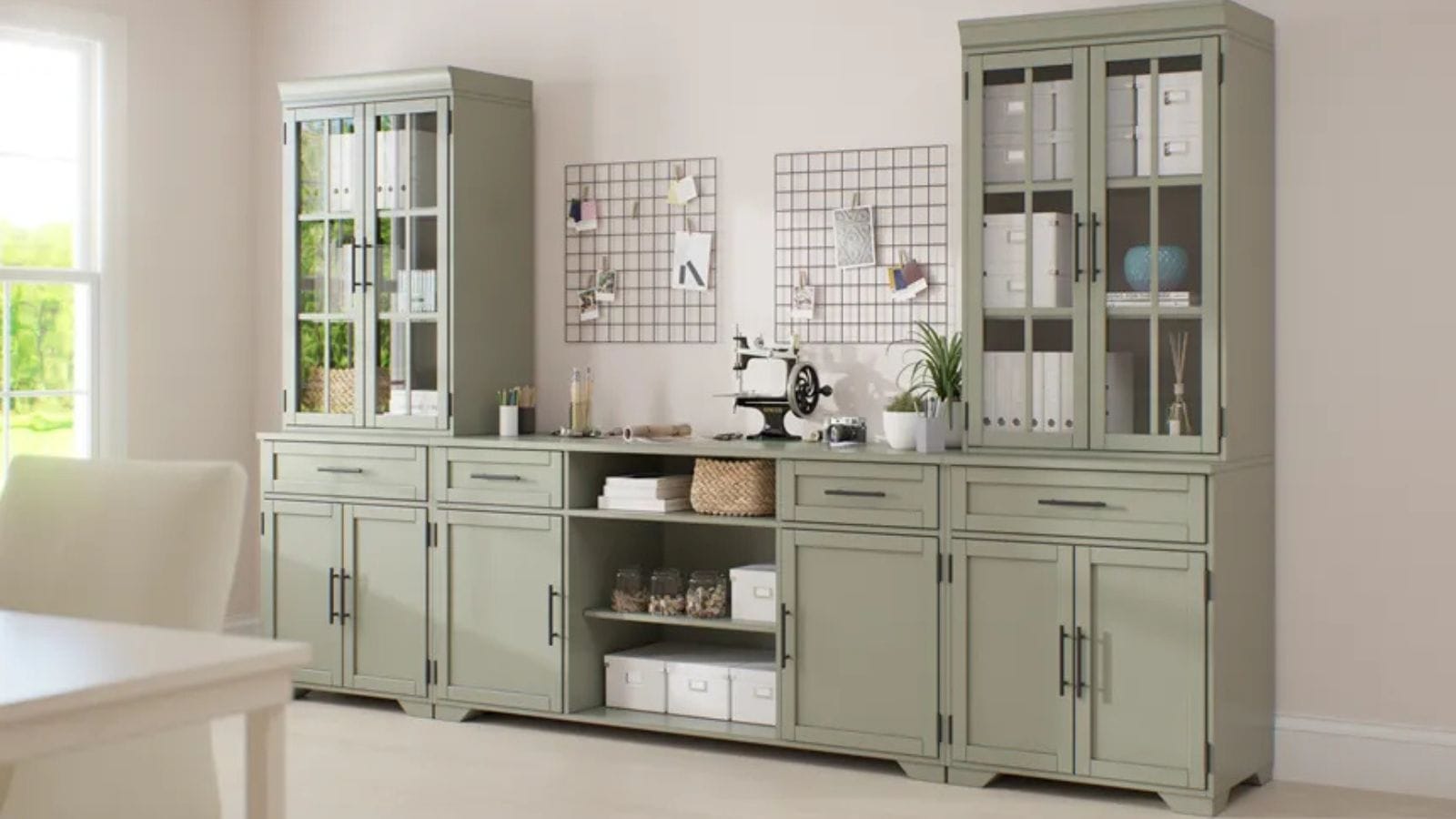
At last month’s High Point Market, the American manufacturer debuted a new modular storage line designed to offer customizable, design-forward options for residential spaces — a category the company sees as underserved and full of opportunity.
Sherrill describes its product strategy as a proactive search for unmet needs, supported by the speed and agility of its domestic manufacturing network.
“We’re constantly looking at new categories that help our customers grow, while growing our business in the process,” said Dax Allen, senior vice president of business development, in an interview with Furniture Today. “We recently launched a customizable, domestically made bedroom program at an exceptional price point, and it’s been a strong performer.”
Building on that success, the team applied the same mindset to storage.
“There’s a large gap between full custom-built-ins and furniture-quality cabinetry — a lot of imports and lower-priced alternatives,” Allen said. “We came in with something more customizable, made in the U.S., and the response has been extremely positive.”
Thanks to its domestic production capabilities, Sherrill can offer shortened lead times and pricing that appeals to both retailers and designers.
“Typically, we run four to six weeks, but right now, we’re getting products into the warehouse in about two and a half weeks,” Allen noted. “Most of the remaining time is just transport. That speed is a real advantage.”
Source: https://www.furnituretoday.com/
Designed for designers
The new program emphasizes customization as both a design tool and a functional benefit, giving designers broad freedom to tailor pieces to their clients’ needs.
“From a trend standpoint, it’s all about infusing customization into every part of the product,” Allen said. “In the bedroom program, we added Greek key motifs, hand-painted pinstriping, and dual-tone finishes. People love being able to play with contrast. It’s flexible and can be built out in countless ways.”
During development, Sherrill explored a wide range of potential residential uses. Allen visited roughly 13 accounts in Michigan and Ohio to gather feedback.
“Many designers mentioned clients with Airbnbs or vacation homes who wanted coffee bars, wine stations, and other experience-driven touches,” he said. “Customization gives them the opportunity to create those moments. That’s what really sparked this program, and it was a major success at market. All of our major customers are on board.”
Flexibility extends to function as well. “This program shows customers just how many ways they can customize,” Allen added. “It’s not only a media center — you can integrate refrigeration, snack stations, bar setups, or even conference room layouts. LED lighting, drawers, doors, hardware — or no hardware — everything can be configured to their preference.”
The domestic advantage
Sherrill’s U.S. manufacturing footprint continues to be a core differentiator, offering consistency, responsiveness, and control that import-heavy competitors struggle to match.
“Customers tell us no one else domestically is doing this,” Allen said. “It’s about listening to the market and responding quickly.”
Tariff uncertainty has also opened new opportunities for American-made alternatives. “Tariffs are creating windows, but you have to move fast,” Allen explained. “That’s where Sherrill’s 80-year history and agility give us an edge.”
The company’s supply chain is highly localized: its Hickory, North Carolina, plant produces nearly everything except hardware, while wood, glass, and veneers are sourced and processed locally.
“Our structure is very lean — we can make decisions over a text message,” Allen said.
In a period where margins are tight, Sherrill also aims to deliver value.
“These pieces cost about half to a third of a custom-built-in,” he said. “For designers, that’s huge — clients save money, and designers retain full margin.”
Retailers also benefit from accessible pricing.
“An 11-foot framed setup will retail for under $10,000,” Allen noted. “It’s outstanding quality at the right time. We see it as a win-win.”


_10.webp)